Building Customer Segmentation Models with AI Tools: A Complete Guide for UK Businesses
Understanding your customers has never been more critical for business success. In today’s competitive marketplace, generic marketing approaches simply do not deliver results. This is where customer segmentation AI becomes a game-changer, enabling businesses to divide their audience into meaningful groups and deliver highly personalised experiences that drive engagement and revenue.
According to McKinsey research, companies that excel at personalisation generate 40% more revenue from those activities than average players. For UK businesses looking to gain competitive advantage, implementing AI-powered customer segmentation is no longer optional – it is essential.
What Is Customer Segmentation AI and Why Does It Matter?
Customer segmentation AI refers to the use of artificial intelligence and machine learning algorithms to automatically categorise customers into distinct groups based on shared characteristics, behaviours, and preferences. Unlike traditional manual segmentation methods, marketing AI can process vast amounts of data in real-time, identifying patterns and correlations that would be impossible for humans to detect.
The power of AI-driven audience analysis lies in its ability to move beyond simple demographic groupings. Modern segmentation models consider hundreds of variables simultaneously, including:
- Purchase history and frequency patterns
- Website browsing behaviour and engagement metrics
- Response rates to previous marketing campaigns
- Customer lifetime value predictions
- Sentiment analysis from customer interactions
- Geographic and seasonal purchasing trends
Research from Gartner indicates that organisations using AI for customer analytics see a 25% improvement in customer satisfaction scores, demonstrating the tangible benefits of sophisticated segmentation approaches.
Key Types of AI-Powered Customer Segmentation Models
Behavioural Segmentation
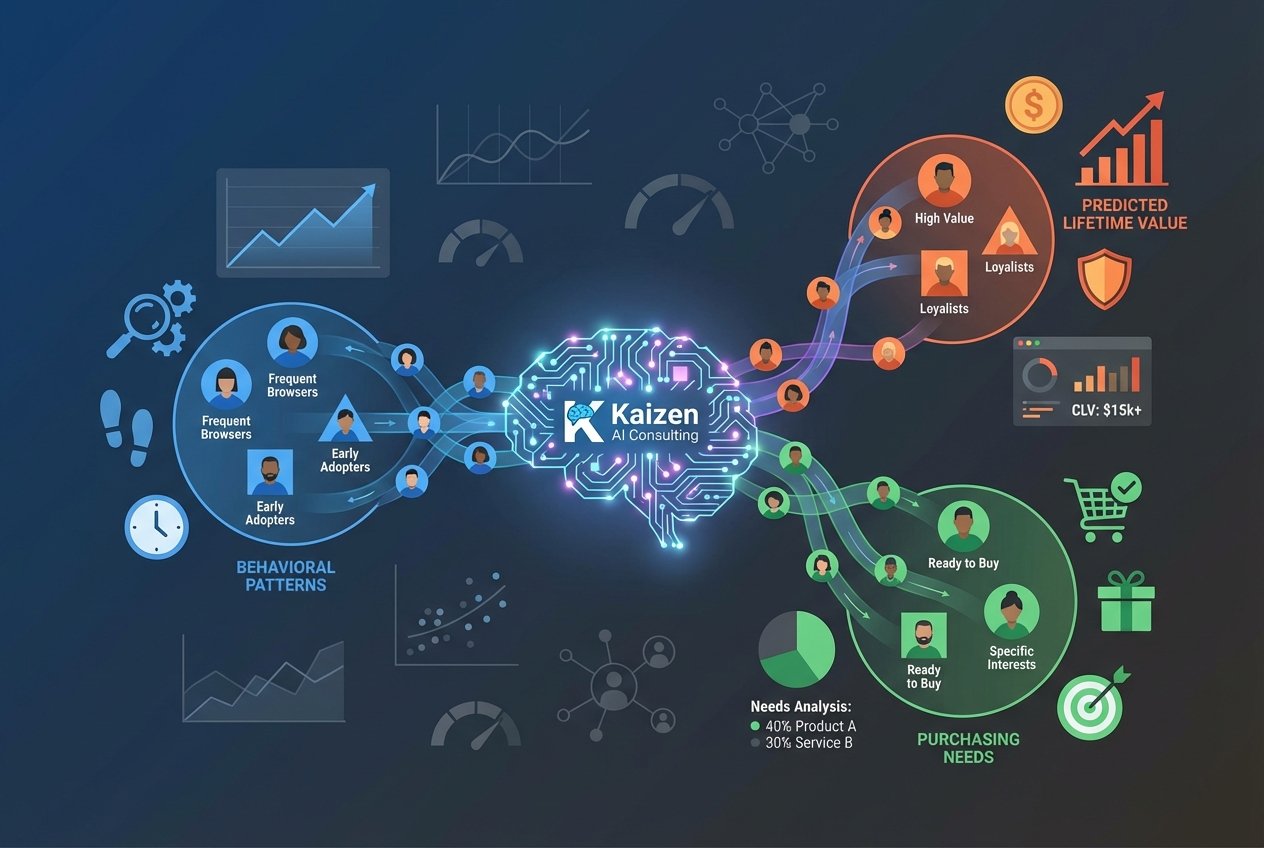
Behavioural segmentation uses machine learning to analyse how customers interact with your brand. This includes purchase patterns, product usage, engagement with marketing materials, and customer journey touchpoints. AI excels at identifying micro-segments within behavioural data, revealing opportunities for targeted interventions.
Predictive Segmentation
Perhaps the most powerful application of customer segmentation AI, predictive models use historical data to forecast future customer behaviour. These models can identify customers at risk of churning, those likely to make repeat purchases, or prospects most likely to convert. UK retailers implementing predictive segmentation have reported conversion rate improvements of up to 30%.
Value-Based Segmentation
AI algorithms can calculate and predict customer lifetime value with remarkable accuracy, enabling businesses to prioritise high-value segments. This approach ensures marketing resources are allocated efficiently, focusing efforts on customers who deliver the greatest return on investment.
Needs-Based Segmentation
By analysing customer feedback, support tickets, and social media interactions, AI can identify distinct customer needs and pain points. This enables businesses to develop targeted solutions and messaging that resonates with specific audience segments.
Essential AI Tools for Building Customer Segmentation Models
The UK market offers numerous platforms for implementing audience analysis and segmentation. Here are some leading solutions worth considering:
Enterprise-Level Platforms
Salesforce Einstein Analytics provides comprehensive AI-powered customer insights integrated with CRM data. Its segmentation capabilities allow businesses to create dynamic audience groups that update automatically as customer behaviour changes.
Adobe Experience Platform offers real-time customer profiling and segmentation, particularly powerful for businesses with complex omnichannel customer journeys.
Mid-Market Solutions
HubSpot has significantly enhanced its AI capabilities, offering predictive lead scoring and customer segmentation features accessible to growing businesses. Its integration with marketing automation makes implementing segmented campaigns straightforward.
Segment specialises in customer data infrastructure, collecting and unifying data from multiple sources to enable sophisticated segmentation strategies.
Specialist AI Tools
Pecan AI and Faraday focus specifically on predictive analytics and customer intelligence, offering powerful segmentation capabilities without requiring in-house data science expertise.
Selecting the right combination of tools depends on your existing technology stack, budget, and specific business objectives. At Kaizen AI Consulting, we help UK businesses navigate this complex landscape, identifying and implementing the optimal AI solutions for their unique customer segmentation requirements.
Step-by-Step Guide to Building Your AI Segmentation Model
Step 1: Define Your Segmentation Objectives
Before diving into technology, clearly articulate what you want to achieve. Are you looking to reduce customer churn? Identify upselling opportunities? Improve campaign targeting? Your objectives will determine the type of segmentation model and data requirements.
Step 2: Audit and Prepare Your Data
AI models are only as good as the data they are trained on. Conduct a thorough audit of your customer data sources, including:
- CRM records and transaction history
- Website analytics and behavioural data
- Email engagement metrics
- Customer service interactions
- Social media engagement data
Ensure data is clean, consistent, and properly integrated. According to Experian, UK businesses lose an estimated 12% of revenue due to poor data quality, making this step crucial.
Step 3: Select Appropriate Algorithms
Different segmentation objectives require different algorithmic approaches:
- K-means clustering – Ideal for discovering natural groupings in customer data
- Random Forest – Effective for predictive segmentation and identifying key variables
- Neural networks – Powerful for complex, multi-dimensional segmentation
- RFM analysis enhanced with ML – Combines traditional recency, frequency, monetary analysis with predictive capabilities
Step 4: Train and Validate Your Model
Split your data into training and testing sets to ensure your model performs well on unseen data. Regularly validate results against business outcomes to confirm segments are meaningful and actionable.
Step 5: Implement and Integrate
Connect your segmentation model to marketing automation, CRM, and campaign management systems. Automation ensures segments are used consistently across all customer touchpoints.
Step 6: Monitor and Refine
Customer behaviour evolves, and your segmentation model should too. Establish regular review cycles to assess model performance and retrain as necessary.
Generating Actionable Customer Insights from Your Segments
Building a segmentation model is only valuable if it leads to actionable customer insights. Here is how to extract maximum value from your AI-powered segments:
Personalised Marketing Campaigns
Use segment characteristics to craft tailored messaging, offers, and content. A study by Epsilon found that 80% of consumers are more likely to make a purchase when brands offer personalised experiences.
Product Development Insights
Segment analysis can reveal unmet customer needs and preferences, informing product development priorities. Understanding what different customer groups value helps create offerings that resonate with target audiences.
Customer Journey Optimisation
Map how different segments move through your customer journey, identifying friction points and opportunities for improvement specific to each group.
Resource Allocation
Prioritise marketing spend and customer service resources based on segment value and potential, ensuring optimal return on investment.
UK Compliance Considerations for AI Customer Segmentation
UK businesses must navigate specific regulatory requirements when implementing marketing AI and customer data analysis:
- UK GDPR – Ensure all customer data processing has appropriate legal basis and that customers can exercise their data rights
- Data Protection Act 2018 – Additional UK-specific requirements around data processing and storage
- ICO Guidelines – The Information Commissioners Office provides specific guidance on AI and automated decision-making
Transparency is essential. Customers should understand how their data is being used, and automated segmentation should not result in unfair treatment or discrimination. Working with experienced consultants ensures your AI implementation meets all regulatory requirements while delivering business value.
Measuring the Success of Your Customer Segmentation Strategy
Track these key metrics to evaluate your segmentation effectiveness:
- Campaign performance by segment – Compare conversion rates, engagement, and ROI across different customer groups
- Customer lifetime value changes – Monitor whether targeted approaches increase overall customer value
- Segment stability – Assess whether segments remain consistent or require frequent adjustment
- Prediction accuracy – For predictive models, track how well forecasts match actual customer behaviour
- Marketing efficiency – Measure cost per acquisition and customer retention rates by segment
Transform Your Customer Understanding with Expert Support
Implementing effective customer segmentation AI requires expertise in data science, marketing strategy, and technology integration. Many UK businesses find that partnering with specialists accelerates their journey and avoids costly mistakes.
At Kaizen AI Consulting, we combine deep expertise in AI implementation with practical marketing experience to help businesses build and deploy customer segmentation models that deliver measurable results. From initial strategy development through to ongoing optimisation, our team supports every stage of your AI transformation.
Whether you are just beginning to explore audience analysis capabilities or looking to enhance existing segmentation approaches, professional guidance ensures you extract maximum value from your customer data while maintaining compliance and best practices.
Ready to unlock deeper customer insights and drive personalised marketing at scale? Contact Kaizen AI Consulting today for a free consultation on how AI-powered customer segmentation can transform your business results.
Conclusion
Customer segmentation AI represents one of the most impactful applications of artificial intelligence for UK businesses. By moving beyond basic demographic groupings to sophisticated, behaviour-driven segments, organisations can deliver personalised experiences that customers increasingly expect and reward.
The tools and techniques are more accessible than ever, but success requires thoughtful implementation, quality data, and ongoing refinement. With the right approach, AI-powered customer segmentation becomes a sustainable competitive advantage, driving improved marketing performance, customer satisfaction, and business growth.
Start your journey today by assessing your current data assets, defining clear objectives, and exploring how modern AI tools can transform your understanding of your customers.