In today’s competitive digital landscape, knowing how to build and allocate your advertising budget effectively can mean the difference between marketing success and wasted spend. Whether you’re a startup testing the waters or an established business looking to optimise your marketing budget, strategic planning is essential. This comprehensive guide will walk you through smart allocation strategies tailored for UK businesses, helping you maximise return on investment whilst minimising unnecessary expenditure.
Understanding the UK Digital Advertising Landscape
The UK digital advertising market continues to grow at an impressive rate. According to the IAB UK, digital ad spend reached £29.6 billion in 2023, representing a 10.5% increase from the previous year. This growth demonstrates the continued shift towards digital channels, making it more crucial than ever to allocate your advertising budget strategically.
Before diving into allocation strategies, it’s important to understand what constitutes UK advertising costs. These vary significantly depending on your industry, target audience, competition level, and chosen platforms. For instance, the average cost-per-click (CPC) in Google Ads for UK businesses ranges from £0.50 to £6.50, with highly competitive sectors like finance and legal services seeing even higher rates.
Establishing Your Foundation: Setting Your Initial Advertising Budget
The first question most business owners ask is: how much should I spend on advertising? Whilst there’s no one-size-fits-all answer, several established methods can guide your decision-making process.
The Percentage of Revenue Method
Many UK businesses allocate between 5% and 12% of their gross revenue to their marketing budget, with a significant portion dedicated to digital advertising. According to Gartner’s CMO Spend Survey, companies typically allocate around 9.5% of their revenue to marketing activities. Startups and businesses in growth phases often invest 12-20% to establish market presence and accelerate customer acquisition.
The Objective-Based Method
This approach works backwards from your business goals. If you need to acquire 100 new customers and your average customer acquisition cost (CAC) is £150, you’ll need at least £15,000 in your advertising budget. This method ensures your ad spend strategy aligns directly with tangible business outcomes, making it easier to justify expenditure and measure success.
The Competitive Parity Method
Researching what your competitors spend can provide valuable benchmarks. Tools like SEMrush and SimilarWeb can offer insights into competitor advertising activities, helping you understand the investment required to remain competitive in your sector. However, this shouldn’t be your only consideration as your unique value proposition and business goals may require different approaches.
At Kaizen AI Consulting, we help businesses determine the optimal budget based on their specific circumstances, combining data analysis with industry expertise to create tailored advertising strategies that deliver measurable results.
Smart Budget Allocation Across Digital Channels
Once you’ve established your total advertising budget, the next critical step is allocating it across various digital channels. Each platform offers unique advantages and reaches different segments of your target audience.
Search Engine Advertising (Google Ads)
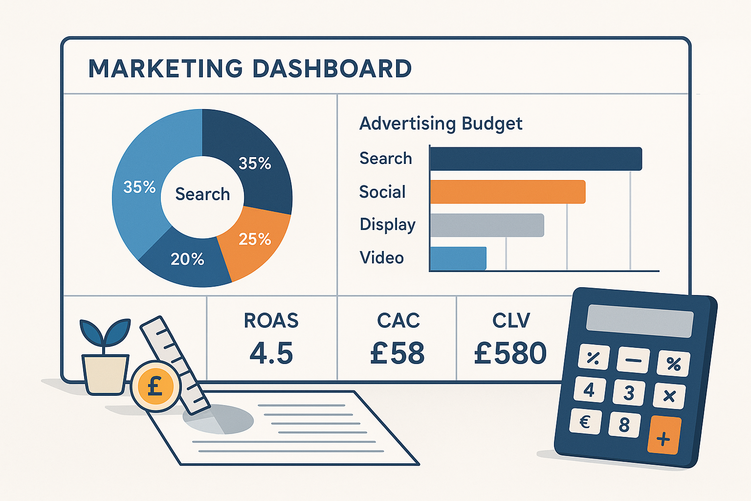
Search advertising typically captures high-intent audiences actively looking for solutions. For most UK businesses, allocating 30-40% of your digital advertising budget to search campaigns makes strategic sense. The average conversion rate for Google Ads across industries is 3.75%, though this varies significantly by sector.
When budgeting for search advertising, consider both brand and non-brand campaigns. Whilst brand campaigns typically have lower CPCs and higher conversion rates, non-brand campaigns drive new customer discovery and market expansion.
Social Media Advertising
Social platforms like Facebook, Instagram, LinkedIn, and TikTok excel at building brand awareness and reaching specific demographic segments. Allocating 20-30% of your budget to social media advertising allows for creative testing and audience development. UK advertising costs on social media vary by platform, with Facebook averaging £0.50-£2.00 per click and LinkedIn typically commanding higher rates of £2.00-£5.00 per click due to its professional audience.
Display and Programmatic Advertising
Display advertising works excellently for retargeting and brand awareness campaigns. Consider allocating 15-20% of your marketing budget here, focusing on retargeting previous website visitors who didn’t convert initially. The average click-through rate for display ads in the UK is approximately 0.35%, making them better suited for awareness rather than direct response objectives.
Video Advertising
With video consumption continuing to rise, platforms like YouTube offer powerful advertising opportunities. Allocating 10-15% of your budget to video advertising can significantly boost brand recognition. UK YouTube ads average around £0.10-£0.30 per view, making it relatively cost-effective for reaching large audiences.
The Testing and Optimisation Framework
Smart budget allocation isn’t static. It requires continuous testing, measurement, and refinement. Implementing a structured framework ensures your ad spend strategy evolves with performance data.
The 70-20-10 Rule
This proven framework suggests allocating 70% of your advertising budget to proven, high-performing campaigns, 20% to promising experimental approaches, and 10% to completely new, innovative tests. This balance ensures stability whilst maintaining the flexibility to discover new opportunities and optimise over time.
Seasonal Adjustments
UK businesses must account for seasonal fluctuations in consumer behaviour. Retail businesses typically increase advertising budgets by 40-50% during the November-December holiday period, whilst B2B companies might reduce spend during August when decision-makers are often on holiday. Building seasonal flexibility into your budget allocation ensures you’re investing heavily during peak conversion periods.
Performance Monitoring and Reallocation
Review your campaign performance at least monthly, analysing key metrics like return on ad spend (ROAS), cost per acquisition (CPA), and customer lifetime value (CLV). Be prepared to reallocate budget from underperforming channels to those delivering stronger results. Setting clear performance thresholds helps automate this decision-making process.
Advanced Strategies for Budget Optimisation
Audience Segmentation and Tiered Budgeting
Not all audiences are equally valuable. Implementing tiered budgeting based on audience segments ensures premium spend on high-value prospects. For example, remarketing to abandoned cart visitors might justify higher CPCs than cold prospecting, given their higher conversion probability.
Dayparting and Scheduling
Analysing when your target audience is most active and most likely to convert allows for strategic budget pacing. Many UK B2B businesses find optimal engagement during weekday business hours, whilst B2C companies might see peak activity during evenings and weekends. Adjusting your bid strategies and budget allocation accordingly maximises efficiency.
Geographic Targeting Refinement
The UK market isn’t homogeneous. London advertising costs are typically 20-30% higher than other regions, but purchasing power and market density may justify this premium. Analyse performance by region and adjust budget allocation to areas delivering the strongest ROI for your business.
Automation and Smart Bidding
Modern advertising platforms offer sophisticated automated bidding strategies that optimise spending in real-time. Google’s Target ROAS and Maximize Conversions strategies, when properly configured with sufficient conversion data, can significantly improve budget efficiency. However, they require careful monitoring and periodic manual adjustment to align with changing business objectives.
Navigating these complex optimisation strategies requires expertise and continuous attention. The team at Kaizen AI Consulting specialises in implementing advanced advertising technologies and strategies, using artificial intelligence and machine learning to continuously optimise budget allocation for maximum performance.
Common Budget Allocation Mistakes to Avoid
Even experienced marketers can fall into common traps when managing their advertising budget. Awareness of these pitfalls helps you avoid costly mistakes.
Spreading Budget Too Thin
Attempting to be present on every platform with limited budget often results in insufficient spend to achieve meaningful results anywhere. It’s better to dominate two channels than to have minimal presence across five. Focus your resources where your target audience is most active and receptive.
Neglecting Landing Page Experience
Increasing ad spend without optimising landing pages wastes money. If your landing page converts at 1% instead of an industry-standard 3%, you’re effectively tripling your acquisition costs. Allocate a portion of your marketing budget to conversion rate optimisation to ensure advertising investment translates into results.
Ignoring Customer Lifetime Value
Fixating solely on initial acquisition costs without considering customer lifetime value can lead to underinvestment in profitable channels. A customer costing £100 to acquire but generating £500 in lifetime revenue represents excellent value, even if competitors are paying only £50 for lower-value customers.
Failing to Account for Attribution
In today’s multi-touch customer journey, a single channel rarely deserves full credit for conversions. Implementing proper attribution modeling ensures you understand each channel’s role in the customer journey, preventing premature budget cuts to valuable awareness-building channels that don’t show last-click conversions.
Building Flexibility Into Your Budget
Market conditions change rapidly, requiring adaptive budget management. Building a 10-15% contingency reserve allows you to capitalise on unexpected opportunities or respond to competitive pressures. This flexibility can be invaluable when a new advertising opportunity emerges or when you need to defend market share against an aggressive competitor campaign.
Additionally, consider implementing quarterly budget reviews rather than annual-only planning. This shorter planning cycle enables faster response to market changes, platform updates, and performance trends, keeping your ad spend strategy agile and responsive.
Measuring Success: Key Performance Indicators
Effective budget allocation requires robust measurement frameworks. Beyond basic metrics like clicks and impressions, focus on business-outcome metrics that demonstrate real value.
Return on Ad Spend (ROAS) shows how much revenue each pound of advertising generates. Whilst a 4:1 ROAS (£4 revenue for every £1 spent) is often cited as a benchmark, appropriate targets vary by industry and business model. Customer Acquisition Cost (CAC) measured against Customer Lifetime Value (CLV) provides deeper insight into campaign sustainability. A healthy ratio typically shows CLV at least 3x higher than CAC.
Track metrics like brand search volume growth, which indicates successful awareness building, and assisted conversions, which reveal how different channels work together in the customer journey. These insights inform smarter future budget allocation decisions.
Getting Expert Help With Your Advertising Budget
Building and managing an effective advertising budget requires significant expertise, ongoing attention, and sophisticated analytical capabilities. Many UK businesses find that partnering with specialists delivers better results than managing campaigns in-house, particularly when resources are limited or internal expertise is developing.
Kaizen AI Consulting offers comprehensive digital advertising services that take the complexity out of budget management. Our team uses advanced AI-powered analytics to continuously monitor performance, identify optimisation opportunities, and reallocate budget dynamically for maximum return. We understand UK market dynamics, platform-specific best practices, and industry benchmarks that inform smarter spending decisions.
Taking Action: Your Next Steps
Building an effective advertising budget and allocation strategy doesn’t happen overnight. Start by auditing your current spending, identifying which channels drive the strongest results, and reallocating resources accordingly. Implement testing frameworks that allow continuous improvement, and build measurement systems that provide clear visibility into performance.
Remember that your advertising budget isn’t just an expense but an investment in business growth. Strategic allocation ensures every pound works hard to deliver measurable results, whether that’s increased sales, qualified leads, brand awareness, or customer engagement.
The digital advertising landscape will continue evolving, with new platforms, formats, and strategies emerging regularly. Staying informed about market changes, platform updates, and industry best practices ensures your budget allocation strategy remains effective and competitive.
Ready to optimise your advertising budget and maximise your marketing ROI? Contact Kaizen AI Consulting today for a comprehensive budget analysis and customised allocation strategy tailored to your business goals. Our team of experts will help you navigate the complex digital advertising landscape, implement proven strategies, and achieve measurable results that drive real business growth. Get in touch now to transform your advertising investment into sustained competitive advantage.