Can AI Replace Employees? The Truth for Small Businesses
The conversation around AI job replacement has reached fever pitch in recent years, with headlines alternating between utopian promises of increased productivity and dystopian warnings of mass unemployment. For small business owners across the UK, the question isn’t merely academic – it’s a pressing concern that affects hiring decisions, investment strategies, and long-term planning. But what’s the actual truth about AI workforce impact on small businesses?
The reality is far more nuanced than the binary human vs AI narrative suggests. Rather than wholesale replacement, we’re witnessing a fundamental transformation in how work gets done. According to a PwC report, whilst AI and automation could displace approximately 7% of UK jobs, they could also create an additional 7.2 million jobs by 2037. The question for small businesses isn’t whether to resist this change, but how to navigate it strategically.
Understanding AI Employment in Today’s Small Business Landscape
Before we dive into whether AI can replace your employees, it’s essential to understand what AI actually does well – and where it falls short. Modern AI excels at pattern recognition, data processing, and repetitive tasks. It can analyse thousands of customer interactions in seconds, automate invoice processing, or schedule social media posts across multiple platforms.
However, AI struggles with tasks requiring genuine creativity, emotional intelligence, complex problem-solving in novel situations, and nuanced human judgement. A study by the Office for National Statistics found that jobs involving caring, teaching, and creative roles are amongst the least likely to be automated, whilst routine administrative and process-driven roles face higher risk.
The Real Impact of Workforce Automation on Small Businesses
For small businesses, workforce automation presents a unique opportunity. Unlike large corporations with deep pockets and dedicated IT departments, small businesses must be strategic about where they deploy AI. The goal isn’t replacing people wholesale – it’s augmenting human capabilities and freeing up your team to focus on high-value activities.
Consider a typical small marketing agency. Rather than hiring additional staff to manage client reporting, sentiment analysis, and data collection, they might implement AI tools that automate these tasks. The existing team can then redirect their energy towards creative strategy, client relationship building, and campaign innovation – activities that genuinely drive business growth.
Where AI Can Support (Not Replace) Your Workforce
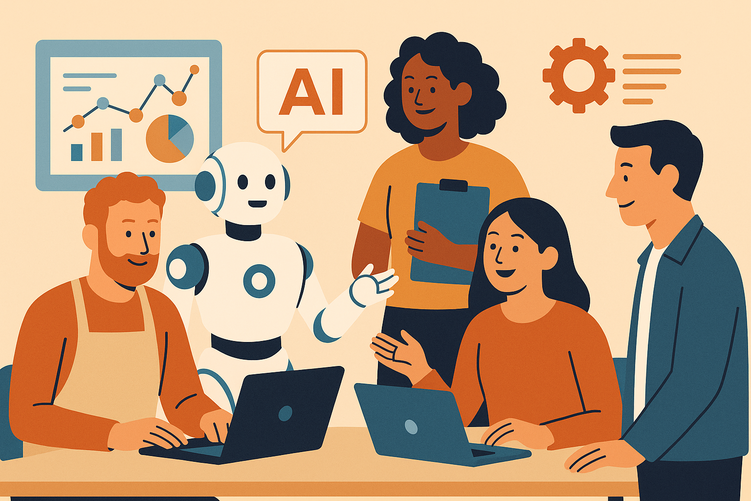
The most successful small businesses are those that view AI as a collaborative tool rather than a replacement. Here are key areas where AI employment makes strategic sense:
Customer Service Enhancement: AI-powered chatbots can handle routine enquiries 24/7, but they should escalate complex issues to human team members. This hybrid approach ensures customers receive immediate responses for simple questions whilst preserving the human touch for sensitive matters. Research from Salesforce indicates that 78% of customers still prefer human interaction for complex issues.
Administrative Task Automation: From expense tracking to appointment scheduling, AI can eliminate hours of administrative burden weekly. This is particularly valuable for small businesses where every team member wears multiple hats. By automating these routine tasks, your employees can focus on activities that directly contribute to revenue and growth.
Data Analysis and Insights: Small businesses generate vast amounts of data but often lack the resources to analyse it effectively. AI tools can identify trends, forecast demand, and highlight opportunities that would take humans weeks to uncover manually. However, interpreting these insights and making strategic decisions based on them remains distinctly human territory.
The Human vs AI Debate: What Really Matters for Small Businesses
The human vs AI debate often misses a crucial point: the question isn’t about superiority but complementarity. According to CBI research, businesses that successfully integrate AI whilst investing in workforce reskilling see the greatest productivity gains – up to 40% in some sectors.
For small businesses, this means identifying tasks where AI adds value without diminishing the human elements that differentiate your brand. Your customers likely choose you over larger competitors precisely because of the personal service, expert judgement, and relationship-building your team provides. AI should enhance these strengths, not replace them.
Strategic Implementation: A Practical Approach for Small Businesses
If you’re considering AI integration in your small business, avoid the temptation to implement technology for technology’s sake. Start with a clear-eyed assessment of your current operations. Where do bottlenecks occur? Which tasks consume disproportionate time relative to their value? Which activities could your team excel at if they had more bandwidth?
Kaizen AI Consulting specialises in helping small businesses identify these opportunities and implement AI solutions that complement rather than compete with human talent. The key is taking a phased approach that allows your team to adapt and upskill alongside technological implementation.
The Cost-Benefit Reality of AI Job Replacement
Whilst headlines focus on AI job replacement, the financial reality for small businesses is more complex. Implementing AI requires upfront investment in software, training, and integration. For many small businesses, this investment delivers better returns when it enables existing employees to increase output rather than when it replaces headcount entirely.
Consider the true cost of employee replacement. Beyond salary savings, you must account for implementation costs, ongoing maintenance, the learning curve, potential customer dissatisfaction during transition, and the loss of institutional knowledge. For many small businesses, strategic AI deployment that enhances employee productivity delivers superior ROI compared to wholesale replacement strategies.
Future-Proofing Your Small Business Workforce
The AI workforce impact will continue evolving rapidly. Rather than viewing this as a threat, forward-thinking small businesses are treating it as an opportunity to future-proof their operations. This involves several key strategies:
Invest in Continuous Learning: Create a culture where upskilling and reskilling are expected and supported. As AI handles routine tasks, your team should develop expertise in areas where human judgement remains paramount – strategy, relationship management, creative problem-solving, and complex decision-making.
Redefine Roles Rather Than Eliminate Them: When AI automates part of someone’s role, work with that employee to redefine their position around higher-value activities. A bookkeeper who previously spent 30 hours monthly on data entry might redirect that time towards financial analysis and strategic planning once AI handles the routine processing.
Maintain the Human Touch: As your competitors adopt AI, the human elements of your business become more valuable, not less. Whilst AI handles routine interactions, ensure your team has the capacity to deliver exceptional, personalised service where it truly matters.
Common Pitfalls to Avoid
Many small businesses approach workforce automation with unrealistic expectations. AI is not a magic solution that works flawlessly from day one. It requires training, refinement, and ongoing management. Nor can it replicate the intuition, creativity, and emotional intelligence that experienced employees bring to complex situations.
Another common mistake is implementing AI without adequately preparing your team. This breeds resentment and resistance. Instead, involve employees in the decision-making process. Help them understand how AI will make their jobs easier and create opportunities for more fulfilling work. Transparency and inclusion are essential for successful AI integration.
Making the Right Decision for Your Business
So, can AI replace employees in your small business? The answer is: it depends on which employees and which tasks. AI excels at augmenting human capabilities, not wholesale replacement. The most successful small businesses will be those that strategically deploy AI to handle routine, repetitive tasks whilst investing in their human workforce to deliver the creativity, judgement, and personal touch that drive customer loyalty and business growth.
For small business owners navigating these decisions, expert guidance can make the difference between costly missteps and strategic success. Kaizen AI Consulting works with small businesses across the UK to develop practical, cost-effective AI strategies that enhance productivity without sacrificing the human elements that make your business unique.
The future of work isn’t about choosing between humans or AI – it’s about intelligently combining both to create more efficient, productive, and fulfilling business operations. By taking a thoughtful, strategic approach to AI employment, small businesses can compete more effectively whilst creating better opportunities for their teams.
Ready to explore how AI can enhance (not replace) your workforce? Contact Kaizen AI Consulting today for a personalised assessment of your business needs and a practical roadmap for AI integration that works for your team, your customers, and your bottom line.