In today’s competitive UK business landscape, understanding and optimising your sales funnel is no longer optional – it’s essential for survival and growth. Whether you’re a startup in Manchester or an established enterprise in London, sales funnel optimization can dramatically improve your conversion rates and revenue. This comprehensive guide explores proven strategies for maximising conversions at every stage of your customer journey.
Understanding the Modern Sales Funnel
The traditional sales funnel has evolved significantly in recent years. What once was a simple linear process has transformed into a complex, multi-touchpoint customer journey. According to Salesforce research, the average B2B buyer now consumes 13 pieces of content before making a purchase decision, making funnel strategy more crucial than ever.
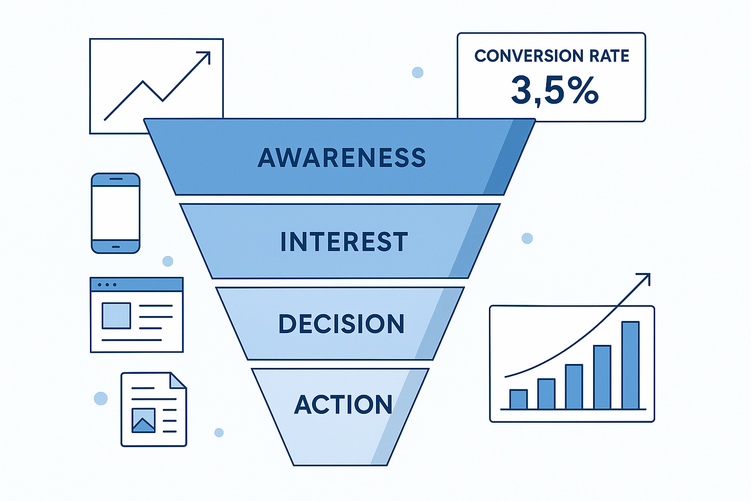
A well-optimised sales funnel guides prospects through four key stages: awareness, interest, decision, and action. Each stage requires tailored content, messaging, and engagement tactics. Research from Invespcro reveals that companies with optimised sales funnels see conversion improvements of up to 300% compared to those without structured processes.
Awareness Stage: Capturing Attention in a Crowded Market
The awareness stage is where potential customers first discover your brand. In the UK market, where consumer trust and brand reputation matter immensely, this initial impression is critical. Your goal here isn’t immediate conversion – it’s about establishing credibility and providing value.
Content That Attracts Quality Leads
Create educational content that addresses your audience’s pain points without immediately pushing for a sale. Blog posts, infographics, social media content, and video tutorials perform exceptionally well at this stage. According to Content Marketing Institute, 71% of B2B buyers consume blog content during the awareness stage.
Search engine optimisation plays a vital role here. Ensure your content ranks for relevant keywords that your target audience is searching for. This includes both broad industry terms and specific problem-solving queries. Tools like Google Search Console can help identify opportunities in the UK market specifically.
Multi-Channel Visibility
Don’t rely on a single channel. Research from McKinsey shows that customers who engage with brands across multiple channels have a 30% higher lifetime value. Combine organic search, paid advertising, social media, email marketing, and partnerships to maximise your reach.
Interest Stage: Nurturing Engagement and Building Relationships
Once you’ve captured attention, the interest stage is about deepening engagement. Prospects at this stage are actively researching solutions and comparing options. Your sales process must provide compelling reasons for them to choose you over competitors.
Personalisation Drives Conversion
Generic messaging no longer cuts through. Epsilon research indicates that 80% of consumers are more likely to purchase when brands offer personalised experiences. Segment your audience based on behaviour, industry, company size, and pain points, then tailor your messaging accordingly.
Email marketing remains powerful for nurturing leads. Create drip campaigns that provide progressive value – case studies, whitepapers, webinar invitations, and product demonstrations. Track engagement metrics to identify when prospects are ready to move to the next stage.
Social Proof and Trust Building
UK buyers are particularly influenced by peer recommendations and proven results. Display customer testimonials, case studies, and industry certifications prominently. According to BrightLocal, 87% of consumers read online reviews before making a business purchase decision.
At Kaizen AI Consulting, we help businesses implement sophisticated lead nurturing systems that automatically deliver the right content at the right time. Our AI-powered automation solutions can segment audiences and personalise messaging at scale, dramatically improving engagement rates.
Decision Stage: Removing Barriers to Purchase
The decision stage is where prospects evaluate final options and decide whether to purchase. This critical juncture requires you to address objections, differentiate from competitors, and make the buying process as frictionless as possible.
Clear Value Proposition
Your unique selling proposition must be crystal clear. What specific benefits do you offer that competitors don’t? Quantify these benefits wherever possible. Research from Forrester shows that buyers who understand a product’s value are 67% more likely to convert.
Create comparison guides, detailed product specifications, and ROI calculators. Make it easy for prospects to visualise the tangible benefits of choosing your solution. In the UK market, transparency around pricing and deliverables is particularly valued.
Addressing Objections Proactively
Don’t wait for prospects to raise concerns – address them upfront. Common objections include price, implementation complexity, integration challenges, and support availability. Create FAQ pages, objection-handling content, and consultation opportunities that provide reassurance.
Live chat and chatbots can be incredibly effective at this stage. Comm100 research reveals that 42% of customers prefer live chat for immediate answers to questions, and sites with live chat see 3-5 times more conversions.
Action Stage: Optimising the Conversion Process
You’ve done the hard work of attracting, engaging, and convincing prospects. Don’t lose them at the final hurdle. The action stage requires meticulous attention to user experience and conversion rate optimisation.
Streamlined Checkout and Sign-Up Processes
Every additional field in a form reduces conversion rates. Unbounce data shows that reducing form fields from four to three can increase conversions by 50%. Request only essential information initially – you can gather more details later.
Offer multiple payment options for UK customers, including direct debit, credit card, and increasingly popular digital wallets. Clearly display security badges and guarantees to reassure customers about data protection compliance, particularly important with UK GDPR regulations.
Strategic Calls-to-Action
Your calls-to-action must be compelling, visible, and action-oriented. Use contrasting colours that stand out from your page design. Test different copy variations – “Start Your Free Trial” often outperforms generic “Submit” buttons by 200% or more.
Place CTAs strategically throughout your content, not just at the end. Ensure they’re visible above the fold and at natural decision points in your copy.
Measuring and Optimising Sales Funnel Performance
Sales funnel optimization is not a one-time project – it’s an ongoing process of measurement, analysis, and improvement. Establish clear metrics for each funnel stage and regularly review performance.
Key Performance Indicators to Track
Monitor conversion rates between each stage, average time in each stage, cost per acquisition, customer lifetime value, and funnel abandonment points. Google Analytics, CRM systems, and marketing automation platforms provide comprehensive tracking capabilities.
According to Gartner research, companies that base decisions on data-driven insights are 6 times more likely to achieve year-over-year profitability growth.
A/B Testing for Continuous Improvement
Test everything – headlines, images, copy, form layouts, colour schemes, and CTAs. Even small improvements compound over time. A 1% improvement in conversion rate at each stage of a four-stage funnel results in a 4% overall improvement.
Prioritise tests that could have the biggest impact. Landing pages, pricing pages, and checkout flows typically offer the highest return on optimisation efforts.
Common Sales Funnel Optimization Mistakes to Avoid
Even experienced marketers make funnel optimisation errors that cost them conversions. Here are critical mistakes to avoid:
Neglecting Mobile Users: With over 60% of UK internet traffic coming from mobile devices according to Statista, a mobile-optimised funnel is essential. Ensure fast loading times, thumb-friendly buttons, and simplified navigation.
Ignoring Existing Customers: Acquiring new customers costs 5-25 times more than retaining existing ones. Don’t let your funnel end at the first purchase. Create retention and upsell funnels that maximise customer lifetime value.
Overcomplicating the Process: More steps equal more abandonment. Simplify wherever possible. Can you reduce the number of pages in your checkout? Eliminate unnecessary form fields? The simpler your funnel, the better it typically performs.
How Kaizen AI Consulting Can Transform Your Sales Funnel
Optimising a sales funnel requires expertise across multiple disciplines – data analytics, conversion rate optimisation, customer psychology, marketing automation, and more. This is where working with specialists like Kaizen AI Consulting makes a significant difference.
Our team conducts comprehensive funnel audits to identify bottlenecks and opportunities. We implement advanced tracking and analytics to provide clear visibility into funnel performance. Our consulting services include developing personalised strategies tailored to your specific industry, target audience, and business goals.
We leverage AI and automation to create sophisticated nurturing sequences that guide prospects through your customer journey with minimal manual intervention. This allows your team to focus on high-value activities while technology handles repetitive tasks.
Taking Action on Sales Funnel Optimization
Understanding sales funnel optimization is one thing – implementing effective strategies is another. Start by mapping your current funnel and identifying where prospects drop off. Calculate conversion rates between each stage and prioritise the areas with the biggest opportunities for improvement.
Remember that effective funnel strategy combines art and science. Data tells you what’s happening, but understanding why requires customer insights, market knowledge, and strategic thinking. The most successful UK businesses continuously test, learn, and refine their approach.
Whether you’re just beginning to structure your sales process or looking to take an existing funnel to the next level, professional guidance can accelerate your results and avoid costly mistakes.
Ready to maximise your conversion rates and transform your sales performance? Contact Kaizen AI Consulting today for a comprehensive sales funnel audit and personalised optimisation strategy. Our team of experts will help you implement proven tactics that deliver measurable results. Visit our contact page to schedule your consultation.