AI Content That Google Still Ranks: How to Create Helpful Content in 2026
The conversation around AI content SEO has shifted dramatically over the past year. With AI-written pages now appearing in over 17% of top Google search results, up from just 2.27% in 2019, the question is no longer whether AI writing can rank. The real question is: what separates AI content that thrives from AI content that sinks without a trace?
For UK businesses navigating an increasingly competitive digital landscape, understanding how to produce AI writing that ranks is not a nice-to-have skill. It is a commercial necessity. This guide breaks down exactly what Google rewards in 2026, what it penalises, and how you can create content quality AI tools help produce while still earning top positions in search results.
Google’s Stance on AI Content in 2026: No Blanket Penalty
Let us start with the most important point. Google does not penalise content simply because it was generated by artificial intelligence. As Google’s own guidelines state: “Appropriate use of AI or automation is not against our guidelines.”
The March 2026 Core Update reinforced this position by re-weighting quality signals around three overlapping properties, according to analysis by Evertune AI:
- Information originality: Does the content contain insights, data, or perspectives that exist nowhere else?
- Author expertise: Does the person behind the content have a verifiable track record that E-E-A-T signals can confirm?
- Topical coherence: Has the domain earned consistent authority within a defined subject area over time?
What Google does target is something called Scaled Content Abuse, where websites use AI to generate many pages without adding genuine value for users. Individual, well-edited pieces that demonstrate expertise are treated no differently from human-written content.
The Helpful Content Update: What It Actually Means for AI Writing That Ranks
The helpful content update system, which has evolved significantly through 2025 and into 2026, specifically targets thin, generic, and unedited AI content that fails to serve user intent. According to a comprehensive LinkedIn analysis, the principle is simple: user value trumps content origin.
This means your AI content SEO strategy must prioritise genuine helpfulness above all else. Google’s ranking systems evaluate clarity, accuracy, experience, and user intent, not the tool that produced the words on the page.
What Google Considers Helpful Content
Helpful content in 2026 shares several characteristics that distinguish it from the mass-produced AI output flooding the internet:
- Factual accuracy supported by proper sourcing and citations
- Comprehensive coverage that fully satisfies user intent
- Original insights that go beyond generic information already available
- Natural language that genuinely engages readers
- Clear expertise signals that build trust with both humans and algorithms
A critical concept driving the helpful content update in 2026 is “information gain.” As QuickSEO reports, Google’s indexing decisions are now heavily influenced by whether a page tells users something not found on other ranking pages. Simply rewording what already exists will not cut it.
The Numbers That Matter: AI Content Performance in 2026
Understanding the current search landscape helps frame your content strategy. Here are the figures every UK marketer should know:
- 58.5% of Google searches now end without any clicks, according to GoodFirms research
- AI Overviews trigger in nearly 55% of all Google searches, with 2 billion monthly users
- Being featured as an AI Overview source increases click-through rate from 0.6% to 1.08%
- About two-thirds of AI-generated content ranks within two months when it meets quality standards
- Almost 70% of businesses report higher ROI from using AI in SEO, per Beyond Your Brand
For UK businesses specifically, Google handles over 90% of general search queries, and the Competition and Markets Authority has noted that search is increasingly relying on AI-generated responses. The shift is clear: visibility now means becoming the source that AI systems choose to cite and trust.
Seven Strategies for Creating AI Content That Google Rewards
Now for the practical guidance. These seven strategies will help you produce content quality AI tools assist with while maintaining the standards Google demands.
1. Start With Human Expertise, Then Scale With AI
The most effective approach to AI content SEO treats artificial intelligence as an amplifier of human knowledge, not a replacement for it. Begin every piece of content with genuine expertise: your own experiences, proprietary data, client case studies, and professional insights. Then use AI to help structure, expand, and refine that foundation.
Google’s March 2026 Core Update specifically favours original research, proprietary data, first-hand testing, and case studies built from real outcomes. These are precisely the elements AI cannot fabricate on its own.
2. Add Genuine Information Gain
Every page you publish should offer something readers cannot find elsewhere. This might be a unique dataset, a contrarian perspective backed by evidence, a detailed process breakdown from your own experience, or analysis that requires specialist access or expertise.
Ask yourself before publishing: does this content tell the reader something the top ten results do not? If the answer is no, revise until it does.
3. Build Topical Authority Through Content Clusters
Google’s systems in 2026 care less about ranking for a single keyword and more about whether your site consistently demonstrates expertise across a topic. Rather than publishing scattered articles on unrelated subjects, build interconnected content clusters around your core areas of knowledge.
This is where a strategic approach to AI-powered content planning can make a significant difference. At Kaizen AI Consulting, we help UK businesses develop topical authority strategies that align AI efficiency with genuine expertise, ensuring every piece of content strengthens your overall domain authority.
4. Ensure Substantial Human Editing and Attribution
AI-assisted content must be grounded in original perspective and attributed with verifiable credentials. This means every article should have a named author with a genuine biography, demonstrable expertise in the subject, and a presence that Google can verify across multiple platforms.
According to Rewarx Studio’s analysis, Google’s 2026 guidelines make clear that generic AI-generated content that merely restates existing information will no longer meet quality thresholds. Substantial human editing is not optional.
5. Optimise for AI Overviews and Citations
With AI Overviews appearing in over half of all searches, being cited as a source is now a primary visibility goal. Structure your content with clear, quotable sections, use structured data markup where appropriate, and create unambiguous attribution for all claims.
Research from Ahrefs via Beyond Your Brand found that YouTube mentions are now the single strongest predictor of AI visibility, even stronger than Domain Rating or backlinks. A multi-platform presence strengthens your content’s chances of being cited.
6. Prioritise Transparency and Disclosure
Google’s 2026 guidelines place growing emphasis on transparency in AI-assisted content creation. While disclosure requirements are strictest for ecommerce, where product descriptions and reviews must clearly indicate AI involvement, the principle extends across all content types.
Being upfront about AI assistance builds trust with both readers and search engines. Consider adding editorial notes explaining your content creation process where relevant.
7. Refresh and Improve Rather Than Endlessly Publish
One of the most effective content quality AI strategies is updating existing content rather than constantly publishing new, shallow articles. Add fresh data, new perspectives, and current examples to your best-performing pages.
This approach signals to Google that your content is maintained, accurate, and genuinely useful, all qualities the helpful content update rewards.
Common Mistakes UK Businesses Make With AI Content
As a detailed LinkedIn report on UK SEO highlights, many British companies are using generative AI to scale content volume rather than to scale originality and proof. Google’s warning signs map almost perfectly to what many UK SMEs are doing with generative AI: producing lots of content on many topics, using extensive automation, and summarising what others say without adding much value.
The businesses that succeed are those who use AI as a tool for enhancing genuine expertise, not as a shortcut for avoiding the hard work of creating something truly valuable. If you are unsure whether your current content strategy meets these evolving standards, speaking with specialists like Kaizen AI Consulting can help you audit your approach and identify gaps before they impact your Google rankings AI performance.
The Role of E-E-A-T in AI Content Success
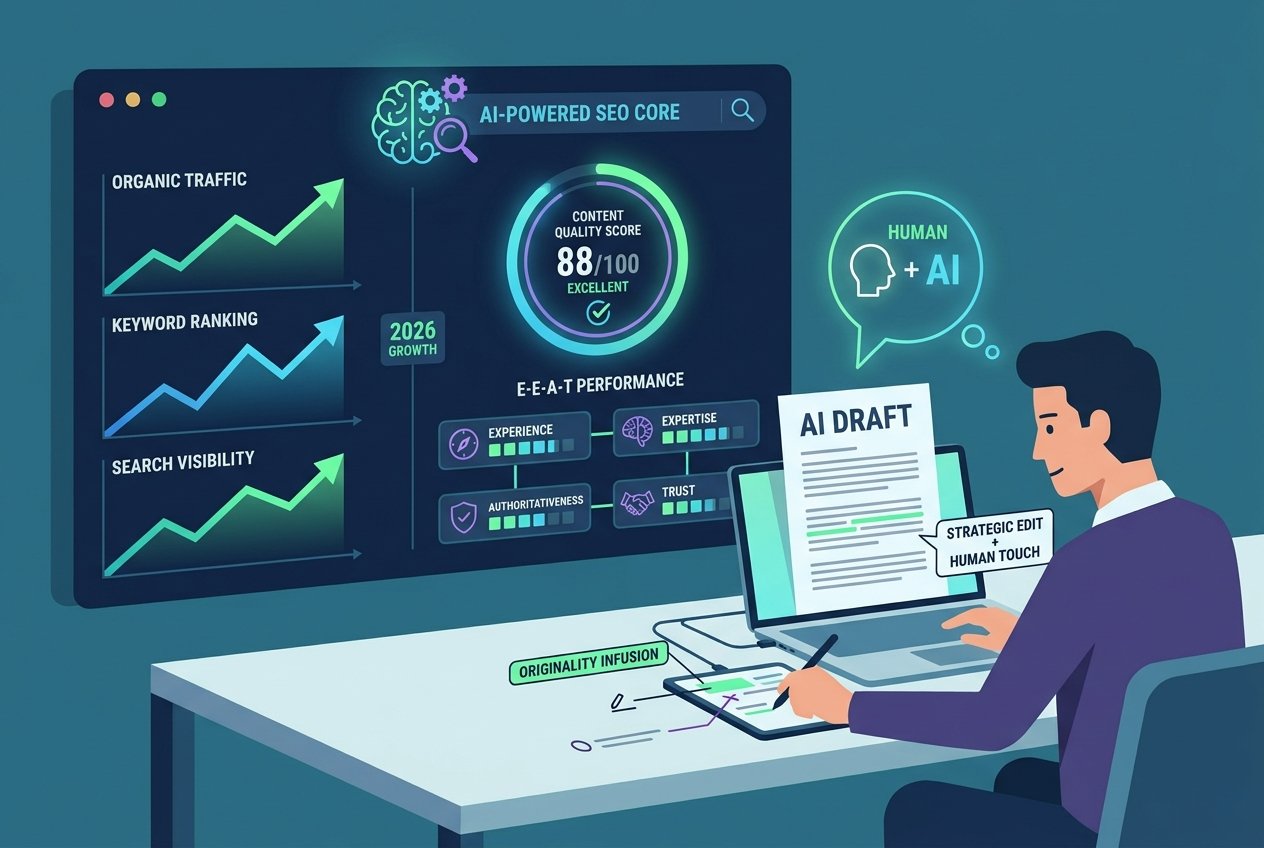
Experience, Expertise, Authoritativeness, and Trustworthiness remain the gold standard for content evaluation in 2026. For AI-assisted content, E-E-A-T signals become even more important because they provide the human credibility layer that algorithms increasingly demand.
Practical steps to strengthen E-E-A-T in your AI content include:
- Experience: Include first-hand case studies, lessons learned, and real-world outcomes from your business
- Expertise: Attribute content to qualified authors with verifiable credentials and author pages
- Authoritativeness: Build consistent topical depth rather than publishing broadly on unrelated subjects
- Trustworthiness: Cite reputable sources, maintain factual accuracy, and keep content updated
With 64.48% of SEO professionals now prioritising accuracy and reliability above all else when choosing AI solutions, the industry consensus is clear. Quality beats quantity every time.
Building Your 2026 AI Content Strategy
Success with AI writing that ranks in 2026 requires a shift in mindset. It is not about using AI to produce more content faster. It is about using AI to produce better content more efficiently while preserving the human expertise and originality that Google rewards.
Your AI content strategy should accomplish four things:
- Optimise for AI Overviews so your content gets cited in zero-click results
- Build topical authority through interconnected content clusters
- Meet E-E-A-T standards with human-reviewed, AI-assisted content
- Track performance beyond traditional rankings including AI visibility, citation rates, and engagement metrics
Implementing this kind of strategic approach is exactly what Kaizen AI Consulting helps UK businesses achieve. From auditing your existing content to building AI-enhanced workflows that meet Google’s evolving standards, our team ensures your content investment delivers measurable returns. Get in touch today to discuss how we can help you create AI content that not only ranks but drives genuine business growth.
Final Thoughts
The era of worrying about whether Google will penalise AI content is over. In 2026, the playing field is level: Google ranks content based on quality and intent, not how it was produced. The businesses that win are those who combine AI efficiency with human expertise, original insight, and a genuine commitment to helping their audience.
Focus on information gain, build topical authority, invest in E-E-A-T signals, and treat AI as a powerful collaborator rather than a content factory. Do this, and your AI content will not just survive the helpful content update. It will thrive because of it.