For UK service businesses, time is money and nowhere is that more evident than in appointment booking. Whether you run a hair salon in Manchester, a plumbing firm in Bristol, or a consultancy in London, the daily friction of managing a diary, chasing confirmations, and handling last-minute cancellations drains precious hours that could be spent delivering your services. Fortunately, appointment booking AI is rapidly changing the game, offering scheduling automation tools that work around the clock so you do not have to.
In this guide, we explore the most effective AI tools and strategies for service businesses looking to streamline their booking process, reduce no-shows, and convert more enquiries into confirmed appointments. Whether you are just starting to explore automation or looking to level up your existing systems, read on for a practical, UK-focused breakdown.
Why Appointment Booking AI Matters for UK Service Businesses
The numbers tell a compelling story. According to the British Chambers of Commerce (March 2026), 54% of UK firms are now actively using AI, up from just 35% in 2025 and 25% in 2024. Among those using AI for admin and scheduling, adoption has surged to 43% of SMEs, making it the single most commonly automated task. And it is easy to see why.
No-shows and missed appointments are a silent drain on service business revenues. According to Etisia’s 2026 UK no-show statistics report, industry no-show rates range from 10% for legal and consulting firms up to 22% for therapists and counsellors. Home services trades sit at 18%, and medical clinics face an average of 18% no-shows, while hair and beauty salons contend with rates of 14-15%. These figures translate directly into lost revenue, with annual losses exceeding £25,000 per business in many cases.
The good news? AI-powered scheduling automation and automated SMS reminders can reduce no-shows by 38-50%, with recovery rates of 80-92% when reminders are deployed 24 hours before an appointment. For most service businesses, the return on investment from even a basic AI booking tool is swift and measurable.
The Core Benefits of Scheduling Automation for Service Businesses
Before diving into specific tools, it is worth understanding what scheduling automation actually delivers for a service business. The key benefits include:
- 24/7 availability: AI booking tools accept appointments around the clock, capturing leads and confirmed bookings even when your team is off the clock. Research from Intelibot (2026) shows that small businesses that deploy AI booking systems can see booking rates increase by 30-50%.
- Reduced admin burden: According to a QuickBooks UK SME survey (2026), 77% of SMEs using AI report improved productivity, with 63% reporting significant time savings.
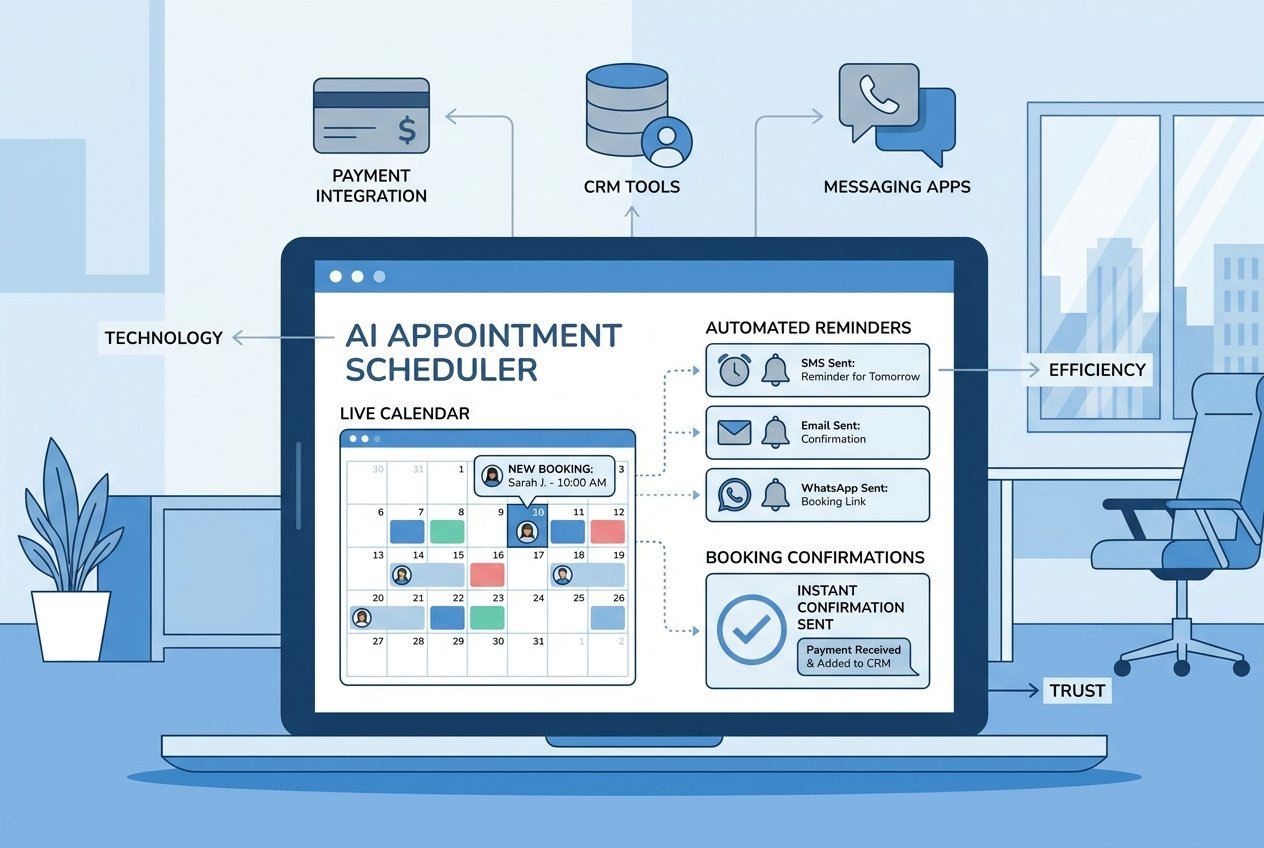
- Fewer no-shows: Automated reminders via SMS, WhatsApp, or email keep clients informed and engaged, dramatically cutting missed appointment rates.
- Better customer experience: Clients increasingly prefer self-service booking options. Offering a seamless, instant booking process helps you stand out from competitors who still rely on phone calls or manual email exchanges.
- Improved cash flow: Some AI booking platforms allow you to take deposits or payments at the point of booking, reducing the financial risk of last-minute cancellations.
The Leading Calendar AI and Appointment Booking Tools in 2026
The market for appointment booking AI tools has matured significantly. Here is a breakdown of the leading platforms service businesses should consider:
1. Calendly
A market leader that has evolved well beyond its rule-based origins, Calendly now incorporates AI-powered time suggestions, conflict resolution, and intelligent routing. It integrates seamlessly with Google Calendar, Microsoft Outlook, Zoom, Salesforce, and thousands of other tools via Zapier. For consultancies, coaches, and professional service businesses, Calendly remains one of the most polished and straightforward scheduling automation solutions available.
2. Motion
Motion positions itself as a full workday automation hub rather than a standalone booking tool. Starting from around £27/month for individuals, it uses AI to optimise your entire schedule, automatically fitting appointments, tasks, and priorities together in a way that maximises your working day. For sole traders and small teams, it is a powerful all-in-one option.
3. SimplyBook.me
Particularly popular among UK-based beauty, wellness, and fitness businesses, SimplyBook.me offers a feature-rich booking platform with built-in reminder automation, intake forms, deposit collection, and a customisable client-facing booking page. Its free plan makes it accessible to micro-businesses just getting started with scheduling automation.
4. Square Appointments
For service businesses that also take payments, Square Appointments combines calendar AI with integrated point-of-sale functionality. The Square Assistant feature uses AI to automatically respond to booking requests via text, confirming, cancelling, or rescheduling appointments without any manual input from your team.
5. Cal.com
An open-source scheduling platform built specifically with AI agent integration in mind, Cal.com is increasingly favoured by tech-forward service businesses and agencies. Its Cal.ai voice agent can handle inbound phone booking requests entirely autonomously, making it an excellent choice for businesses that receive a high volume of phone enquiries.
6. My AI Front Desk
My AI Front Desk acts as a 24/7 AI receptionist, answering calls, qualifying leads, and booking appointments while integrating with over 9,000 apps via Zapier. For trades businesses, clinics, and salons that rely heavily on inbound phone calls, this type of voice AI booking assistant can replace or supplement a human receptionist at a fraction of the cost.
AI Chatbots for Appointment Booking: A Game Changer for Service Businesses
One of the most accessible entry points into appointment booking AI is the website or messaging chatbot. These conversational AI tools sit on your website or connect to platforms like WhatsApp and Facebook Messenger, engaging visitors in natural conversation, checking real-time availability, and confirming bookings without any human involvement.
For UK service businesses, WhatsApp-integrated AI booking bots are proving particularly effective. Given that WhatsApp is used by over 40 million people in the UK, deploying a booking bot via the platform means clients can book appointments through a channel they already use every day. Tools like ChatBot and Kenyt.ai handle multi-channel scheduling across websites, WhatsApp, and social media simultaneously, syncing everything to a central calendar.
At Kaizen AI Consulting, we specialise in helping UK service businesses design and deploy AI chatbot and automation systems tailored to their specific workflows. From selecting the right platform to configuring integrations with your existing CRM and calendar tools, our team ensures your scheduling automation is set up correctly from day one, so you start seeing results quickly.
Integrating Appointment Booking AI with Your Existing Business Tools
For scheduling automation to deliver maximum value, it needs to connect with the other tools your business relies on. The most important integrations to consider include:
- CRM systems: When a new booking is made, the client’s details should automatically sync to your CRM, whether that is HubSpot, Zoho, or a sector-specific platform. This ensures your sales and follow-up workflows are triggered without manual data entry.
- Payment processors: Collecting deposits at the point of booking reduces no-shows significantly. Platforms like Square Appointments and SimplyBook.me offer native payment integration, while others connect to Stripe or PayPal via Zapier.
- Marketing automation: Post-appointment follow-up emails, review requests, and rebooking nudges can all be automated based on booking data, driving repeat business without any manual effort.
- Google Calendar and Outlook: Essential for preventing double bookings and ensuring your whole team is aligned. Most AI booking tools offer two-way sync with both major calendar platforms.
Getting these integrations right is often where service businesses struggle. The technology exists; the challenge is in the configuration. This is precisely the kind of hands-on implementation support that the team at Kaizen AI Consulting’s services provides, ensuring your AI tools work together as a cohesive system rather than a collection of disconnected apps.
How to Choose the Right Appointment Booking AI for Your Service Business
With so many service business tools on the market, choosing the right platform can feel overwhelming. Here is a practical framework to guide your decision:
- Volume of bookings: High-volume businesses (50+ appointments per week) need robust platforms with strong automation and multi-staff management. Lower-volume businesses can start with a free or low-cost tool and scale up later.
- Channels your clients use: If most of your enquiries come via phone, prioritise a voice AI solution. If clients predominantly contact you via your website or WhatsApp, a chatbot-first approach makes more sense.
- Integration requirements: List the tools you currently use (CRM, accounting software, payment processor) and verify that any shortlisted booking platform offers native or Zapier-based integration with them.
- Budget: Most AI booking tools operate on a monthly subscription model ranging from free (with limitations) to around £50-£100/month for full-featured plans. Calculate the revenue recovered from just a 20% reduction in no-shows to put this cost in perspective.
- Setup complexity: Some platforms are designed for self-service setup in under an hour; others require technical configuration to unlock their full potential. Be realistic about your team’s technical capacity, or consider working with a specialist to get it right.
Agentic AI: The Next Frontier in Scheduling Automation
Looking ahead, the most significant development in appointment booking AI is the rise of agentic AI. Unlike traditional booking tools that simply present available slots for a client to select, agentic AI systems can independently navigate complex scheduling scenarios, manage conflicts, reach out to clients proactively, and even re-optimise an entire day’s schedule in response to a cancellation.
According to research from Epiphany Dynamics (April 2026), automated service businesses are already outperforming manual competitors by 15-20% on profit margins, a gap that is projected to widen as agentic AI capabilities mature. For UK service businesses, early adoption of these technologies is becoming a genuine competitive differentiator rather than a nice-to-have.
Platforms like Cal.com and Motion are already incorporating agentic scheduling features, and the pace of development in this space is accelerating rapidly. McKinsey research cited in recent automation trend analyses highlights 20-30% cycle time reductions achievable through AI-driven scheduling optimisation.
Getting Started: A Practical Action Plan
If you are ready to move from manual diary management to scheduling automation, here is a simple action plan to get started:
- Audit your current booking process: Map out every step from initial enquiry to confirmed appointment and identify the biggest friction points and time drains.
- Calculate the cost of no-shows: Multiply your average no-show rate by your average appointment value and weekly booking volume to understand exactly what you are losing each month.
- Select a platform that fits your needs: Use the framework above to shortlist two or three tools and take advantage of free trials to test them with real bookings.
- Configure reminders and confirmations: Even before advanced features, setting up automated SMS or WhatsApp reminders 24-48 hours before appointments will deliver an immediate reduction in no-shows.
- Integrate with your existing tools: Connect your booking platform to your CRM, calendar, and payment processor to create a seamless end-to-end workflow.
- Review and optimise: After 30 days, review your no-show rate, booking conversion rate, and time saved. Use these insights to refine your setup.
If you would like expert guidance on selecting, configuring, and optimising appointment booking AI for your specific business, the team at Kaizen AI Consulting is here to help. We work with UK service businesses of all sizes to implement practical AI solutions that deliver measurable results. Get in touch today to book a free discovery call and find out how scheduling automation can transform the way your business operates.
Final Thoughts
Appointment booking AI is no longer the preserve of large enterprises with sizeable technology budgets. In 2026, a growing range of accessible, affordable tools puts scheduling automation within reach of every UK service business, from the sole trader to the growing multi-location operation. With no-show rates costing businesses tens of thousands of pounds each year and client expectations for instant, self-service booking rising steadily, the question is no longer whether to adopt calendar AI, but how quickly you can get started.
The service businesses that invest in scheduling automation today will be better positioned, more profitable, and more competitive tomorrow. The tools are ready. The only step left is taking action.