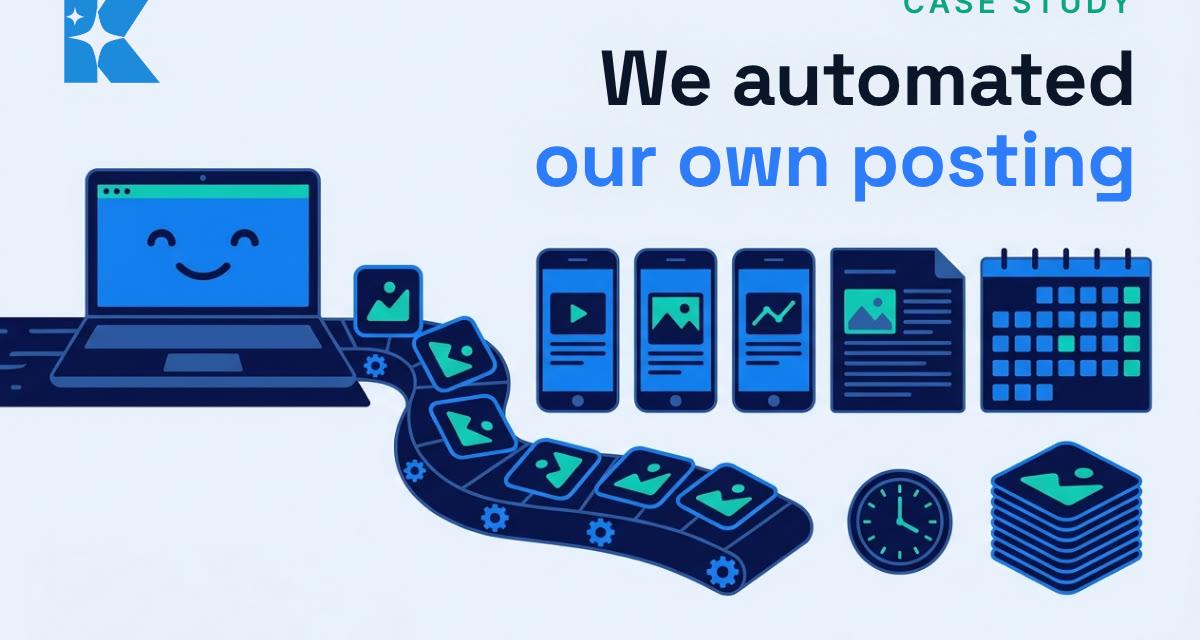
We stopped doing our daily social posting by hand. A routine now researches a topic, writes the blog post and the captions for each platform, makes the illustrations and a short video, and publishes the lot once a person has approved it. It costs about £58 a month in tools, took a day to build, and saves us over 7 hours a week. This is our own system, built for ourselves, so here is exactly what it is, what it costs and where it still needs us.
The problem: too slow and too inconsistent
Doing the daily content properly took over an hour every time. A blog post, a caption for each platform, a cover image, a video. Done by hand, the quality drifted. The tone changed from one day to the next, and on a busy day something got skipped. A business that posts every day for a week and then vanishes for ten days is not building much of anything.
We did not need more ideas. We needed the same steps run the same way every day, with a person making the final call.
What we built
The routine runs every morning and follows a written operating manual. In plain English, it does the following:
- Looks for a topic worth writing about, checks it has not been covered recently, and researches it.
- Writes the blog post and a separate caption for each platform, in our brand voice and style.
- Generates the illustrations and builds a short video, with all text added afterwards as real typography rather than painted by an image model.
- Publishes to our blog, Google Business Profile, LinkedIn, Instagram, TikTok and X.
The result is a daily post that is consistent in brand, theme, language and style, which was the whole point. If you have ever tried to keep a human team to a single voice across six channels, you will see why that matters.
A person still signs it off
Nothing goes live on its own. Every morning the routine stops at a draft and waits for approval. We read it, ask for changes, or throw it out and start again. Some days we do reject it, and that is the system working as designed. The automation does the repetitive work, and the judgement stays with us.
If you build something similar, decide where the human check goes before you build anything else. It is much easier to put in on day one than to add after something embarrassing has gone out.
What it costs to run
These are tool costs only, and they are the real monthly figures for our setup:
- Claude, £20 a month on the standard plan
- Zernio, which handles the scheduling and publishing to social platforms, £20
- n8n, the automation tool, on £10 a month hosting
- Higgsfield, for video generation, about £5 in credits
- Gemini, for illustrations, about £3
- GitHub, free
That comes to about £58 a month. Your own mix will differ, and prices change, so check each provider's current pricing before you plan around ours. You can look at n8n, Zernio and GitHub to see what each one does.
How long it took
The first working version took one day. We have kept adjusting it since, because the platforms change, our own rules change, and we learn what does not work. An automation is something you maintain, not something you finish. If you are budgeting for one, budget for the upkeep as well as the build.
The trade-offs we would tell a client about
Automation is not free of cost just because the tools are cheap. First, it needs a written manual. Ours is long, and it grows every time we find a rule the routine keeps breaking. Second, a drafting routine can be confidently wrong, so every figure and claim has to be checked before it goes out, which is another reason the approval step stays. Third, you depend on several services, and any one of them can change its terms, its limits or its prices. We keep a short list of what to do when a step fails, and we would suggest you do the same.
What changed, and what we are not claiming
The honest results are these. We now post consistently and regularly, and we save over 7 hours a week compared with doing it by hand. A job that would take more than an hour each day now arrives as a draft to approve.
What we are not claiming is that it has grown our audience. We have not measured that well enough to say, and we would rather tell you so than imply it. Time back and steady output are the results we can stand behind.
What to take from this
You do not need our exact stack to get the same kind of result. The pattern is simple enough to copy:
- Write down your routine step by step. You cannot automate something you have not described.
- Pick the repetitive, rules-based steps and hand those over. Keep the judgement calls for yourself.
- Put a human approval in before anything goes public.
- Build the smallest version that works from start to finish, then improve it in short passes.
- Write down the monthly tool costs before you start, so the bill is no surprise.
If you have a job in your week that takes over an hour and follows the same steps every time, it is probably a candidate. We are happy to talk it through on a free 30 minute strategy call.


