You Don’t Need a Developer Anymore: Build Your First App MVP for Under £100
There was a time when turning a business idea into a working app required deep pockets, a technical co-founder, or months of negotiation with development agencies. In 2026, that era is officially over. Thanks to a new wave of AI-powered app builders and no-code platforms, non-technical founders across the UK can now build a functional minimum viable product (MVP) for less than the cost of a decent dinner for two.
If you have been sitting on a brilliant idea because you thought you could not afford to build it, this guide is for you. We will walk you through exactly how to go from concept to working prototype for under £100, which tools to use, and the strategic steps that separate successful MVPs from expensive failures.
The Traditional MVP Is Dead (And That Is a Good Thing)
Let us start with some numbers that tell the story. According to Riseup Labs, the average cost to build a basic MVP with a UK development agency in 2026 ranges from £20,000 to £60,000. Complex apps with AI features or payment integrations can exceed £250,000. For most aspiring founders, those figures are simply out of reach.
Meanwhile, UK startup statistics for 2026 reveal that 832,000 new companies were incorporated in 2025, with 1.2 million startups now active across the country. Yet 60% of these startups will fail within five years, with 42% closing because they misread market demand and 29% simply running out of cash.
The lesson is clear: spending tens of thousands of pounds on an untested idea is one of the riskiest things a founder can do. The smarter approach is to build a lean, functional MVP that lets you validate your concept with real users before committing serious capital.
What Exactly Is an MVP (And What It Is Not)
Before we dive into the tools, let us get clear on what an MVP actually means. A minimum viable product is the simplest version of your app that solves a core problem for your target users. It is not a half-finished product. It is not a wireframe or a slide deck. It is a working piece of software that people can actually use.
Your MVP should do one thing well. Think of it as a focused experiment designed to answer a single question: Will people actually use this?
What a good MVP includes
- A clear value proposition solving one specific problem
- Core functionality that delivers on that promise
- A clean, usable interface (it does not need to be beautiful, just functional)
- Basic user authentication if needed
- A way to collect user feedback
What a good MVP does not need
- Every feature you have ever imagined
- Complex integrations with third-party services
- Native iOS and Android apps (a web app is perfectly fine)
- Custom animations or advanced design flourishes
The AI App Builder Revolution: Your New Development Team
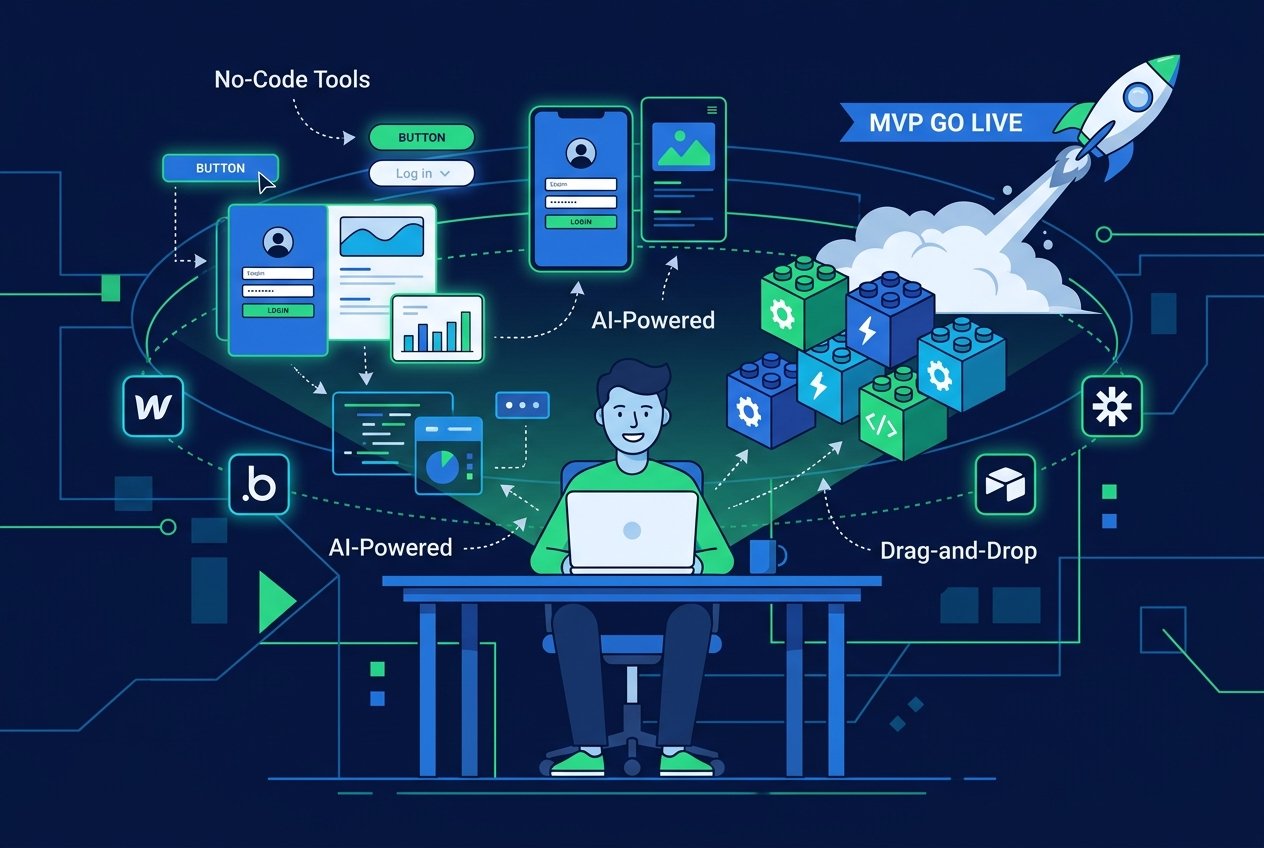
The real game-changer in 2026 is AI-powered app builders. These tools go far beyond traditional no-code platforms. Instead of dragging and dropping components, you describe what you want in plain English, and the AI generates a working application complete with front-end, back-end, database, and deployment.
According to SQ Magazine, 75% of new applications are forecast to be created using low-code or no-code tools by 2026, and these platforms can reduce development time by up to 90% compared to traditional methods. Gartner confirms that over 75% of enterprise apps will be built on no-code or low-code tools by the end of this year.
Here are the top AI app builders that can get your MVP live for under £100:
Base44 – Best for production-ready apps
Ranked as the top AI app builder for 2026 with a score of 91 out of 100, Base44 is fast, produces high-quality output, and includes built-in functionality without requiring extra tools. At approximately £16 per month, you can build and launch a production-ready MVP well within your £100 budget over a two-month sprint.
Lovable – Best for non-technical founders
Explicitly designed for people without coding experience, Lovable offers full-stack generation with native back-end support, authentication, and deployment. The Pro Plan costs roughly £17 per month when billed annually. It also offers a free tier with five daily credits, so you can start building before spending a penny.
Bolt.new – Best for rapid prototyping
If speed is your priority, Bolt.new excels at getting a shareable prototype live quickly. It offers a generous free tier that is perfect for initial MVP development, letting you demo your idea to potential users and investors without any upfront cost.
Google AI Studio – Best free option
For founders on the tightest budgets, Google AI Studio is completely free during the building phase. It is a solid choice for testing concepts and building simple MVPs without spending anything at all.
Glide – Best for mobile-friendly apps
Starting at approximately £15 per month, Glide lets you create attractive mobile-friendly web apps. It is especially good for apps built around data, such as directories, booking systems, or inventory tools.
Your Step-by-Step Plan: Idea to MVP in Under £100
Now let us map out exactly how to build your MVP without breaking the bank. This is the same strategic framework that teams at Kaizen AI Consulting use when helping founders move from concept to launch with maximum efficiency.
Step 1: Define your core problem (Cost: £0)
Write down in one sentence the specific problem your app solves. If you cannot explain it simply, you are not ready to build. Talk to at least five potential users and confirm they actually experience this problem. This step costs nothing but saves everything.
Step 2: Map your core user journey (Cost: £0)
Sketch out the three to five screens your user needs to accomplish their goal. Use a free tool like Excalidraw or even pen and paper. Focus ruthlessly on the single most important workflow. Everything else can wait for version two.
Step 3: Choose your AI builder (Cost: £0 to £20)
Based on our research, here is a simple decision framework:
- Zero budget? Start with Google AI Studio or Bolt.new’s free tier
- Want the best all-rounder? Choose Base44 at £16 per month
- Non-technical and need guidance? Go with Lovable at £17 per month
- Building a data-driven app? Try Glide at £15 per month
Step 4: Build with AI prompts (Cost: £16 to £20 per month)
Describe your app to the AI builder in clear, specific language. For example: “Build a booking platform where dog walkers in Manchester can list their availability and dog owners can browse, filter by location, and book a session.” The AI will generate your app structure, database, and user interface. Iterate by giving it feedback: “Make the booking confirmation screen show the walker’s photo and rating.”
Step 5: Test with real users (Cost: £0)
Share your working prototype with ten to fifteen potential users. Watch them use it. Note where they get confused. Ask what is missing and what they love. This feedback is worth more than any feature you could build.
Step 6: Refine and launch (Cost: £20 to £40)
Based on user feedback, make targeted improvements. Most AI builders let you deploy to a custom domain for a small additional cost. Budget approximately £10 to £20 for a domain name and you are live.
Total estimated cost: £45 to £80
That is your MVP, live and in the hands of real users, for less than £100. Compare that to the £20,000 minimum you would pay a UK development agency.
Common Mistakes That Kill MVPs (And How to Avoid Them)
Building cheaply does not mean building carelessly. Here are the most common pitfalls we see founders fall into:
Feature creep
The temptation to add “just one more feature” is the number one MVP killer. Every feature you add increases complexity, delays your launch, and moves you further from validation. Remember: the purpose of an MVP is to learn, not to impress.
Skipping user research
Building something nobody wants is the reason 42% of UK startups fail. Spend more time talking to users than building features. The UK Business Data Survey 2026 shows that businesses using data to generate insights are significantly more likely to succeed, and that principle starts with your very first customer conversation.
Ignoring the business model
Your MVP should test not just whether people will use your product, but whether they will pay for it. Include a pricing page or payment flow, even if it is simple. Validate willingness to pay early.
Building in isolation
Do not spend three months perfecting your app in secret. Get it in front of users within two weeks. The faster you launch, the faster you learn.
When to Level Up: Knowing Your MVP Has Succeeded
Your sub-£100 MVP is a starting point, not the finish line. Here are the signals that tell you it is time to invest more seriously:
- Users are returning: People come back without being prompted
- Organic growth: Users are telling others about your app
- Revenue signals: People are willing to pay, even small amounts
- Clear feedback patterns: Users consistently request the same improvements
- Engagement metrics: Session times and completion rates are healthy
When these signals appear, that is the moment to think about scaling. You might migrate to a more robust platform, hire developers for custom features, or seek investment. But you will be doing so with validated evidence, not blind hope.
This is precisely the stage where working with an experienced AI consultancy becomes invaluable. At Kaizen AI Consulting, we specialise in helping founders bridge the gap between a validated MVP and a scalable product, ensuring you invest in the right technology at the right time. Our startup coaching approach combines strategic business guidance with deep AI expertise to help you make decisions that accelerate growth rather than burn cash.
The Bigger Picture: Why This Matters for UK Entrepreneurs
The democratisation of app development is not just a technological trend. It is a fundamental shift in who gets to be an entrepreneur. According to the latest UK startup data, AI startups alone raised £3 billion in Q1 2026. The tools that power those startups are now available to anyone with a laptop and an internet connection.
For UK founders specifically, this shift addresses a persistent challenge. The UK ranks third globally for venture capital after the US and China, yet the majority of new businesses are bootstrapped. When you can validate an idea for under £100, the barrier between a great idea and a real business effectively disappears.
Whether you are a teacher with an idea for an education platform, a tradesperson who wants to streamline bookings, or a consultant looking to productise your expertise, the tools exist today to make it happen without writing a single line of code and without emptying your savings account.
Ready to Build? Here Is Your Next Step
Stop waiting for the perfect moment, the right co-founder, or enough savings to hire a developer. The technology to build your MVP exists right now, and it costs less than your monthly coffee budget.
Pick one tool from the list above, define your core problem in one sentence, and start building today. If you want expert guidance on turning your idea into a strategic, scalable product, get in touch with Kaizen AI Consulting. We help UK founders navigate the journey from first prototype to thriving business, combining AI expertise with practical business strategy to ensure every pound you invest delivers real results.
Your idea deserves to exist. Now you have no excuse not to build it.