
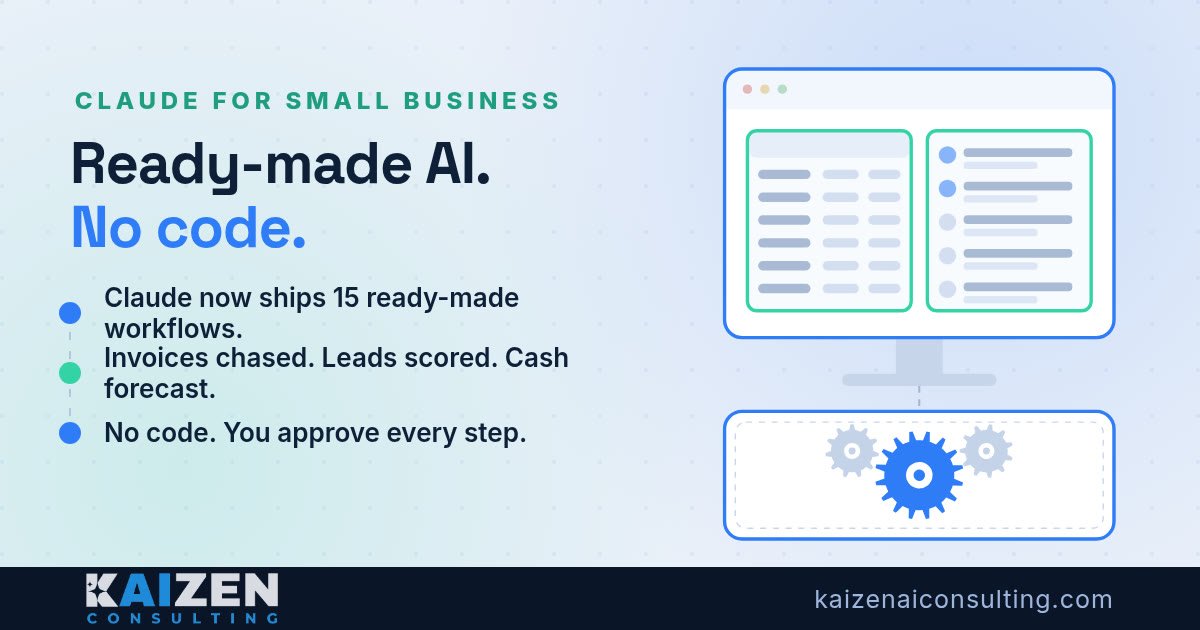
Anthropic has done something unusual for an AI company. Instead of launching yet another chatbot, it has packaged Claude into a set of ready-to-run workflows aimed squarely at small business owners who do not write code and do not want to. Claude for Small Business arrived in May 2026 as a free plugin for the Claude Cowork desktop app, and it is one of the clearest signs yet that the industry has realised where the real bottleneck sits. It was never the technology. It was the setup.
What Claude for Small Business actually is
The plugin bundles more than two dozen pre-built skills and 15 ready-to-run agentic workflows into Claude’s Cowork desktop app. Rather than a blank chat box, you get named jobs a business recognises: reconcile the month, forecast 30 days of cash, chase overdue invoices, score this week’s leads, triage a customer complaint, prepare quarterly tax figures for your accountant, draft a job post with an interview guide attached.
It connects natively to eight tools most small firms already run on: QuickBooks, HubSpot, PayPal, Canva, DocuSign, Google Workspace, Microsoft 365 and Slack. The workflows read from those systems, do the analysis, and hand you the result. Daniela Amodei, Anthropic’s president, described the target as the “work that often falls to owners outside normal business hours”, and that is exactly the territory: the Sunday-evening bookkeeping, the invoice chasing nobody enjoys, the CRM that has not been touched since March.
Two details matter more than the feature list. First, every workflow requires your approval before anything executes. Claude drafts the invoice reminder, but you press send. It proposes the CRM cleanup, but you confirm it. For a business owner nervous about handing an AI the keys, that design choice is the difference between usable and terrifying. Second, the plugin itself is free. You pay for the underlying Claude subscription, which starts at roughly £20 a month including VAT for the Pro plan. That is the entire tool cost for a system that would have needed a bespoke build 18 months ago.
Why ready-made workflows matter more than better models
Here is the uncomfortable statistic. The British Chambers of Commerce and Atos found that 54% of UK SMEs now actively use AI, up from 35% a year earlier. Adoption has more than doubled in two years. Yet the same research programme keeps finding that most firms stop at exactly one use case, usually drafting emails or marketing copy, and never connect AI to the systems where the hours actually go.
We see this constantly in our audit calls. The owner has ChatGPT or Claude open in a browser tab. They use it to reword letters. Meanwhile the jobs eating their evenings, reconciliation, quoting, chasing payments, sit untouched, because connecting an AI to QuickBooks or HubSpot felt like a development project. Ready-to-run workflows collapse that gap. The integration work is done, the prompts are written, the guardrails are in. What is left is a decision about which job to hand over first.
What we would run first
Having built versions of these automations for clients ourselves, we would point a typical UK small business at three of the bundled workflows before any others.
The weekly business brief is the quiet winner. It reads your accounts, payments and pipeline, and gives you one page every Monday: cash position, sales trend, what needs attention. Most owners have never had a Monday report because producing one took a bookkeeper half a day.
Invoice chasing is the fastest payback. UK small firms are owed billions in late payments at any given moment, and the follow-up email that never gets sent is the single cheapest fix in business finance. A workflow that drafts reminders matched to each customer’s payment history, and queues them for your approval, turns an awkward chore into a two-minute review.
Lead triage is the growth one. If enquiries land in your inbox and HubSpot, the workflow scores them, surfaces the five worth calling today and drafts the follow-ups. Speed to first response is still the strongest predictor of winning the work, and it is precisely what a busy owner cannot maintain by hand.
The honest limitations
It is desktop only, Mac or Windows, through the Claude Cowork app. There is no browser version, so if your business lives on a Chromebook this is not for you yet. The integration list is eight tools deep, which covers a lot of UK small businesses but not those on Xero, Sage, Salesforce or Stripe, and for a UK audience the absence of Xero is the gap we expect owners to feel first. If your stack is not covered, a custom build with the same approval-first design is still the route, which is precisely the work we do.
And the approval requirement cuts both ways. Nothing runs truly unattended, which is the right default for finance and customer contact, but it means this is an assistant that prepares work for you, not a silent employee. Anyone promising you a fully autonomous business in 2026 is selling something.
What this means for UK small businesses
The significance of Claude for Small Business is less the product and more the direction of travel. The AI companies have accepted that small businesses will not hire prompt engineers, and the products are being reshaped around that reality. Packaged workflows, plain English, human approval, tool costs of around £20 a month. The excuse that AI is too technical for a trades firm or a five-person agency is expiring quickly.
The 54% adoption figure will keep climbing. The question that decides whether the productivity shows up in your accounts is not whether you use AI, it is whether AI is connected to the systems where your hours actually go. Ready-to-run workflows are the shortest path anyone has shipped so far. We built our practice on exactly this principle, and it is encouraging to see the platform vendors catch up.