Introduction
The phrase cheap AI models rarely sits comfortably alongside cutting-edge performance, yet DeepSeek V4 is forcing UK business owners to rethink that assumption. Released to general availability on 20 July 2026, the Chinese open source LLM offers a one-million-token context window, benchmark scores nipping at the heels of the best models from OpenAI and Anthropic, and API pricing that can be ten to fifty times lower than its Western rivals.
For UK SMEs already squeezed by rising operational costs, this looks like a gift. The catch? Data sovereignty, GDPR compliance, and an active ICO investigation mean that choosing the right AI implementation partner has never been more critical. In this article, we break down what DeepSeek V4 actually delivers, where the risks lie for British businesses, and how to make an informed decision.
What Is DeepSeek V4?
Capable, Open, and Remarkably Inexpensive
DeepSeek V4 arrived as a two-tier release after a preview period that began in April 2026. The headline variants are V4-Pro and V4-Flash:
- V4-Pro: 1.6 trillion total parameters with 49 billion active, a one-million-token context window, and output generation up to 384,000 tokens. Input pricing is $1.74 per million tokens; output is $3.48 per million tokens.
- V4-Flash: 284 billion total parameters with 13 billion active, the same one-million-token context, and pricing of just $0.14 per million input tokens and $0.28 per million output tokens.
Both models are available via OpenAI-compatible and Anthropic-compatible API endpoints, making integration relatively straightforward. DeepSeek has also introduced peak and off-peak pricing, with rates doubling during busy windows (09:00-12:00 and 14:00-18:00 daily).
On benchmarks, V4-Pro scores 80.6% on SWE-bench Verified and 93.5% on LiveCodeBench. The model is particularly strong in agent-based tasks, mathematical reasoning, and code generation. Because the weights are published under an MIT open-source licence, businesses can in theory download and host the model themselves rather than sending data to Chinese servers.
Why UK SMEs Are Paying Attention
Budget AI Has Never Looked This Competitive
Adoption of artificial intelligence among British small and medium enterprises is accelerating rapidly. According to research from the British Chambers of Commerce published in March 2026, 54% of UK firms are now actively using AI in some capacity, up from 35% in 2025. Among SMEs specifically, 31% already use AI tools and another 15% plan to do so within the next year.
Yet cost remains a stubborn barrier. Frontier models from major American labs can rack up thousands of pounds in monthly API bills once a business moves beyond superficial chatbot usage. DeepSeek V4 is positioning itself as the ultimate budget AI alternative, promising near-frontier capability at pocket-change prices. For a cash-conscious SME in Manchester or Milton Keynes, the temptation is obvious.
The Regulatory Reality: AI Data Residency UK
GDPR and Sovereignty Concerns You Cannot Ignore
Price tags tell only half the story. The United Kingdom maintains strict standards around data protection, and the AI data residency UK question sits at the centre of the DeepSeek debate.
The National Cyber Security Centre has been clear: using DeepSeek is a personal choice for individuals, but the service sends input data to China, where it becomes subject to Chinese law. The NCSC explicitly warns that UK public-sector and sensitive data should not be processed on unvetted tools.
Meanwhile, the Information Commissioner’s Office is actively investigating DeepSeek over data protection concerns. China does not have a UK GDPR adequacy decision, and there are no Standard Contractual Clauses in place that would legitimise the transfer of personal data to DeepSeek’s hosted service. Italy banned the consumer application within 72 hours of reviewing its practices. For a UK SME handling client records, employee details, or any personally identifiable information, routing that data through a China-hosted inference endpoint is a compliance minefield.
When Should a UK SME Consider DeepSeek V4?
Scenarios Where It Can Make Sense
Despite the red flags, there are legitimate use cases for a cheap AI model like DeepSeek V4 within a British SME:
- On-premise or EU-hosted deployment: Because V4 is an open source LLM, a technically capable business can download the weights, strip the telemetry, and run inference on servers located inside the UK or European Economic Area. This removes the cross-border data transfer problem entirely.
- Non-personal, public-domain workloads: If you are generating marketing copy from publicly available product specifications, summarising open research papers, or prototyping internal developer tools that never touch client data, the hosted API risk profile drops considerably.
- Development and proof-of-concept stages: Early-stage prototyping where no real customer data is involved lets teams test capability without racking up frontier-model bills.
When Should a UK SME Avoid It?
Getting It Wrong Is Expensive
There are sectors and scenarios where DeepSeek V4 should remain firmly off the table:
- Client-facing applications processing personal data: If your chatbot or support tool ingests names, addresses, medical histories, or financial details, using the Chinese-hosted API would likely breach UK GDPR.
- Highly regulated industries: Financial services, healthcare, and legal firms face additional sector-specific rules that compound the sovereignty issue.
- Supply-chain or government contracts: Many UK procurement frameworks and security standards now explicitly require that data remains within approved jurisdictions.
A data breach or ICO enforcement action can cost tens or hundreds of thousands of pounds, easily erasing any savings from a budget API.
The Safer Path: Building a Responsible AI Strategy
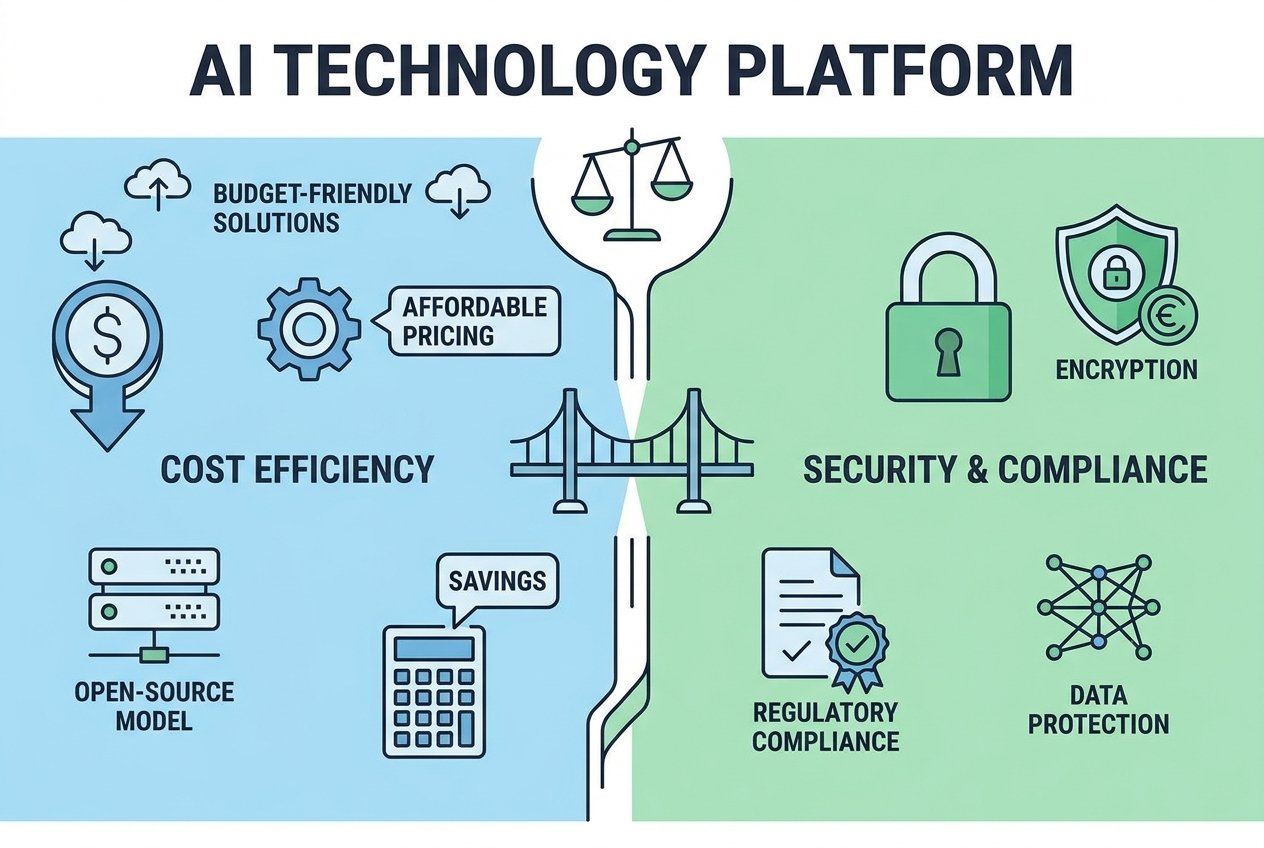
The smartest approach for most UK SMEs is not to banish cheap AI models outright, but to adopt them within a governed framework. That means understanding where inference happens, which data crosses which borders, and whether your provider can sign a UK-compliant Data Processing Agreement.
At Kaizen AI Consulting, we help British businesses design AI implementation and integration strategies that marry cost efficiency with regulatory compliance. Whether that means evaluating open-source models for self-hosted deployment, selecting GDPR-safe API providers, or building a hybrid stack that keeps sensitive data onshore, getting expert guidance early prevents costly remediation later.
Final Thoughts: Budget AI Demands Budget for Compliance
DeepSeek V4 is a remarkable technical achievement. It proves that the gap between premium Western models and cheap AI models is narrowing faster than many predicted. For UK SMEs, however, capability must be weighed against control.
If you are exploring how to capture the productivity benefits of an open source LLM without gambling on data sovereignty, speak with the team at Kaizen AI Consulting. We will help you assess your use case, audit your data flows, and build an AI roadmap that delivers results without Regulatory surprises.