OpenAI has officially unveiled GPT-5.6, its most capable family of AI models to date. On 9 July 2026, the San Francisco-based lab began a global rollout that will continue gradually over a 24-hour period, bringing three distinct variants to market: Sol, Terra and Luna. Yet whilst the headlines trumpet universal availability, the reality for British businesses is more nuanced. This article explains what the OpenAI release 2026 means in practice, why staggered AI rollout strategies are becoming the norm, and how small and medium-sized enterprises across the United Kingdom can prepare without being left behind.
Understanding the GPT-5.6 Family
GPT-5.6 is not a single model but a tiered family designed to balance capability with cost. According to OpenAI’s official announcement, GPT-5.6 is available across ChatGPT, Codex and the OpenAI API, giving developers and enterprises multiple pathways to integration. The three variants are structured as follows:
- GPT-5.6 Sol – The flagship model priced at $5 per million input tokens and $30 per million output tokens. It is optimised for complex reasoning, coding, cybersecurity research and agentic workflows.
- GPT-5.6 Terra – A balanced mid-tier option at $2.50 input and $15 output per million tokens, aimed at daily professional tasks.
- GPT-5.6 Luna – The budget-friendly entry point at $1 input and $6 output per million tokens, suitable for simpler automation and content generation.
According to TechCrunch’s launch coverage, the model family is intended to give organisations granular control over both performance and expenditure. For UK SMEs watching every penny, this tiered approach is welcome news, provided they can actually access the models.
Restricted Access: Why You Probably Cannot Use GPT-5.6 Sol Yet
Here is where the frontier model news meets commercial reality. Despite the global rollout announcement, OpenAI’s own support documentation confirms that GPT-5.6 Sol is rolling out only to eligible paid ChatGPT plans. Free users, ChatGPT Go subscribers and logged-out visitors are explicitly excluded from accessing Sol during this period.
Furthermore, business and enterprise users may find their access governed by administrator settings within managed workspaces. In other words, even if your organisation pays for a premium plan, your IT admin may need to enable the model before it appears in your interface. API access is also being phased in, meaning developers cannot always assume immediate availability.
The staggered release is not accidental. Earlier in June 2026, Reuters reported that OpenAI initially limited GPT-5.6 to a small group of trusted partners following requests from the United States government over national security concerns. CNBC confirmed the broader public launch came roughly two weeks later, after political pressure eased. This pattern of regulatory gatekeeping is likely to repeat with future frontier models, making AI model access an increasingly strategic consideration.
What Staggered Rollouts Mean for British SMEs
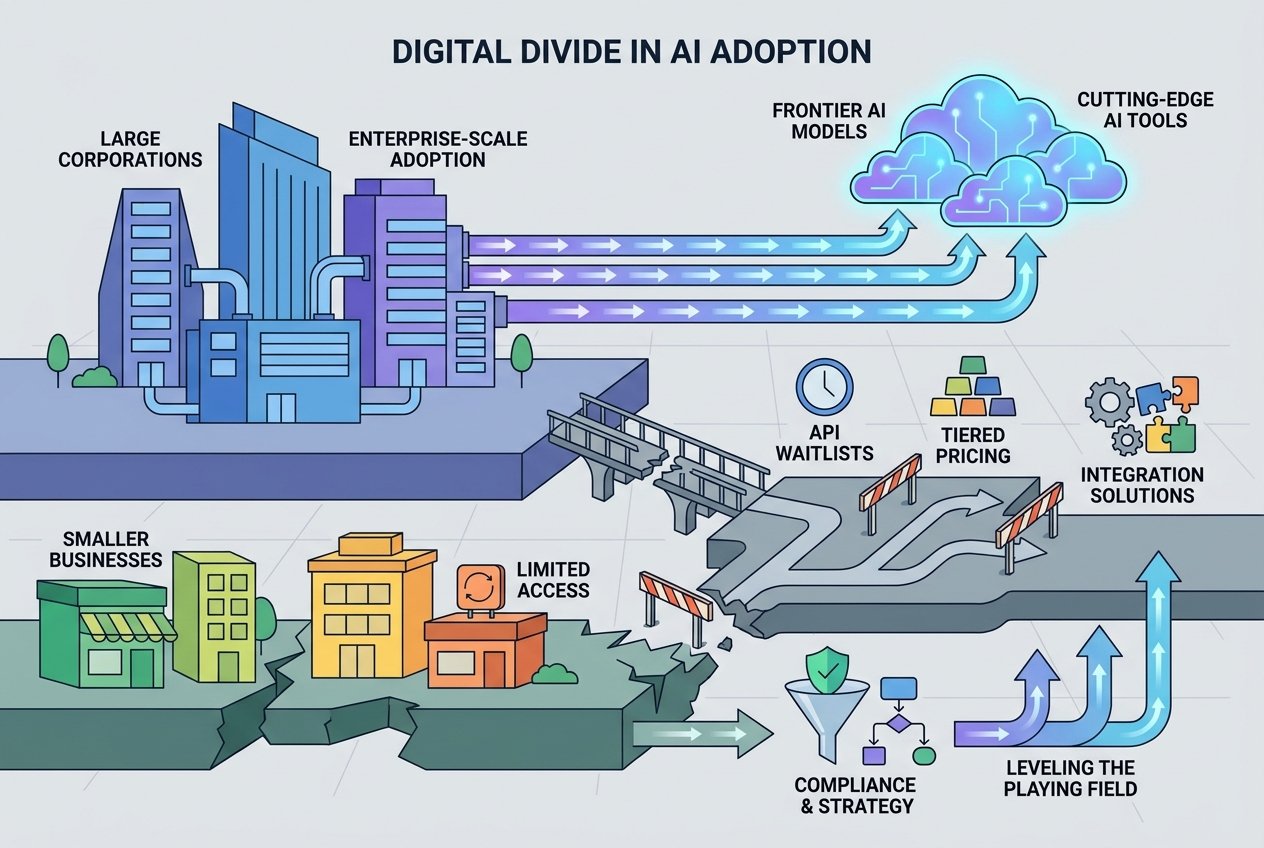
For UK small and medium-sized enterprises, staggered AI rollout strategies create a two-speed economy. Large corporates with enterprise agreements, dedicated procurement teams and direct vendor relationships typically gain first access to the most powerful tools. SMEs, by contrast, often wait for those tools to filter down through consumer plans, third-party integrations or reduced-cost tiers.
Recent data underscores the growing divide. The Department for Science, Innovation and Technology published its AI Adoption Research in January 2026, finding that around 16% of UK businesses currently use at least one AI technology. However, a March 2026 survey by the British Chambers of Commerce and Atos found that 54% of UK firms are now actively using AI, up from 35% in 2025. The disparity in figures largely reflects how AI usage is defined, but the trend is unmistakable: adoption is accelerating, yet many SMEs remain on the sidelines.
Businesses without a clear AI strategy risk watching competitors automate customer service, optimise supply chains and generate marketing content at scale, all whilst they wait for premium models to become affordable. The question is not whether AI will transform your sector, but whether you will be among the early beneficiaries or the late adopters.
Enterprise Integration and the Microsoft Angle
One route around direct AI model access restrictions is to consume frontier capabilities through platforms you already use. OpenAI announced that GPT-5.6 is now the preferred model in Microsoft 365 Copilot, meaning Word, Excel, PowerPoint and Teams users will begin encountering its capabilities via their existing subscriptions. For SMEs already embedded in the Microsoft ecosystem, this indirect path may offer the fastest route to leveraging GPT-5.6 power without navigating API keys or tiered subscriptions.
However, Copilot integration still requires a suitable licence, and custom workflows that depend on Sol-grade reasoning will likely need direct API access or bespoke development. SMEs should audit their current software stack to identify where these indirect integrations exist and where gaps remain.
Practical Steps for SMEs During a Staggered Release
If your business is eager to experiment with GPT-5.6 but lacks immediate access, consider the following practical measures:
- Audit your existing AI tools – Before chasing the newest model, evaluate whether you are extracting full value from current platforms. Many SMEs already own AI capabilities through cloud subscriptions they underutilise.
- Register for API waitlists and developer previews – OpenAI, Anthropic and Google all offer early access programmes. Having your development team on these lists can shorten the gap between announcement and deployment.
- Evaluate Luna and Terra first – The lower-tier GPT-5.6 models are substantially cheaper and may handle a large proportion of SME use cases, from drafting emails to automating social media posts.
- Review governance and data compliance – As regulatory scrutiny intensifies, ensure any AI deployment aligns with UK GDPR, the EU AI Act and sector-specific rules. Falling foul of data protection law is costlier than missing a model release.
- Leverage third-party managed services – Working with specialists who maintain enterprise relationships with OpenAI can fast-track your access and integration without requiring in-house AI expertise.
At Kaizen AI Consulting, we help SMEs across the United Kingdom navigate exactly these complexities. Our AI Implementation and Integration service is designed to bridge the gap between frontier model announcements and practical business outcomes. Whether you need to evaluate which GPT-5.6 tier fits your budget, build compliant workflows or train your staff to leverage new tools effectively, we bring the technical expertise and vendor relationships that accelerate adoption.
The Opportunity Cost of Waiting
Every staggered release creates a window where early adopters gain competitive advantage. A small e-commerce firm using GPT-5.6 to generate personalised product descriptions, analyse customer feedback and automate inventory forecasting will outperform a rival that waits six months for consumer-tier access. An accounting practice that deploys Terra for client report drafting will free senior staff for higher-value advisory work long before competitors catch up.
The challenge for SMEs is not technical ambition but operational execution. According to YouGov polling from July 2026, 31% of SME businesses currently use AI-powered tools, with another 15% planning to do so. That means over half of your competitors may still be standing still. The businesses that move decisively during staggered rollout periods will define the market for the next several years.
How Kaizen AI Consulting Supports Your AI Journey
Navigating frontier model news, tiered pricing and regulatory compliance is not core business for most SMEs. You should be focused on serving customers, developing products and growing revenue, not translating OpenAI release notes into an actionable strategy. This is where Kaizen AI Consulting adds measurable value.
Our team closely monitors announcements like the OpenAI release 2026 so our clients do not have to. We assess which model tier matches your use case, handle integration architecture, ensure data governance compliance and provide ongoing support as the technology evolves. By partnering with specialists, SMEs gain enterprise-grade access and expertise without the enterprise-grade headcount.
Ready to move beyond the headlines and put GPT-5.6 to work in your business? Contact Kaizen AI Consulting today for a complimentary consultation. We will help you cut through the complexity of staggered AI rollout strategies and build an implementation plan that delivers real results, regardless of which model tier you start with.
Conclusion
GPT-5.6 represents a significant leap in artificial intelligence capability, but its staggered AI rollout means universal access remains a promise rather than a present reality for many UK SMEs. Understanding the tiered model structure, the limitations on free and lower-tier plans, and the alternative pathways through enterprise platforms is essential for business leaders who want to stay competitive. Rather than waiting passively for access to arrive, proactive SMEs should audit their current tools, evaluate the Luna and Terra tiers, and seek expert guidance to bridge the gap between announcement and implementation. In the rapidly evolving AI landscape, those who plan ahead will be the ones who profit.