
How to Use AI Image Generation for Product Photography
The way UK businesses present their products online is undergoing a quiet revolution. AI product photos are no longer a niche experiment reserved for Silicon Valley start-ups; they are rapidly becoming a mainstream tool for e-commerce brands of every size across the country. With the UK ranking as the third-largest e-commerce market globally, generating over £127 billion in online retail sales in 2024, the pressure to stand out visually has never been greater.
Traditional product photography has long been the standard, yet the costs involved can be prohibitive, particularly for small and medium-sized enterprises. UK studios typically charge between £100 and £500 per product for basic e-commerce shots, with lifestyle imagery pushing that figure to £300 to £1,000 or more. For a business with hundreds of SKUs, those costs quickly become unsustainable. This is where image generation for business is reshaping the competitive landscape.
Why Visual Content Matters More Than Ever in E-Commerce
Before exploring the tools themselves, it is worth understanding the commercial stakes. Research consistently shows that high-quality product images achieve up to 94% higher conversion rates than their low-quality counterparts. Brands that standardise product angles and incorporate lifestyle shots report double-digit increases in conversion rates, and adding just one in-scale or contextual image has been shown to lift sales meaningfully.
With online retail now accounting for 28% of all UK retail sales and projected to continue growing, the quality of your e-commerce photography is directly tied to your bottom line. Customers cannot touch or try your products; your images must do all the persuasive work. AI-powered visual content is making it possible to produce that persuasive imagery at a fraction of the traditional cost and in a fraction of the time.
What Is AI Image Generation for Product Photography?
AI image generation for product photography refers to the use of machine learning models to create, enhance, or transform product visuals without the need for a physical photo shoot. These tools can remove and replace backgrounds, place products in lifestyle scenes, generate on-model fashion imagery, upscale low-resolution images to 4K, and even produce entirely new product visualisations from text prompts.
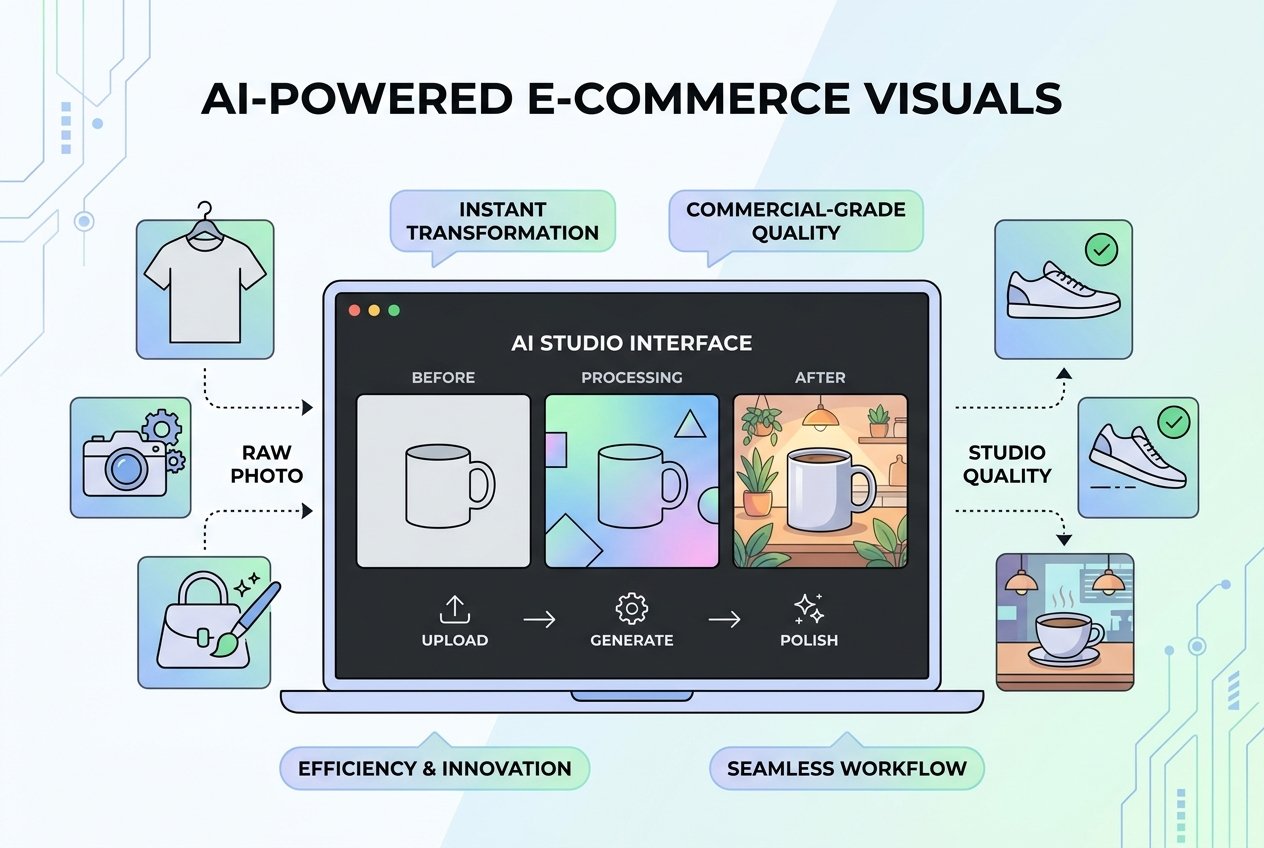
In practical terms, a business can photograph a product on a plain white surface, upload that image to an AI platform, and within minutes receive a polished set of images showing that product on a marble kitchen counter, in a sunlit living room, or in a seasonal outdoor setting. What once required a studio, a stylist, a photographer, and hours of post-production can now be achieved by a single person with a smartphone and the right software.
The Leading AI Product Photography Tools in 2026
The market for AI-driven e-commerce photography tools has matured considerably. According to a comprehensive 2026 guide from Digital Applied, the following platforms represent the current best-in-class options for UK businesses:
Claid.ai
Widely regarded as the most comprehensive all-in-one solution for high-volume catalogues, Claid.ai offers AI Photoshoot functionality, virtual model generation, background replacement, 4K upscaling, and batch API processing. It is particularly well-suited to fashion and apparel brands managing hundreds of SKUs. Pricing starts from around $9 per month, making it accessible even for growing businesses.
Photoroom
One of the most popular tools among UK small businesses and independent sellers, Photoroom offers a powerful free tier alongside paid plans from approximately $7.50 per month. Its one-tap background removal, AI-generated shadow effects, and marketplace-ready templates make it ideal for sellers on Amazon, eBay, and Etsy.
Flair.ai
Flair.ai gives users a drag-and-drop canvas interface for creative product scene staging. With access to 3D props, virtual models, and a growing library of templates, it offers precise art direction at a starting price of around $8 per month. It is particularly effective for campaign imagery and social media content.
Pebblely
Designed for speed and simplicity, Pebblely allows businesses to generate lifestyle backgrounds from standard packshots using over 90 scene templates. With a Shopify integration and pricing from $19 per month, it is an excellent entry point for brands new to AI-assisted e-commerce photography.
For businesses seeking enterprise-grade solutions, Adobe Firefly integrates with the full Creative Cloud suite and offers powerful AI image generation capabilities with strong brand consistency controls, albeit at a higher price point.
Step-by-Step: How to Implement AI Product Photography for Your Business
Integrating AI product photography into your workflow does not need to be complicated. The following process has been adopted successfully by UK e-commerce businesses across sectors from homewares to health and beauty.
Step 1: Capture a Clean Base Image
Most AI tools perform best when given a clear, well-lit photograph of your product against a plain background. You do not need professional equipment; a modern smartphone in good natural light is sufficient for most platforms. Ensure the product fills the frame and is in sharp focus. Think of this base image as the raw ingredient the AI will work with.
Step 2: Choose the Right Tool for Your Goals
Consider your volume, budget, and use case. If you are a fashion brand processing hundreds of garment images, Claid.ai offers the batch processing and virtual model capabilities you need. If you are a sole trader listing handmade goods on Etsy, Photoroom’s free tier may be all you require. Match the tool to the task rather than opting for the most feature-rich platform by default.
Step 3: Generate and Iterate Your Backgrounds and Scenes
Once your base image is uploaded, experiment with different scene types. Test a plain white background for marketplace compliance alongside a lifestyle scene for social media. Many platforms allow you to generate multiple variations simultaneously. Use A/B testing on your product listings to identify which image style drives the highest conversion rate for your specific audience.
Step 4: Upscale and Quality-Check Your Outputs
AI-generated images should always be reviewed carefully before publication. Check for inconsistencies around product edges, unusual shadows, or distorted text on packaging. Most leading platforms include automatic upscaling to ensure your images meet the resolution requirements of major marketplaces, but a human quality check remains essential.
Step 5: Build a Consistent Visual Identity
One of the most powerful advantages of AI product photography is the ability to create visual consistency at scale. Use the same background style, lighting temperature, and compositional approach across your entire catalogue. This consistency builds brand recognition and trust, two factors that are critical for converting first-time visitors into buyers.
The Real Cost Savings for UK E-Commerce Businesses
The financial case for adopting AI product photography is compelling. UK e-commerce brands have reported cost savings of between 75% and 86% on product shoots by eliminating logistics, studio hire, stylists, and post-production costs. At the enterprise level, annual AI tool subscriptions for a catalogue of 500 SKUs can cost as little as $300 to $1,200 compared to traditional photography costs that can run to £95,000 or more per year for the same volume.
For start-ups and growing businesses, this is transformative. Budget that was previously consumed by photography can be redirected into product development, marketing, or customer acquisition. The speed advantage is equally significant: AI tools can produce a full set of product images in minutes rather than the days or weeks typically required for a traditional shoot and post-production workflow.
Important Considerations and Best Practices
While the benefits of AI-driven visual content are clear, there are nuances that UK businesses should bear in mind. Authenticity remains a priority; consumers and regulators are becoming more attuned to AI-generated content, and misleading representations of product colour, texture, or scale can damage trust and generate returns. Always ensure your AI images accurately represent the physical product.
There is also an ongoing discussion about the appropriate balance between AI efficiency and professional craft. Many industry practitioners recommend a hybrid approach: using AI for catalogue essentials and rapid content generation whilst investing in professional photography for hero imagery, launch campaigns, and high-stakes brand moments where the finest detail and authenticity matter most.
Additionally, UK businesses selling on regulated marketplaces such as Amazon or ASOS should review each platform’s policies regarding AI-generated content to ensure compliance before publishing.
How Kaizen AI Consulting Can Help You Get Started
Choosing the right AI tools, establishing a consistent workflow, and integrating visual content AI into a broader digital marketing strategy can feel overwhelming, particularly if your team is new to these technologies. At Kaizen AI Consulting, we work with UK businesses to identify the AI tools that deliver real commercial value for their specific context, implement them efficiently, and build the internal capability to keep pace with a rapidly evolving landscape.
Whether you are an independent e-commerce brand looking to improve your product listings or a larger retailer seeking to streamline your entire visual content operation, our team brings the strategic insight and hands-on technical experience to help you achieve measurable results. We have supported businesses across sectors in adopting AI-driven approaches to marketing and operations, always with a focus on practical outcomes rather than technology for its own sake. Explore our AI consulting services to find out how we can support your business.
The Future of E-Commerce Photography Is Already Here
The trajectory is clear. AI product photos are moving from an optional advantage to a competitive necessity in UK e-commerce. Businesses that adopt these tools now will build the workflows, the brand consistency, and the cost efficiencies that will increasingly distinguish high-performing online retailers from those struggling to keep pace.
The opportunity is not simply to cut costs; it is to produce richer, more varied, and more contextually relevant visual content than was ever previously achievable within a reasonable budget. Lifestyle scenes, seasonal variations, localised imagery, and on-model fashion shots that once required significant investment are now within reach for businesses of any size.
If you are ready to explore how AI image generation can transform your e-commerce photography strategy, we would love to hear from you. Get in touch with the team at Kaizen AI Consulting today and let us help you build a visual content strategy that drives real commercial results.