Preparing Your Business for Agentic AI: A Practical Roadmap
Artificial intelligence is no longer simply a tool that responds to commands. In 2026, AI has evolved into something far more significant: autonomous systems capable of planning, reasoning, and taking multi-step actions without constant human input. This is the era of agentic AI, and for UK businesses, the question is no longer whether to prepare, but how quickly they can do so.
The numbers speak for themselves. The UK enterprise agentic AI market generated USD 156.6 million in revenue in 2024 and is projected to reach USD 1.35 billion by 2030, growing at a compound annual rate of 43.9%. Globally, the market has already surpassed USD 9 billion in 2026, with analysts forecasting exponential expansion over the coming years.
If your business AI strategy does not yet account for agentic systems, now is the time to build your roadmap. This guide walks you through each critical stage of AI readiness, from assessing your current capabilities to deploying and governing autonomous systems responsibly.
What Is Agentic AI and Why Does It Matter for UK Businesses?
Agentic AI refers to AI systems that can operate with a high degree of autonomy: setting sub-goals, executing multi-step workflows, interacting with external tools and data sources, and adapting based on outcomes, all with minimal human intervention. Unlike traditional AI tools that respond to a single prompt, agentic systems can manage entire processes end-to-end.
A March 2026 report from the UK Government highlighted how agentic AI is beginning to fundamentally reshape consumer-business interactions, with agents capable of handling requests, processing refunds, managing orders, and escalating issues, all without a human agent in the loop. The report also noted that by automating optimisation and follow-through, these systems have the potential to significantly reduce cognitive load for both businesses and their customers.
According to SQ Magazine, around 79% of organisations reported some level of agentic AI adoption in 2025, with 96% planning expansion in 2026. Furthermore, by the end of 2026, an estimated 40% of enterprise applications will embed task-specific AI agents, up from fewer than 5% in 2024.
For UK businesses, the window of competitive advantage is open right now. Early movers who invest in genuine agentic AI preparation will build durable operational advantages that latecomers will struggle to replicate.
Step 1: Conduct an Honest AI Readiness Assessment
Before deploying any autonomous system, businesses must understand where they currently stand. An AI readiness assessment evaluates four core dimensions: data quality and availability, technical infrastructure, governance structures, and workforce capability.
Start by asking the critical questions. Is your data clean, accessible, and well-structured? Do you have the cloud or on-premise infrastructure capable of supporting multi-step AI workflows? Is there a governance framework in place to manage AI decisions, errors, and escalations? And critically, do your people understand what agentic systems can and cannot do?
According to OneReach.ai’s 2026 Enterprise Guide, only 17% of enterprises currently have formal AI governance in place, yet those that do scale agentic deployments significantly more effectively. Building this foundation before deployment is not optional: it is the difference between a successful rollout and a costly, reputation-damaging failure.
At Kaizen AI Consulting, we work with UK businesses at precisely this stage, helping leadership teams conduct structured AI readiness assessments that identify gaps, prioritise opportunities, and create a realistic plan for moving forward. Whether you are at the very beginning of your AI journey or looking to scale existing pilots, having an expert lens on your starting point is invaluable.
Step 2: Build the Right Data and Technical Infrastructure
Agentic AI systems are only as effective as the data they are built upon. These systems require secure, high-quality data pipelines that support multi-step decision-making: reading inputs, processing context, evaluating options, taking action, and self-checking outcomes.
For UK businesses, data infrastructure planning must account for compliance requirements under UK GDPR, the Data Protection Act 2018, and, where relevant, the EU AI Act. A detailed compliance guide from Zenity published in April 2026 outlines 12 practical priorities for deploying agentic AI safely under UK and EU regulations, including narrow permission structures, deterministic operational boundaries, robust audit logging, and incident response planning.
Practically, this means businesses should:
- Audit existing data sources for quality, consistency, and coverage
- Establish secure API integrations that allow agents to interact with internal systems such as CRMs, ERPs, and databases
- Define clear permission boundaries that restrict agent actions to pre-approved scopes
- Implement comprehensive logging so every agent action can be reviewed and audited
- Design human-in-the-loop checkpoints for higher-risk decisions
Investing in the right infrastructure now prevents the expensive rework that comes with retrofitting governance and security controls onto deployed systems later.
Step 3: Develop a Governance and Risk Management Framework
One of the most critical and most frequently overlooked aspects of agentic AI preparation is governance. As AI agents begin making consequential decisions, businesses need robust frameworks that define who is accountable, how errors are escalated, and how risks are monitored over time.
The techUK report on scaling responsible adoption of agentic AI (January 2026) identifies the need for organisations to map best practices and identify levers for responsible scale. A practical governance framework for agentic AI should include:
- A defined AI ethics policy with clear principles on fairness, transparency, and accountability
- Ownership structures that assign human accountability for every agentic workflow
- Risk classification processes that identify which agent actions qualify as high-risk under UK regulatory guidance
- Continuous post-market monitoring to detect performance degradation, bias, or unintended behaviour
- Consumer protection safeguards aligned with the Competition and Markets Authority’s expectations
The UK Government’s March 2026 publication specifically notes that businesses exploring agentic AI must ensure compliance with consumer law and competition law, with a central principle of ensuring fair treatment of consumers at every stage of an autonomous interaction.
Step 4: Upskill Your People for an Agentic World
The narrative around AI and employment is complex, but one truth is consistent: businesses that invest in upskilling their people alongside deploying AI systems outperform those that do not. According to Cyntexa’s 2026 agentic AI statistics report, 40% of employers anticipate workforce changes through AI-driven automation, yet the most successful implementations frame agentic systems as augmenting human capability, not replacing it.
Effective workforce preparation for agentic AI involves three layers:
- Awareness training: Ensuring all staff understand what agentic AI is, how it works in your organisation, and what its boundaries are
- Operational training: Equipping the teams who work alongside agents, in customer service, finance, operations, and IT, with the skills to supervise, interrogate, and escalate agent decisions
- Strategic upskilling: Developing internal champions and AI leads who can drive continuous improvement of your agentic systems over time
Change management is equally important. Resistance to agentic AI often stems from misunderstanding rather than genuine objection. Building a culture of informed engagement with autonomous systems is a leadership responsibility.
Step 5: Start Small, Prove Value, Then Scale
The most common mistake businesses make with autonomous systems integration is attempting to scale too quickly without a validated proof of concept. The recommended approach, consistently echoed across industry guidance and expert frameworks, is to identify a bounded, low-risk use case, deploy a controlled pilot, measure outcomes rigorously, and then use those learnings to scale.
In the UK, sectors including financial services, telecoms, and retail and consumer goods are leading the way. Cognipeer’s April 2026 guide to AI agents in the UK highlights that telecom companies are at 48% agentic AI adoption, followed by retail and consumer goods at 47%, with financial services deploying agents across customer operations, compliance monitoring, and transaction processing.
For businesses at the beginning of this journey, strong candidate use cases include:
- Customer service triage and first-response automation
- Internal IT helpdesk ticket resolution
- Document processing, extraction, and summarisation
- Sales pipeline management and follow-up automation
- Supply chain monitoring and exception handling
When defining your pilot, set clear KPIs from the outset. Benchmark accuracy targets of 95% or above, task completion rates, time savings versus manual processes, and cost per resolution. These metrics will be essential when making the business case for broader investment.
The team at Kaizen AI Consulting specialises in helping UK businesses identify the right entry points for agentic AI, structuring pilots that deliver measurable ROI and building the internal confidence needed to scale responsibly. Our practical, hands-on approach ensures that your investment in AI translates into genuine operational improvement, not just an impressive proof of concept that never makes it into production.
Step 6: Align Your Business AI Strategy with Long-Term Goals
Agentic AI preparation is not a one-time project. It is an ongoing strategic capability that evolves alongside your business and the technology itself. As ADSP’s analysis of the top AI trends for UK organisations in 2026 notes, the businesses extracting the most value from AI are those that have embedded it into their broader strategic planning, not treated it as a siloed technology initiative.
Your business AI strategy should address:
- How agentic AI aligns with your 3-5 year business objectives
- The budgeting and investment profile for AI capability development
- How AI performance will be reported to leadership and boards
- The partnership and vendor ecosystem that will support your capabilities
- How you will stay ahead of regulatory change in the UK AI landscape
According to NVIDIA’s 2026 State of AI Report, 88% of organisations report that AI has had a meaningful impact on increasing annual revenue. By 2030, 45% of organisations are expected to be orchestrating AI agents at scale across multiple business functions. The businesses that will reach that milestone with confidence are those that start building strategic foundations today.
Your Next Step: Get Expert Guidance
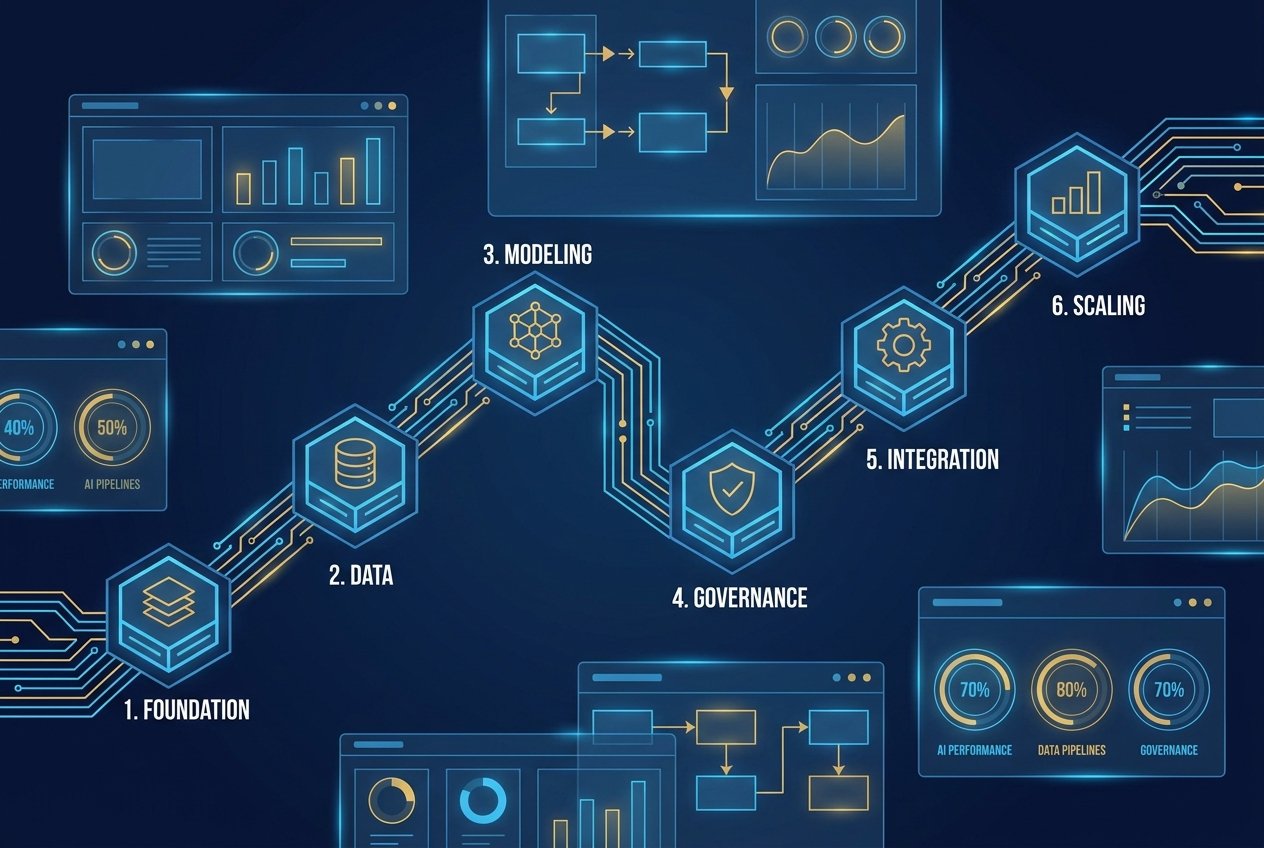
Preparing for agentic AI is a significant undertaking, but it does not have to be overwhelming. The key is to approach it methodically: assess your readiness honestly, build the right foundations, govern responsibly, upskill your people, start with proven use cases, and align everything with your long-term strategy.
If you are ready to move from curiosity to action, the team at Kaizen AI Consulting is here to help. We work with UK businesses of all sizes to develop clear, practical, and commercially grounded agentic AI strategies. From initial readiness assessments through to deployment and governance, we provide the expertise and hands-on support you need to move forward with confidence.
Ready to build your agentic AI roadmap? Get in touch with Kaizen AI Consulting today and let us help you take the next step.