The Rise of Vibe Coding and Its Security Reality
Vibe coding has transformed from an experimental curiosity into a mainstream development methodology embraced by startups and enterprises alike. By mid-2026, AI-assisted development tools are embedded in nearly every modern integrated development environment, enabling developers to ship features at unprecedented speed. Natural language prompts now generate complete modules, APIs, and user interfaces in minutes rather than days.
Yet this remarkable velocity carries a steep security cost. Recent data from the first quarter of 2026 reveals that 91.5% of vibe-coded apps had at least one AI-traceable vulnerability. A separate forensic analysis found that 92% of AI-generated codebases contained at least one critical vulnerability, with the average vibe-coded application carrying 8.3 exploitable findings at launch.
The problem is not that AI coding assistants are malicious. It is that they are optimised for functional completeness over secure design. Veracode’s Spring 2026 testing shows security pass rates remain stubbornly stuck at approximately 55%, virtually unchanged from two years prior. For UK businesses navigating strict data protection regulations and supply-chain due diligence, these figures are a wake-up call.
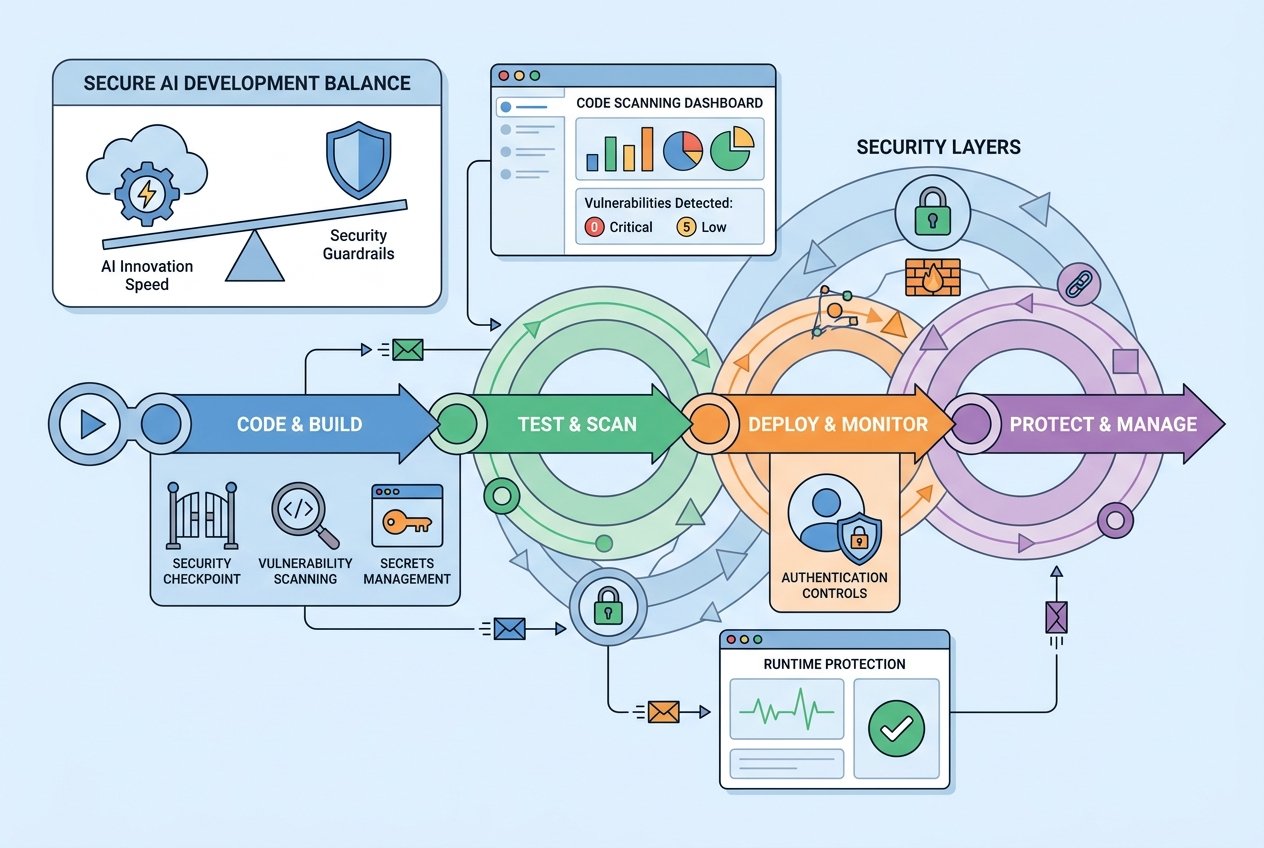
Secure vibe coding in 2026 is not about abandoning AI tools. It is about wrapping them in robust guardrails, enforcing disciplined self review, and layering security controls so speed does not compromise safety. At Kaizen AI Consulting, we work with organisations across the United Kingdom to implement exactly these protections as part of our broader digital transformation and consulting services, ensuring that AI acceleration does not become an AI liability.
1. Adopt Explicit Security Prompting
The simplest way to improve AI output is to tell the model precisely what you require. Vague prompts produce vague code. When you ask an assistant to build an authentication endpoint without specifying input validation, parameterised queries, or rate limiting, you invite predictable vulnerabilities.
Security prompting means including concrete constraints in every request. Specify OWASP-aligned requirements. Demand secrets be read from environment variables, never hard-coded. Ask for output encoding by default. Veracode’s research confirms that security degrades sharply when explicit guidance is absent, which explains why 45% of AI-generated code fails OWASP Top 10 benchmarks.
Building Your Prompt Library
Build a prompt library for your team that pre-frames common tasks with security requirements. Treat it as a living document that evolves with your threat model. Over time, this discipline compounds into measurably safer output.
2. Enforce Automated Scanning in CI and CD
Manual code review cannot keep pace with AI-generated volume. If your pipeline does not automatically scan every commit, you are flying blind. Static application security testing, software composition analysis, and secret-detection scanners must run before any merge is permitted.
The statistics justify the urgency. Mandiant’s M-Trends 2026 report found that 28.3% of CVEs were exploited within 24 hours of disclosure. Attackers move faster than ever, which means your defences must shift left and operate continuously. Automated scanning acts as your first line of defence, catching known vulnerabilities before they reach production.
Tooling Integration
Integrate SAST and SCA tools that understand your stack. Ensure scan results block merges by default rather than appearing as optional warnings that busy developers ignore.
3. Implement Human Review Gates for Sensitive Paths
Not all code carries equal risk. Authentication, authorisation, payment processing, and personal data handling deserve heightened scrutiny. AI-generated code touching these areas should never bypass senior review, no matter how clean it appears.
Establish a risk-based review matrix. Low-risk utility functions may pass through automated checks alone, but any change to sensitive paths requires a qualified engineer to verify logic, boundary cases, and security properties. This hybrid approach preserves velocity where it is safe and demands rigour where it matters.
Clear Escalation Pathways
Define escalation pathways so developers know when to flag code for security team review. Ambiguity leads to assumptions, and assumptions in security-critical code lead to incidents.
4. Lock Down Secrets Management
AI assistants have a troubling habit of embedding secrets directly into source code. The 2026 Sherlock Forensics report revealed that 78% of AI-generated code stored secrets in plaintext or committed dot-env files. GitGuardian’s 2026 findings show AI-assisted commits leak secrets at more than double the baseline rate.
Your guardrails must make secret leakage mechanically impossible. Use pre-commit hooks that block credentials. Scan repositories continuously for exposed keys. Rotate secrets automatically and store them in dedicated vaults. Never allow an AI tool to generate placeholder credentials that look real enough to be mistaken for production values.
The Zero-Hardcoded Rule
Institute a zero-hardcoded-secrets policy with automated enforcement. If a scanner can detect it, so can an attacker. Secrets belong in managed vaults, never in version control.
5. Verify Every Dependency Rigorously
Modern applications rely on open-source packages, and AI coding assistants frequently hallucinate dependencies or suggest outdated, vulnerable libraries. The Sherlock Forensics study found that 34% of AI-generated Node.js projects contained hallucinated package dependencies. Meanwhile, the average codebase now carries hundreds of open-source vulnerabilities.
Require every suggested dependency to be verified against the official registry. Pin exact versions in lock files. Run software composition analysis on every build. If your AI tool recommends a package you have never heard of, treat it with suspicion until proven legitimate.
Supply-Chain Hygiene
Supply-chain attacks are rising. A single compromised dependency can undermine your entire application. Make dependency verification a mandatory checkpoint, not an optional courtesy.
6. Build Prompt-Injection Defences
Attack surfaces have expanded beyond the code itself into the toolchain. OWASP’s Q1 2026 round-up warned that prompt injection has evolved into a practical enterprise data-leakage vector. Third-party AI integrations, browser agents, and multi-step reasoning tools can be manipulated to exfiltrate source code or sensitive context.
Isolate untrusted context from trusted instructions. Restrict tool permissions so that even a compromised prompt cannot access production databases or external APIs without explicit approval. Monitor AI agent activity for anomalous behaviour. The same guardrails you apply to human users should govern AI agents.
Agent Permissions
Apply the principle of least privilege to AI agents. If an agent does not need access to a system, remove that access. Reduce the blast radius of any potential compromise.
7. Strengthen Authentication and Authorisation
Basic security controls are conspicuously absent from much AI-generated code. The same forensic research found that only 12% of AI-built applications implemented rate limiting on authentication endpoints. This leaves brute-force attacks trivially easy.
When vibe coding authentication flows, explicitly require multi-factor authentication, account lockout policies, secure session management, and granular authorisation checks. Do not assume the AI has included these by default. Verify that password reset flows resist enumeration attacks and that administrative functions are segregated from standard user capabilities.
Rate Limiting
Rate limiting is not merely a performance optimisation. It is a fundamental security control that protects your authentication surface from automated attack. Ensure it is present, tested, and monitored.
8. Make Self Review a Non-Negotiable Habit
Self review is the discipline of reading, understanding, and critiquing AI-generated code before accepting it. It sounds obvious, yet the pressure to ship quickly often overrides caution. In 2026, self review is not a luxury; it is a survival skill.
Ask yourself whether you could explain every line to a colleague. Check for off-by-one errors, missing null checks, and implicit trust of user input. Look for hard-coded values that should be configurable. If the code generates SQL, confirm it uses parameterisation. At Kaizen AI Consulting, we train engineering teams to treat self review as a structured quality gate, not an afterthought.
Self Review Checklist for Vibe Coding 2026
Before merging any AI-generated change, confirm input validation is present, secrets are externalised, dependencies are verified, error handling is graceful, and logging does not leak sensitive data. A simple checklist enforced consistently prevents the majority of common vulnerabilities.
9. Maintain Pre-Merge Policy Gates
AI-generated code must never bypass the same review, testing, and security criteria applied to human-written code. In fact, many organisations now apply stricter rules to AI contributions. Pre-merge policy gates enforce this consistently.
Configure your version control platform to require passing build checks, security scans, and at least one peer review for every pull request. Block direct pushes to main branches. Require signed commits where possible. These mechanical controls remove the temptation to skip steps when deadlines loom.
Consistency Builds Culture
Inconsistent enforcement erodes security culture. If policy gates are optional for senior developers or emergency fixes, they will be optional for everyone. Consistency builds trust and resilience.
10. Treat AI Output as Accelerated Prototyping
The most effective mindset shift in vibe coding 2026 is to view AI output as sophisticated scaffolding rather than finished architecture. It gets you to a working demo faster than ever, but production readiness demands refinement.
Factor the code for maintainability. Add observability. Harden configurations. Write tests that cover both success and failure paths. Document assumptions and constraints. The organisations that thrive are those that use AI to amplify human expertise, not replace engineering judgment.
Final Thoughts: Security as a Competitive Advantage
The businesses that master secure vibe coding in 2026 will outpace competitors who either reject AI entirely or accept it uncritically. Security guardrails, automated scanning, disciplined self review, and human oversight together create a development culture that is fast and resilient.
If your organisation is scaling AI-assisted development and needs expert guidance on implementing these essentials, Kaizen AI Consulting is here to help. Our AI implementation and integration services are designed to embed security into every layer of your software lifecycle, protecting your data, your customers, and your reputation. Contact Kaizen AI Consulting today to discuss how we can secure your next project.