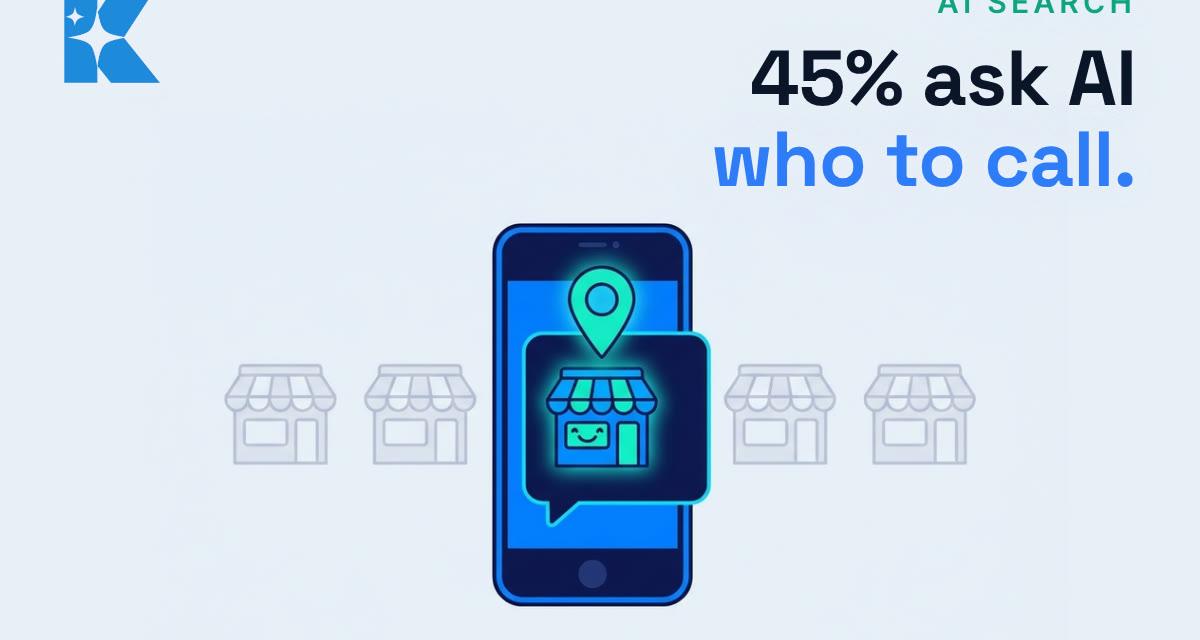
Around 45% of consumers now use AI tools to find local services, up from 6% a year earlier. That is the headline from BrightLocal's 2026 Local Consumer Review Survey, as reported in coverage of the study. The survey is not UK-only and we have only seen it through secondary write-ups, so treat the exact figure with care. The direction of travel is hard to argue with: people are asking ChatGPT, Gemini and Perplexity who to call, and a small business that never gets named simply does not exist in that answer.
This is not a post about panic. It is about a short list of things that are cheap to check this week, because the businesses that get named by AI tools tend to have the basics in place and the ones that do not are invisible.
What the numbers say about being recommended
SOCi's 2026 Local Visibility Index looked at roughly 350,000 business locations across 2,751 multi-location brands. It found that ChatGPT recommended about 1.2% of those locations, against around 36% that appeared in Google's local 3-Pack. Gemini recommended about 11% and Perplexity about 7.4%. You can read the summary on Localogy.
Two cautions. These are large multi-location brands, mostly outside the UK, so a single-site UK plumber or salon is not guaranteed to see the same split. And the report comes from a software vendor that sells local visibility tools. Even so, the shape is clear: AI assistants give far fewer names than a map pack does, so there is less room to be second best.
A separate study by Local Falcon, built on almost 190,000 ChatGPT results from February 2026, found 83% of restaurants did not appear at all in ChatGPT's answers, against 14% invisible on Google. That one is US restaurants, so again it is a signal, not a UK forecast. The write-up is on the Local Falcon blog.
Google and AI do not always agree
BrightLocal's 2026 Local AI Visibility Study, which covered 1,355 businesses across the US, UK and Australia, reported only about a 50% overlap between the businesses recommended on Google Maps and those recommended in AI chat. It also found the same business reappeared only about half the time when the same question was asked again. In plain English, ranking well on Maps does not guarantee a mention, and a mention today may not repeat tomorrow. BrightLocal publishes more on its local AI visibility page.
The same coverage notes that different tools lean on different sources. Google's own AI answers draw heavily on Google Business Profile, while ChatGPT leaned more on review and directory sites. We have not verified that split ourselves, but it points to the same advice either way: be consistent in more than one place.
Six checks you can do this week
None of this needs a developer. It needs an hour and a clear head.
1. Ask the tools about yourself
Open ChatGPT, Gemini and Perplexity and ask, in the words a customer would use, "who is a good [your trade] near [your town]". Write down who gets named, in what order, and what is said about them. Ask it three times, because the answers move around. This is your baseline.
2. Fix your Google Business Profile first
Your name, address, phone number, opening hours, categories and services should be complete and match your website exactly. It is the single most cited local source in Google's own AI answers, according to the BrightLocal coverage, and it costs nothing.
3. Make your details identical everywhere
Check your website, Facebook, Yell, Checkatrade or whichever directories matter in your trade. A different phone number or a spelling variation makes a business look less certain to a machine reading all of them.
4. Put the answer on your website in plain words
If customers ask "do you cover Reading" or "how much is a boiler service", write a short page that answers it in the first sentence. AI tools quote pages that state things clearly.
5. Collect real reviews and reply to them
Reviews are text that describes what you do and where. Ask recent customers for an honest review that mentions the job and the area, and reply to each one. Never buy or fake reviews.
6. Re-check once a month
Repeat step 1 on the first of the month and keep the notes in one document. You are looking for movement, not perfection.
A prompt to run the first check faster
Paste this into Claude or ChatGPT with your own details filled in. It will not know your market, so treat the output as a checklist, not a verdict.
I run a [type of business] in [town, UK]. Act as a customer asking an AI assistant for a recommendation. Write 8 different questions a local customer might ask to find a business like mine. Then list the 10 facts about my business that an AI would need to see clearly on my website and Google Business Profile to recommend me, and mark which ones a typical small business forgets.
What this could be worth
Here is illustrative arithmetic, not a forecast. If you get 20 enquiries a month and a quarter of them come from people who asked an AI first, that is 5 enquiries. At an average job value of £150, 5 enquiries is £750 of potential work a month that depends on being named. Swap in your own numbers. If the basics above lift your chance of being named even a little, the hour is cheap by comparison.
What we would tell a client
We have not run a controlled test of what gets a UK business recommended, and nobody else has published one we would rely on yet. What we would do is the boring, cheap work first: complete profile, consistent details, clear answers on the website, genuine reviews, and a monthly check. If you would like a second pair of eyes on how AI tools describe your business, we offer a free 30 minute AI audit.


