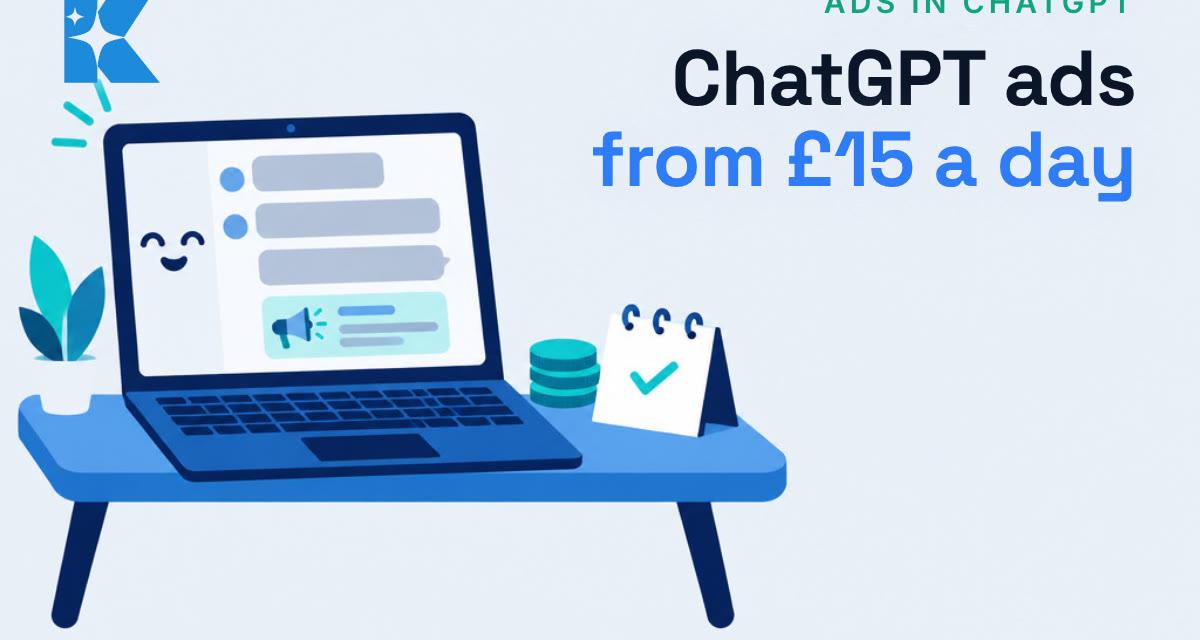
ChatGPT now lets UK businesses buy adverts, and the entry price is lower than most owners assume. Anicca Digital, a UK agency that trialled the platform, reports a minimum daily budget of £15. We have not run a campaign ourselves, so this is not a review. It is what we would tell a client who asks whether to try it, based on the early numbers other people have published.
What you can actually buy
Anicca's UK trial write-up describes a platform that looks familiar if you have used Google or Meta ads, with thin reporting. As of July, only awareness and traffic objectives were available, and conversion tracking was listed as "coming soon". Their account also says ad text is cut short aggressively, so a long headline simply gets chopped. Write the short version first.
The pricing is the part to treat carefully. Anicca reports a £15 minimum daily budget, a recommended starting CPM (the price per thousand times your advert is shown) of £45, and a suggested £500 test budget for a one week campaign. A separate check of OpenAI's help centre on 8 October by UK consultancy Whito found the £15 daily minimum but no published CPM rate and no minimum spend commitment for self-serve accounts, and argued the £45 and £60 figures circulating in UK coverage are an agency's own numbers or converted US pilot prices. In plain terms: £15 a day is the number we can stand behind, and the rest is one agency's experience.
What early results look like
The honest answer is thin. A nine day test by Syntermedia in early June put UK click-through at 0.72% and cost per click at $5.10, from $331.73 of spend, 65 clicks and about 8,989 impressions. Their own write-up on ChatGPT ads real data is a small sample, and 65 clicks is not enough to build a plan on.
Adthena data reported by Campaign under the headline "Still finding its feet" showed one client at a 0.91% click-through rate, against a 6.4% benchmark for traditional Google search in the same sector. That is the uncomfortable number. People are asking ChatGPT questions, not scanning for adverts, and an advert beside an answer is competing with the answer.
Cost per click is also unsettled. Reports range from under $3 to $10 to $13, and PPC Land reported UK CPCs swinging 278% with no explanation. If the price moves that much, a budget based on last month's number is a guess.
What we would tell a client
First, treat it as a test with a ceiling, not a channel. £15 a day is about £105 a week. Decide that figure in advance, and decide what you will do if it produces nothing. A test you cannot lose more than £100 on is cheap. A test with no cap is not.
Second, send every click to one page that does one thing. With conversion tracking not yet available, you cannot lean on the platform to tell you what worked. A single landing page with a phone number or a booking form lets you count enquiries yourself, in whatever you already use. Write the number down before you start and again after a week.
Third, judge it on enquiries, not clicks. At a 0.72% click rate and a few dollars a click, a click is not the prize. If 65 clicks produce no calls, that is useful information for £330. If they produce two jobs, you have a channel to watch.
Fourth, write for being cut off. Put the point in the first few words: what you do, where, and the one reason to click. If the sentence still works with the second half missing, it is ready.
Fifth, keep your existing channels running. Nothing here suggests ChatGPT ads should replace Google Business Profile, search ads or word of mouth. The early evidence is that click-through is lower than search, and the audience is asking questions rather than shopping. The case for trying it is curiosity at a price you can afford, not a promise of better results.
Who it might suit, and who should wait
A capped test makes most sense for a business where one new customer is worth a few hundred pounds, such as a local service firm, a specialist retailer or a consultancy. At roughly £5 a click, you only need a handful of enquiries from a hundred clicks for the maths to work. It makes less sense for low-value, high-volume products, where the same click cost eats the margin before the customer has bought anything.
It also suits people who already know what their search adverts cost. If you run Google ads, you have a benchmark: your current cost per enquiry. Put the ChatGPT figure next to it after a week and the decision makes itself. If you have never run paid adverts, start with the free options first, such as a complete Google Business Profile, because they cost nothing and the evidence for them is much stronger.
The trade-off
The risk is not the £15. It is the time spent learning a platform whose reporting is thin and whose prices are still moving. If you have a marketing budget at all, a small capped test is reasonable. If you have no spare hour a week to check it, skip it for now and revisit when conversion tracking arrives.
We will keep watching how the numbers settle. If you want a second pair of eyes on whether a capped test makes sense for your business, our free 30 minute AI audit is the place to start.
Sources: Anicca Digital UK trial; Syntermedia nine day test; Campaign and Adthena; PPC Land; Whito analysis of OpenAI help centre pricing. Figures are from third-party reports, not OpenAI's own pricing page, and may have changed.


