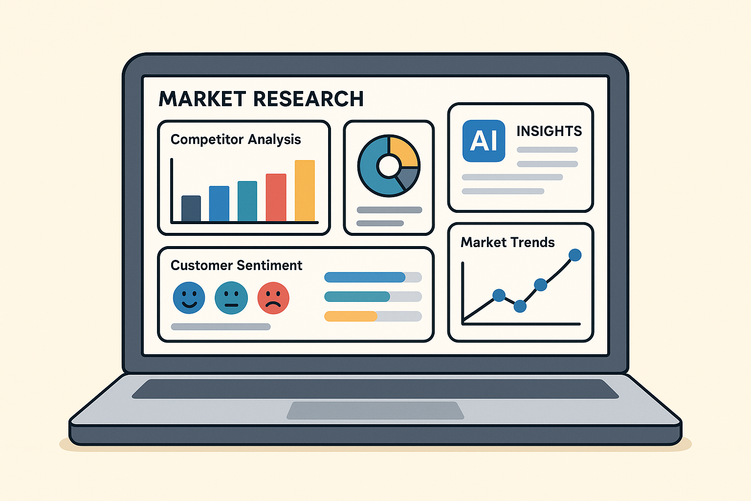
Market research has traditionally been the domain of large corporations with substantial budgets. However, the emergence of artificial intelligence has democratised access to powerful market insights, enabling small businesses to compete on a more level playing field. With AI market research tools now widely available, even organisations operating on limited budgets can access sophisticated analytics that were once prohibitively expensive.
According to recent data from Statista, the global AI market is projected to reach £1.3 trillion by 2030, with a significant portion of this growth driven by accessible business intelligence tools. For UK small businesses, this presents an unprecedented opportunity to leverage technology that can provide competitive advantages without breaking the bank.
Understanding AI-Powered Market Research
AI market research refers to the application of machine learning algorithms, natural language processing, and predictive analytics to gather, analyse, and interpret market data. Unlike traditional research methods that require manual data collection and analysis, AI analytics can process vast amounts of information in seconds, identifying patterns and trends that might otherwise remain hidden.
The beauty of modern business research AI lies in its accessibility. Cloud-based platforms have eliminated the need for expensive infrastructure, whilst freemium models and tiered pricing structures mean businesses can start small and scale as needed. This shift has been particularly beneficial for UK SMEs, which comprise 99.9% of the business population according to government statistics.
Essential AI Tools for Budget-Conscious Research
Social Listening and Sentiment Analysis
Social media platforms contain a wealth of consumer insights, and AI-powered social listening tools can help you tap into these conversations without requiring a large research team. Affordable research tools like Brandwatch, Mention, and Hootsuite Insights use natural language processing to analyse mentions of your brand, competitors, and industry keywords across social platforms.
These tools can track sentiment, identify emerging trends, and highlight potential issues before they escalate. Many offer entry-level packages starting from as little as £50 per month, making them accessible for businesses of all sizes. The key is understanding which metrics matter most to your specific business objectives.
Competitor Intelligence Platforms
Understanding your competitive landscape is crucial for strategic planning. Market intelligence AI tools such as SimilarWeb, SEMrush, and SpyFu provide detailed insights into competitor website traffic, keyword strategies, and digital marketing activities. These platforms use machine learning to aggregate data from multiple sources, offering a comprehensive view of your market position.
Research from McKinsey indicates that organisations using AI for competitive intelligence are 2.3 times more likely to identify market opportunities ahead of competitors. For small businesses, this predictive capability can be the difference between leading the market and playing catch-up.
Customer Survey and Feedback Analysis
Tools like Typeform, SurveyMonkey, and Google Forms have integrated AI capabilities that go beyond simple data collection. They can analyse open-ended responses, identify common themes, and even predict customer behaviour based on response patterns. This eliminates hours of manual coding and analysis whilst providing deeper insights into customer preferences.
Implementing AI Market Research: A Practical Framework
Step 1: Define Your Research Objectives
Before investing in any AI analytics platform, clearly articulate what you need to learn. Are you trying to understand customer pain points? Identify new market segments? Track brand perception? Specific objectives will help you select the most appropriate tools and avoid paying for features you do not need.
Working with experienced consultants like Kaizen AI Consulting can help you establish a focused research strategy that maximises ROI whilst minimising unnecessary expenditure on tools and platforms.
Step 2: Start With Free and Freemium Tools
Many powerful AI market research platforms offer free tiers or trial periods. Google Trends, Answer the Public, and ChatGPT can provide valuable market insights at zero cost. These tools are particularly useful for keyword research, identifying trending topics, and understanding search behaviour in your target market.
For UK businesses, Google Trends can reveal regional variations in search patterns, helping you tailor your offerings to local preferences. According to Think with Google, search trends can predict consumer behaviour with up to 80% accuracy when properly analysed.
Step 3: Leverage APIs for Custom Solutions
If you have basic technical capabilities or can access affordable development resources, API access to platforms like Twitter, Reddit, and news aggregators can provide cost-effective data collection. Many APIs offer free tiers with generous usage limits, perfect for small-scale research projects.
Open-source AI libraries such as Python’s NLTK, spaCy, and scikit-learn enable sophisticated text analysis and predictive modelling without licensing fees. Whilst there is a learning curve, online resources and communities make self-education increasingly accessible.
Step 4: Automate Data Collection and Reporting
Time is money, particularly for small businesses where staff often wear multiple hats. Business research AI excels at automation, turning what might be days of manual work into minutes of automated processing. Tools like Zapier and Make can connect different platforms, creating workflows that automatically collect, process, and report on market data.
For example, you could set up an automated system that monitors competitor pricing, tracks customer reviews, and compiles weekly reports, all without manual intervention. This frees up your team to focus on strategic decision-making rather than data wrangling.
Maximising Value From Budget AI Market Research
Focus on Actionable Insights
The goal is not to collect data for its own sake but to generate insights that drive business decisions. When evaluating affordable research tools, prioritise those that provide clear, actionable recommendations rather than just raw data. Look for platforms with strong visualisation capabilities that make complex data accessible to non-technical stakeholders.
Combine Multiple Data Sources
The most powerful market intelligence AI strategies integrate data from multiple sources. Cross-referencing social media sentiment with search trends, customer feedback, and competitor activity provides a more complete market picture than any single source could offer. This triangulation approach also helps validate findings and reduce the impact of data anomalies.
Invest in Training and Development
The most sophisticated tools are only as effective as the people using them. Allocate part of your budget to training staff on AI analytics platforms and data interpretation. Many tool providers offer free webinars and certification programmes. Additionally, platforms like Coursera and LinkedIn Learning provide affordable courses on data analysis and AI applications.
Common Pitfalls to Avoid
Whilst AI market research offers tremendous potential, there are several traps that budget-conscious businesses should avoid. Firstly, resist the temptation to purchase tools with features you do not need simply because they seem impressive. Feature bloat often comes with price bloat, and you will achieve better results with simpler tools used effectively.
Secondly, be wary of data quality issues. AI algorithms are only as good as the data they process. Ensure your data sources are reliable and representative of your target market. A common mistake is over-relying on social media data, which may not accurately represent your broader customer base, particularly for B2B businesses.
Finally, remember that AI analytics should inform decisions, not make them. Human judgement remains essential for contextualising findings and considering factors that algorithms might miss. The most successful businesses use AI to augment human intelligence, not replace it.
How Professional Guidance Can Accelerate Results
Whilst DIY AI market research is increasingly accessible, there is significant value in professional expertise, particularly when establishing your research infrastructure. Kaizen AI Consulting specialises in helping UK businesses implement cost-effective AI solutions that deliver measurable results. Our team can audit your current research capabilities, recommend appropriate tools for your budget and objectives, and provide training to ensure your team can maximise their investment.
We understand that small businesses need to see clear ROI from every pound spent. Our approach focuses on quick wins that demonstrate value whilst building towards more sophisticated capabilities over time. Whether you need help selecting the right platforms, integrating data sources, or interpreting results, we provide practical support that fits your budget.
The Future of Accessible Market Research
The trajectory of AI technology suggests that market research will become even more accessible and affordable in coming years. Generative AI platforms like ChatGPT and Claude are already being used for qualitative research analysis, competitor monitoring, and trend forecasting. As these tools evolve, the barrier to entry for sophisticated market intelligence will continue to fall.
For forward-thinking UK businesses, now is the time to develop AI literacy and establish research capabilities. According to PwC research, AI could contribute up to £232 billion to the UK economy by 2030, with much of this value coming from productivity gains in business processes like market research.
Taking Action: Your Next Steps
Starting your AI market research journey does not require a massive upfront investment. Begin by identifying your most pressing business questions, then experiment with free tools to see what insights you can uncover. As you gain confidence and demonstrate value, gradually expand your toolkit and capabilities.
Document your findings and share them with stakeholders to build support for further investment in AI analytics. Even modest successes, such as identifying a new customer segment or spotting a competitor weakness, can justify expanding your research capabilities.
If you are ready to harness the power of AI market research but are not sure where to start, Kaizen AI Consulting is here to help. We offer consultations to assess your needs and recommend a roadmap that aligns with your budget and business objectives. Our goal is to help you compete more effectively by making data-driven decisions based on solid market intelligence.
The democratisation of AI technology means that budget constraints no longer need to be a barrier to sophisticated market research. With the right tools, strategy, and support, small businesses can access insights that rival those available to much larger competitors. The question is not whether you can afford to implement AI market research, but whether you can afford not to.