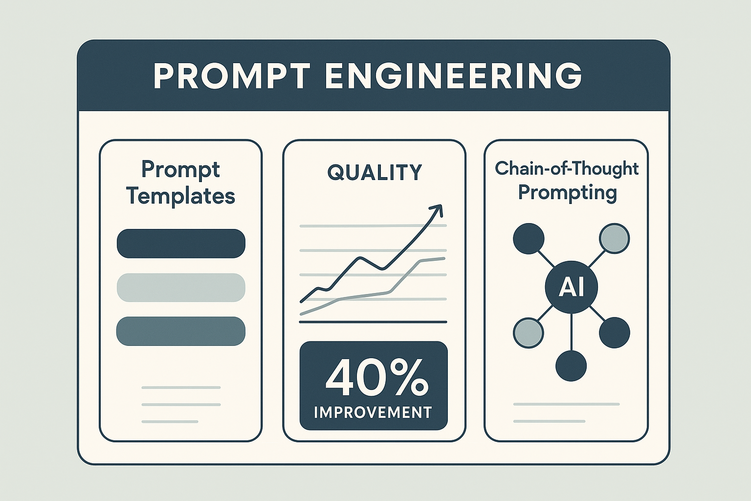
As artificial intelligence continues to reshape the business landscape, one skill has emerged as critical for maximising AI effectiveness: prompt engineering. This technical discipline, which involves crafting precise instructions for AI systems, has become an essential capability for organisations seeking to leverage AI tools effectively. According to PwC research, businesses that implement structured AI prompting techniques see up to 40% improvement in output quality and relevance.
Whether you’re deploying chatbots, automating content creation, or implementing AI-driven analytics, understanding prompt engineering can transform your results from mediocre to exceptional. This technical guide explores the principles, techniques, and business applications that UK companies need to master.
What Is Prompt Engineering?
Prompt engineering is the systematic practice of designing, refining, and optimising inputs (prompts) to elicit desired outputs from AI language models. Unlike casual interactions with AI tools, professional prompt engineering applies structured methodologies to achieve consistent, high-quality results that align with specific business objectives.
The discipline combines elements of computational linguistics, logic design, and domain expertise. At its core, effective prompt engineering requires understanding how AI models interpret instructions, context, and constraints. Research from Stanford University demonstrates that well-engineered prompts can improve task performance by 25-50% compared to basic queries.
The Economic Impact of Prompt Optimisation
For UK businesses, the financial implications of prompt engineering are substantial. Poor prompting leads to wasted API calls, increased processing time, and outputs requiring extensive human revision. Conversely, optimised prompting reduces costs whilst improving accuracy. McKinsey analysis indicates that enterprises implementing advanced AI techniques including prompt optimisation achieve 30% faster deployment timelines and 35% lower operational costs.
Core Principles of Effective Prompt Engineering
1. Clarity and Specificity
Vague prompts generate vague outputs. Effective prompt engineering begins with crystal-clear instructions that leave no room for ambiguous interpretation. Rather than asking an AI to “write about marketing”, a well-engineered prompt specifies: “Create a 300-word analysis of email marketing ROI for UK B2B technology companies, including three specific metrics and one case study example.”
Specificity extends to format requirements, tone parameters, and contextual boundaries. Each additional constraint guides the AI towards outputs that require minimal revision, saving time and resources across your organisation.
2. Context Provision
AI models perform significantly better when provided with relevant context. This might include background information about your industry, target audience characteristics, or previous related content. Context framing helps the AI understand the broader picture and generate responses that align with your business environment.
For UK businesses, context might specify regional considerations such as GDPR compliance, British terminology preferences, or market-specific challenges. This contextual grounding ensures outputs are immediately applicable rather than requiring localisation.
3. Role Assignment
Instructing the AI to adopt a specific role or persona significantly improves output relevance. Rather than treating the AI as a generic tool, assign it expertise: “As a senior financial analyst specialising in UK SME lending, evaluate this business proposal.” This technique leverages the model’s training to access domain-specific knowledge and appropriate communication styles.
Advanced AI Techniques for Business Applications
Chain-of-Thought Prompting
This advanced technique involves instructing the AI to show its reasoning process step-by-step. Particularly valuable for complex analytical tasks, chain-of-thought prompting improves accuracy whilst providing transparency into the AI’s logic. Research published in Nature demonstrates that this method increases problem-solving accuracy by up to 37% for multi-step reasoning tasks.
For businesses, this means more reliable outputs for tasks such as financial modelling, strategic analysis, and risk assessment. The explicit reasoning also makes it easier to identify and correct errors.
Few-Shot Learning
Few-shot prompting provides the AI with several examples of desired outputs before requesting the actual task. This technique is particularly effective for maintaining consistent formatting, tone, and structure across large volumes of content. By showing the AI 2-3 examples of properly formatted reports, you can generate dozens more with matching style and structure.
UK enterprises leveraging few-shot learning for content generation report 60% reduction in editing time and significantly improved brand voice consistency across AI-generated materials.
Iterative Refinement
Professional prompt engineering rarely achieves perfection on the first attempt. The process involves systematic testing, evaluation, and refinement. Document what works, analyse failures, and continuously optimise your prompt library. This iterative approach builds institutional knowledge and creates reusable assets that improve efficiency over time.
Implementing Prompt Engineering in Your Organisation
Successful implementation requires more than understanding techniques; it demands systematic integration into business processes. Start by identifying high-value use cases where AI can deliver measurable impact, then develop standardised prompts for these applications.
Kaizen AI Consulting specialises in helping UK businesses develop comprehensive prompt engineering frameworks tailored to specific industry requirements. Our approach combines technical expertise with deep understanding of business objectives, ensuring that AI implementations deliver tangible ROI from day one.
Building a Prompt Library
Create a centralised repository of tested, optimised prompts organised by function and department. This library becomes a strategic asset, enabling consistent quality across teams whilst reducing the learning curve for new AI users. Include documentation noting performance metrics, common pitfalls, and recommended modifications for different scenarios.
Training and Governance
Whilst AI democratises access to powerful capabilities, prompt engineering requires skill development. Invest in training programmes that teach employees not just how to write prompts, but how to think systematically about AI interactions. Establish governance frameworks that ensure quality control whilst encouraging experimentation and innovation.
Common Prompt Engineering Pitfalls
Even experienced practitioners encounter challenges. Understanding common mistakes helps you avoid costly errors and accelerate your learning curve.
Overcomplication
Whilst specificity improves results, overly complex prompts can confuse AI models or introduce conflicting instructions. Strike a balance between detail and clarity. If a prompt exceeds 500 words, consider breaking it into multiple sequential prompts or simplifying your requirements.
Neglecting Output Validation
AI outputs require verification, particularly for business-critical applications. Never deploy AI-generated content without human review. Establish validation protocols that check for accuracy, brand alignment, and regulatory compliance. This is especially crucial for UK businesses operating under strict data protection and industry-specific regulations.
Ignoring Bias and Limitations
AI models reflect biases present in their training data. Prompt engineering can mitigate but not eliminate these biases. Be especially vigilant when using AI for decisions affecting hiring, lending, or customer segmentation. Build bias-checking mechanisms into your prompt engineering workflow.
Measuring Prompt Engineering Success
Effective measurement requires establishing clear metrics aligned with business objectives. Track output quality scores, revision rates, time savings, and cost per interaction. Forrester research suggests that organisations measuring AI performance systematically achieve 2.5 times greater ROI than those relying on subjective assessments.
Compare performance across different prompt variations through A/B testing. Document which approaches yield superior results for specific use cases, then standardise these practices across your organisation.
Industry-Specific Applications
Financial Services
Banks and financial institutions use prompt engineering for risk assessment automation, compliance documentation, and customer communication personalisation. Properly engineered prompts ensure outputs meet FCA requirements whilst maintaining appropriate tone and accuracy.
Retail and E-commerce
Product description generation, customer service automation, and personalised marketing content benefit enormously from optimised prompting. UK retailers implementing advanced AI techniques report 45% improvement in conversion rates for AI-enhanced product pages.
Professional Services
Law firms, consultancies, and accounting practices leverage prompt engineering for document analysis, research summarisation, and client communication drafting. The ability to maintain professional standards whilst accelerating workflows provides significant competitive advantage.
The Future of Prompt Engineering
As AI models evolve, prompt engineering techniques must adapt. Emerging capabilities such as multi-modal processing (combining text, images, and data) and extended context windows create new opportunities whilst introducing fresh complexities. Staying current with prompt optimisation best practices will remain essential for businesses seeking to maintain competitive advantage.
The integration of prompt engineering with broader automation and integration strategies represents the next frontier. Organisations that master this discipline today position themselves to leverage increasingly sophisticated AI capabilities tomorrow.
Taking Action: Your Next Steps
Understanding prompt engineering theory is valuable, but implementation drives results. Begin with a pilot project focused on one high-impact use case. Develop, test, and refine prompts systematically. Document learnings and expand gradually to additional applications.
For organisations seeking to accelerate their AI journey, professional guidance can compress the learning curve significantly. Kaizen AI Consulting works with UK businesses across industries to develop customised prompt engineering frameworks, train internal teams, and implement governance structures that ensure responsible, effective AI deployment.
Ready to transform your AI capabilities through expert prompt engineering? Contact Kaizen AI Consulting today to discuss how our technical AI expertise can help your organisation achieve measurable results from AI investments. Our team of specialists brings deep experience in advanced AI techniques tailored specifically for UK business requirements.
The organisations that master prompt engineering today will lead their industries tomorrow. Don’t let competitors gain this critical advantage while your business struggles with suboptimal AI performance. Invest in professional prompt optimisation and unlock the full potential of your AI initiatives.