
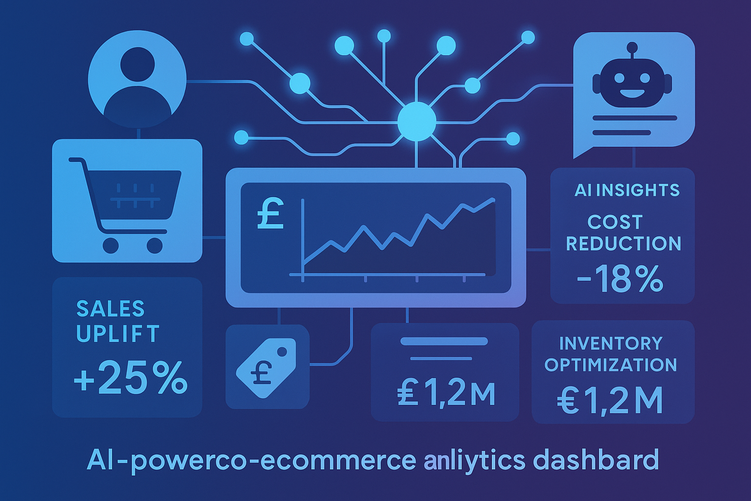
The UK e-commerce sector continues to experience remarkable growth, with online retail sales reaching £121 billion in 2023. As competition intensifies, forward-thinking retailers are turning to artificial intelligence to gain a competitive edge. E-commerce AI is no longer a futuristic concept but a practical necessity for businesses looking to boost sales, enhance customer satisfaction, and streamline operations.
From personalised product recommendations to intelligent inventory management, retail AI is transforming how online businesses operate. This comprehensive guide explores how e-commerce tools powered by artificial intelligence can revolutionise your online retail presence whilst delivering measurable results for your bottom line.
The Current State of E-commerce AI in the UK
British retailers are rapidly embracing online retail automation, with 67% of UK retailers reporting some form of AI implementation in their operations. This adoption surge reflects the technology’s proven ability to address critical challenges facing modern e-commerce businesses, including cart abandonment, inventory inefficiencies, and personalisation at scale.
The integration of e-commerce AI spans multiple business functions, from customer service chatbots to sophisticated predictive analytics systems. These technologies are democratising advanced capabilities that were once exclusive to enterprise-level retailers, making them accessible to small and medium-sized businesses across the United Kingdom.
Personalisation That Drives Conversions
Dynamic Product Recommendations
One of the most powerful applications of e-commerce AI lies in personalised product recommendations. Machine learning algorithms analyse browsing behaviour, purchase history, and similar customer patterns to suggest products that genuinely resonate with individual shoppers. Research indicates that personalisation can deliver five to eight times the ROI on marketing spend and lift sales by 10% or more.
Unlike basic recommendation engines, modern retail AI systems continuously learn and adapt. They consider contextual factors such as time of day, device type, seasonal trends, and even local weather patterns to display the most relevant products at precisely the right moment. This level of sophistication transforms casual browsers into committed buyers.
Intelligent Customer Segmentation
Traditional demographic segmentation is giving way to AI-powered behavioural clustering. E-commerce tools can now identify micro-segments within your customer base, revealing purchasing patterns and preferences that would be impossible to detect manually. This granular understanding enables targeted marketing campaigns with significantly higher conversion rates.
At Kaizen AI Consulting, we help e-commerce businesses implement sophisticated segmentation strategies that transform raw customer data into actionable insights, ensuring your marketing budget delivers maximum impact.
Automating Customer Service Excellence
AI-Powered Chatbots and Virtual Assistants
Customer service expectations have never been higher. Modern consumers expect instant responses, regardless of the time of day. Online retail automation through AI chatbots addresses this challenge by providing 24/7 support without the proportional increase in staffing costs.
Today’s conversational AI systems go far beyond simple FAQ responses. They can handle complex queries, process returns, track orders, and even upsell complementary products. According to IBM research, businesses can reduce customer service costs by up to 30% whilst simultaneously improving response times and customer satisfaction scores.
Sentiment Analysis and Proactive Support
Advanced e-commerce AI systems monitor customer interactions across channels, using natural language processing to detect frustration, confusion, or dissatisfaction. When negative sentiment is identified, the system can automatically escalate to human agents or trigger compensatory actions such as discount codes or expedited shipping options.
This proactive approach transforms potential negative reviews into positive outcomes, protecting your brand reputation whilst demonstrating genuine care for customer experience. The result is higher customer lifetime value and increased positive word-of-mouth referrals.
Sales Optimization Through Predictive Analytics
Dynamic Pricing Strategies
Retail AI enables sophisticated dynamic pricing that responds to market conditions in real-time. By analysing competitor pricing, demand fluctuations, inventory levels, and purchasing patterns, e-commerce tools can automatically adjust prices to maximise revenue whilst remaining competitive.
This sales optimization technique, sometimes called algorithmic pricing, is particularly effective for businesses with large product catalogues or rapidly changing market conditions. Studies show that dynamic pricing can increase margins by 5-10% without negatively impacting sales volume.
Demand Forecasting and Inventory Management
Stockouts cost UK retailers billions annually whilst excess inventory ties up capital and increases storage costs. E-commerce AI addresses both challenges through highly accurate demand forecasting. Machine learning models consider historical sales data, seasonal patterns, promotional calendars, economic indicators, and even social media trends to predict future demand with remarkable precision.
This intelligence enables optimal inventory positioning, ensuring popular products remain in stock whilst avoiding costly overstock situations. The financial impact is substantial, with improved inventory management typically reducing carrying costs by 20-30% whilst simultaneously increasing product availability.
Visual Search and Image Recognition
Visual search technology represents one of the most exciting developments in online retail automation. Customers can now upload images of products they like, and retail AI instantly identifies similar items in your catalogue. This capability is particularly valuable for fashion, home decor, and furniture retailers where aesthetic preferences drive purchasing decisions.
Pinterest reports that visual searches are growing 140% faster than text searches, indicating strong consumer appetite for this technology. Implementing visual search capabilities can significantly reduce the friction between product discovery and purchase, directly impacting conversion rates.
Fraud Detection and Security
E-commerce fraud costs UK businesses approximately £1.2 billion annually. E-commerce AI provides robust protection through real-time transaction analysis that identifies suspicious patterns invisible to rule-based systems.
Machine learning models analyse hundreds of variables for each transaction, including device fingerprinting, purchasing velocity, shipping address inconsistencies, and behavioural anomalies. Legitimate transactions proceed smoothly whilst suspicious activities are flagged or blocked, protecting your revenue and reputation without creating friction for genuine customers.
Marketing Automation and Campaign Optimisation
Email Marketing Intelligence
Retail AI transforms email marketing from batch-and-blast to precision-targeted communication. Advanced e-commerce tools determine optimal send times for individual recipients, personalise subject lines and content, and predict which products each customer is most likely to purchase next.
This level of personalisation drives impressive results. Segmented and targeted email campaigns generate 760% more revenue than generic broadcasts. AI takes this further by automating the segmentation process and continuously optimising based on performance data.
Advertising Budget Allocation
Online retail automation extends to paid advertising, where AI systems continuously test and optimise ad performance across platforms. These systems allocate budget dynamically to the best-performing channels, audiences, and creative variations, maximising your return on ad spend.
For businesses operating across multiple platforms including Google Ads, Facebook, Instagram, and emerging channels, this automated sales optimization ensures your marketing investment delivers consistent returns whilst freeing your team to focus on strategy and creative development.
Implementing AI in Your E-commerce Business
Whilst the benefits of e-commerce AI are clear, successful implementation requires strategic planning and expert guidance. Many businesses struggle with data quality, integration challenges, or selecting appropriate tools from an overwhelming marketplace of options.
The key is starting with clear objectives aligned to your business goals. Are you primarily concerned with reducing cart abandonment? Improving customer service efficiency? Optimising inventory? Each goal suggests different AI applications and implementation priorities.
Partnering with specialists who understand both the technology and e-commerce business models can dramatically accelerate your AI journey whilst avoiding costly mistakes. The team at Kaizen AI Consulting brings deep expertise in implementing retail AI solutions tailored to UK e-commerce businesses of all sizes, ensuring your investment delivers tangible returns.
The Future of E-commerce AI
The trajectory of e-commerce AI points toward even more sophisticated applications. Emerging technologies include augmented reality shopping experiences powered by AI, voice commerce optimisation, and hyper-personalised virtual shopping assistants that understand individual preferences as well as a dedicated personal shopper.
Generative AI is beginning to automate content creation for product descriptions, marketing copy, and even product photography, whilst advanced analytics predict customer lifetime value with increasing accuracy, enabling more sophisticated acquisition and retention strategies.
The businesses that thrive in this evolving landscape will be those that embrace AI not as a replacement for human expertise but as a powerful tool that amplifies capabilities and unlocks new possibilities.
Take Your E-commerce Business to the Next Level
The integration of e-commerce AI represents a fundamental shift in how online retail operates. From personalisation and customer service to inventory management and marketing optimisation, retail AI delivers measurable improvements across every aspect of your business.
The competitive advantage these technologies provide is no longer theoretical. UK retailers implementing comprehensive AI strategies are seeing double-digit improvements in conversion rates, customer satisfaction scores, and operational efficiency. As these tools become more accessible and sophisticated, the gap between AI-powered businesses and traditional operations will only widen.
If you’re ready to explore how e-commerce AI can transform your online retail business, contact Kaizen AI Consulting today. Our team specialises in developing bespoke AI strategies that align with your business objectives, ensuring you capture the full value of these transformative technologies. From initial assessment through implementation and ongoing optimisation, we partner with you to deliver sustainable competitive advantage in the rapidly evolving world of e-commerce.
The future of retail is intelligent, automated, and customer-centric. The question isn’t whether to adopt e-commerce AI, but how quickly you can implement these capabilities to stay ahead of the competition. Start your AI transformation today and position your business for sustained success in the digital marketplace.