In today’s digital marketplace, appearing on the first page of Google can make or break a small business. Yet, many UK business owners find search engine optimisation intimidating, technical, and out of reach. The truth is, understanding SEO basics doesn’t require a degree in computer science. This beginner SEO guide will demystify the fundamentals and show you exactly what every small business owner needs to know to improve their online visibility.
Why SEO Matters for Your Small Business
Search engine optimisation is no longer optional for businesses wanting to compete online. According to BrightEdge research, organic search drives 53% of all website traffic, making it the single largest source of visitors for most businesses. For small businesses in the UK, local SEO has become particularly crucial, with Google reporting that 76% of people who search for something nearby visit a business within 24 hours.
The financial impact is equally compelling. Small businesses that invest in SEO see an average return of £2.75 for every £1 spent, according to industry benchmarks. Unlike paid advertising where visibility stops the moment you stop paying, SEO builds lasting assets that continue delivering results over time.
Understanding How Search Engines Work
Before diving into tactics, it’s essential to understand what search engines are trying to achieve. Google’s primary goal is to provide users with the most relevant, high-quality answers to their questions. The search giant uses over 200 ranking factors to determine which pages deserve to appear at the top of search results.
Search engines work through three main processes: crawling, indexing, and ranking. First, automated bots (called spiders or crawlers) discover and scan web pages. Then, these pages are indexed, essentially filed away in a massive digital library. Finally, when someone performs a search, algorithms rapidly sort through billions of pages to present the most relevant results.
The Foundation: On-Page SEO Basics
Keyword Research and Strategy
Effective small business SEO starts with understanding what your customers are searching for. Keyword research involves identifying the terms and phrases your target audience uses when looking for products or services like yours. For UK businesses, this means considering British spelling variations and local terminology.
Start with seed keywords related to your business, then use free tools like Google Keyword Planner or paid options like SEMrush to expand your list. Look for keywords with decent search volume but manageable competition. Long-tail keywords (phrases of three or more words) are particularly valuable for small businesses because they’re less competitive and often signal higher purchase intent.
For example, instead of targeting the highly competitive term “plumber”, a small business might target “emergency plumber in Manchester” or “boiler repair North London”. These UK SEO tips help you compete effectively in your local market.
Title Tags and Meta Descriptions
Your title tag is arguably the most important on-page SEO element. It tells both search engines and users what your page is about. Keep titles under 60 characters, include your target keyword near the beginning, and make them compelling enough to encourage clicks.
Meta descriptions don’t directly impact rankings, but they significantly affect click-through rates. Write compelling descriptions of 150-160 characters that accurately summarise your page content and include a call-to-action. Think of them as your page’s advertisement in search results.
Content Quality and Structure
Content remains king in the SEO world. Research from Backlinko analysing 11.8 million Google search results found that the average first-page result contains 1,447 words. However, length alone isn’t the goal; your content must provide genuine value to readers.
Structure your content with clear headings (H1, H2, H3 tags) to improve readability and help search engines understand your page hierarchy. Include your target keywords naturally throughout the content, particularly in headings and the first paragraph, but avoid keyword stuffing, which can result in penalties.
At Kaizen AI Consulting, we help small businesses develop content strategies that balance SEO requirements with authentic, engaging writing that resonates with your audience and drives conversions.
Technical SEO Essentials
Website Speed and Mobile Optimisation
Page speed is a confirmed ranking factor, and for good reason. Google research shows that 53% of mobile users abandon sites that take longer than three seconds to load. Use Google’s PageSpeed Insights tool to analyse your site’s performance and identify improvement opportunities.
Mobile optimisation is equally critical. Since Google switched to mobile-first indexing, the search engine primarily uses the mobile version of your site for ranking and indexing. Ensure your website uses responsive design, has easily clickable buttons, and displays properly on all device sizes.
Site Structure and Navigation
A logical site structure helps both users and search engines navigate your website. Create a clear hierarchy with your homepage at the top, followed by category pages, and then individual product or service pages. Use descriptive URLs that include relevant keywords, such as www.yoursite.co.uk/services/web-design rather than www.yoursite.co.uk/page123.
Implement internal linking to connect related pages and distribute page authority throughout your site. This helps search engines discover all your content and understand relationships between pages.
Security and HTTPS
Google has confirmed that HTTPS is a ranking signal. More importantly, browsers now flag non-HTTPS sites as “not secure”, which damages trust and can significantly reduce conversions. Obtain an SSL certificate from your hosting provider to ensure your site uses HTTPS.
Off-Page SEO and Building Authority
The Power of Backlinks
Backlinks are links from other websites to yours and remain one of the most influential ranking factors. They act as votes of confidence, signalling to search engines that your content is valuable and trustworthy. However, quality trumps quantity. One link from a reputable industry publication carries more weight than dozens from low-quality directories.
Focus on earning links naturally by creating exceptional content that others want to reference. Consider guest posting on relevant industry blogs, getting listed in reputable business directories, and building relationships with journalists and bloggers in your niche.
Local SEO for UK Small Businesses
For businesses serving specific geographic areas, local SEO is paramount. Start by claiming and optimising your Google Business Profile (formerly Google My Business). Complete every section, select accurate categories, add high-quality photos, and encourage customer reviews.
Ensure your NAP (Name, Address, Phone number) information is consistent across all online directories and your website. Get listed in UK-specific directories like Yell, Thomson Local, and relevant industry directories. Create location-specific content and pages if you serve multiple areas.
Measuring Your SEO Success
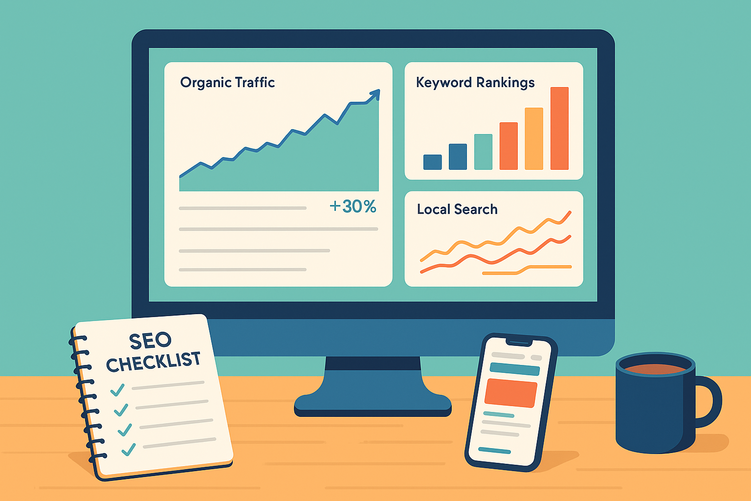
SEO without measurement is guesswork. Set up Google Analytics and Google Search Console to track your performance. Key metrics to monitor include organic traffic, keyword rankings, click-through rates, bounce rate, and conversion rate.
Remember that SEO is a long-term strategy. While some improvements may show results within weeks, significant ranking improvements typically take three to six months. Track progress monthly and adjust your strategy based on data.
Common SEO Mistakes to Avoid
Many small business owners unknowingly sabotage their SEO efforts. Avoid these common pitfalls: keyword stuffing, buying links, duplicating content across pages, neglecting mobile optimisation, ignoring local SEO opportunities, and failing to update content regularly.
Another mistake is trying to optimise for search engines at the expense of user experience. Always prioritise your human visitors. Search engine algorithms are increasingly sophisticated at recognising and rewarding content that genuinely serves user needs.
Creating Your SEO Action Plan
Starting your SEO journey can feel overwhelming, but breaking it into manageable steps makes it achievable. Begin with these priorities:
First, conduct a technical audit to identify and fix critical issues like broken links, slow page speed, and mobile responsiveness problems. Second, complete your keyword research and optimise your most important pages with proper title tags, meta descriptions, and quality content. Third, claim and optimise your Google Business Profile and major directory listings. Fourth, create a content calendar to regularly publish valuable, optimised content. Finally, develop a strategy for earning quality backlinks over time.
Many small business owners find that while they understand SEO basics, implementing a comprehensive strategy whilst running a business proves challenging. This is where Kaizen AI Consulting can provide invaluable support, offering expert guidance and implementation services tailored to your specific business goals and budget.
The Future of SEO
Search engine optimisation continues evolving. Artificial intelligence and machine learning increasingly influence how search engines understand and rank content. Voice search is growing, requiring optimisation for conversational queries. Featured snippets and other SERP features create new opportunities for visibility.
Despite these changes, the fundamentals remain constant: create high-quality content that serves user intent, ensure excellent technical performance, and build genuine authority in your niche.
Taking the Next Step
Understanding SEO basics is the first step; implementation is where real results happen. Whether you choose to handle SEO in-house or work with specialists, the important thing is to start. Every improvement to your website’s SEO compounds over time, building a stronger online presence and driving more qualified traffic to your business.
If you’re ready to take your small business SEO to the next level but need expert guidance, reach out to Kaizen AI Consulting today. Our team specialises in helping UK small businesses develop and implement effective SEO strategies that deliver measurable results. We’ll work with you to create a customised plan that fits your goals, timeline, and budget. Contact us to schedule your free consultation and discover how professional SEO support can transform your online visibility and grow your business.