Google Flow for Storytelling: A Beginner’s Guide to AI Filmmaking
The landscape of video creation has transformed dramatically in 2026, and at the forefront of this revolution stands Google Flow – a groundbreaking AI filmmaking tool that is democratising cinematic storytelling for creators across the United Kingdom and beyond. Whether you are a small business owner looking to create compelling marketing videos or an aspiring filmmaker with limited resources, Google Flow offers an accessible gateway into professional-quality video production.
According to recent industry data, 96% of UK marketers now consider video essential to their strategy, with 89% reporting direct sales increases from video content. The challenge has always been production capability – but AI filmmaking tools like Google Flow are changing that equation entirely.
What is Google Flow?
Google Flow is an AI creative studio built specifically for filmmakers and content creators. Launched initially in 2025 and significantly updated in February 2026, Flow represents the evolution of Google’s VideoFX experiment into a full-fledged filmmaking platform. It is custom-designed to work seamlessly with Google DeepMind’s most advanced AI models, including Veo 3.1, Imagen 4, and Gemini.
Unlike traditional video production that requires expensive equipment, large crews, and extensive technical expertise, Flow enables creators to generate cinematic-quality videos using simple text prompts and reference images. The platform has already facilitated the creation of over 1.5 billion images and videos since its launch, spanning creative projects from independent films to music videos and product campaigns.
Core Features That Make Google Flow Stand Out
Veo 3.1: Advanced Video Generation
At the heart of Google Flow sits Veo 3.1, Google’s state-of-the-art generative video model. This technology excels at producing high-fidelity video content from textual descriptions, capturing intricate details such as lighting, textures, and motion. What sets Veo 3.1 apart is its exceptional physics awareness and prompt adherence – when you describe a scene, the AI understands spatial relationships, subject-object interactions, and realistic motion dynamics.
The model supports native audio generation, meaning environmental sounds, background music, and even character dialogue can be generated directly alongside the visuals. This eliminates the traditional post-production gap where audio had to be added separately after video finalisation.
Scenebuilder: Your Digital Timeline
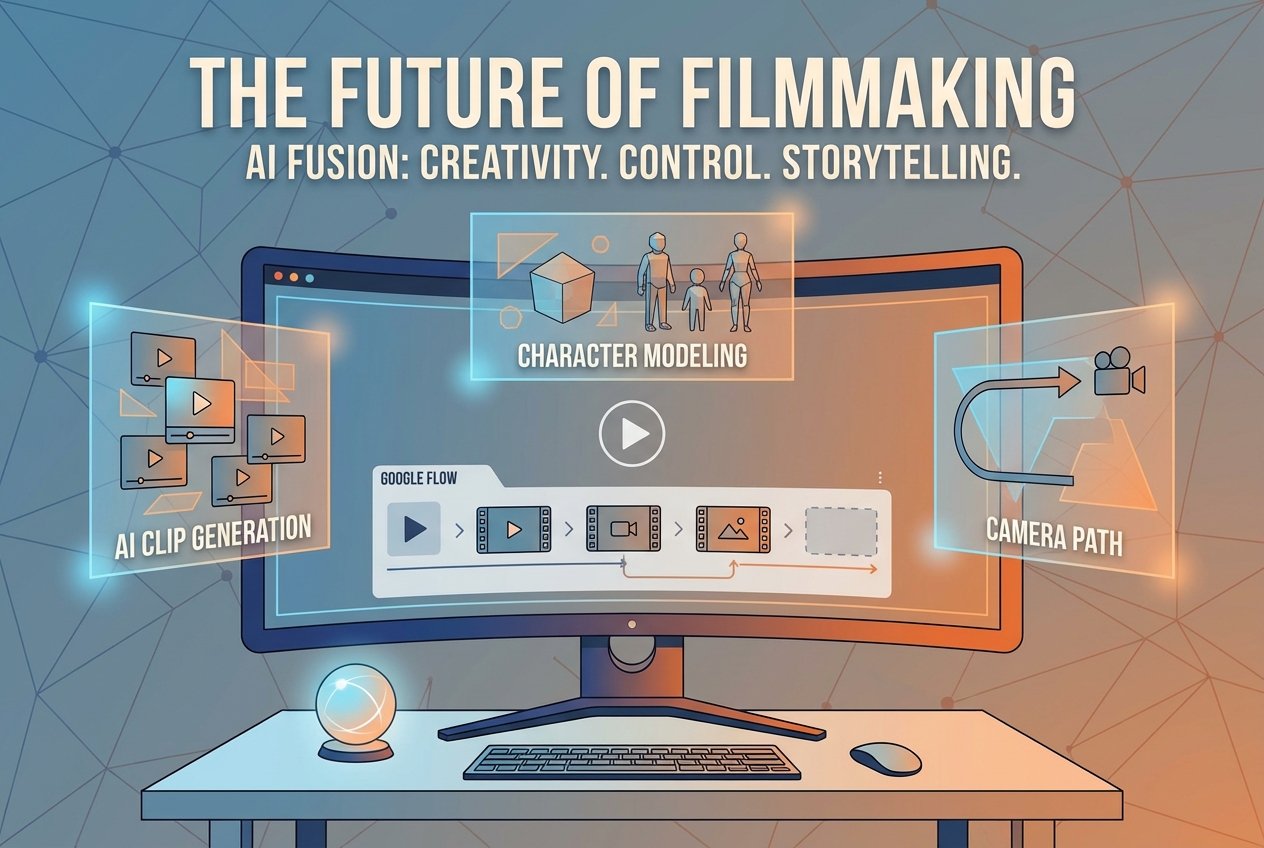
Scenebuilder is where video storytelling truly comes together in Google Flow. This feature allows creators to stitch multiple video clips into cohesive sequences, ensuring smooth transitions and maintaining consistent character appearances across scenes. Think of it as your personal editing suite, but powered by AI intelligence that understands narrative flow.
The system uses Gemini’s natural language processing to understand how your previous clip ended, then seamlessly generates the next shot in the sequence based on your prompts. You can rearrange clips, trim footage, and build complete narratives without ever leaving the platform.
Ingredients System: Consistency Across Your Story
One of the most powerful aspects of AI filmmaking with Google Flow is the Ingredients system. This allows you to create or upload characters, objects, and environments that remain consistent across different clips and scenes. Simply tag your ingredients and reference them in plain language within your prompts.
For UK businesses creating brand videos, this means your brand colours, product designs, and even mascot characters can appear consistently throughout your video content – something that previously required significant production resources to achieve.
Camera Controls for Cinematic Quality
Flow provides professional-grade camera controls including dolly movements, crane shots, handheld effects, pans, tilts, and zooms. These controls enable creators to craft visually sophisticated content that matches the quality of professionally directed sequences. According to industry analysis from LTX Studio, the gap between AI-generated clips and professionally directed sequences is closing rapidly – and in many applications, it has already closed.
Getting Started with Google Flow
Subscription Options and Pricing
Google Flow offers several access tiers to suit different needs:
Free Tier: Receive 100 credits free of charge plus 50 credits daily. Includes access to Veo 3.1, text-to-video, frames-to-video, ingredients-to-video, video extension, object insertion and removal, Scenebuilder, and 2K image upscaling.
Google AI Pro (approximately 16 GBP/month): Includes 1,000 monthly credits, everything in the free tier, plus 1080p upscaling, higher image generation limits, and top-up credits availability.
Google AI Ultra (approximately 100 GBP/month for promotional pricing): Offers 25,000 monthly credits, 4K image and video upscaling, access to Gemini 3.1 Pro Deep Think, and YouTube Premium included.
Your First AI Filmmaking Project
Starting with Google Flow is straightforward. Navigate to labs.google/flow and create a new project. You will find several creation modes at the bottom of your interface:
Text to Video: Simply describe your scene in natural language. For example: “A wide bird’s eye view shot of a female drummer with long blonde hair playing a drum set in the desert with sparks flying.” Flow will generate a cinematic clip based on your description.
Frames to Video: Upload or generate a starting image, then animate it into video. This is particularly useful when you want to lock in a consistent main character from the outset.
Ingredients to Video: Create characters, locations, and objects first, then build scenes around them. This approach ensures consistency across your entire project.
Crafting Compelling Video Stories
The Art of Prompting
Effective video storytelling with Google Flow begins with mastering the art of prompting. Unlike traditional filmmaking where you direct actors and crew, here you are directing an AI through descriptive language. The more specific your prompts, the better your results.
Consider including these elements in your prompts:
- Camera angle and movement (wide shot, close-up, tracking shot)
- Lighting conditions (golden hour, dramatic shadows, soft diffused light)
- Subject actions and emotions
- Environment details and atmosphere
- Pacing and mood indicators
Gemini’s natural language processing means you can describe your vision in everyday language rather than technical jargon – Flow interprets and executes your creative intent.
Building Narrative Structure
Professional video storytelling follows established narrative principles, and AI filmmaking is no different. Begin by planning your story arc: establish your setting and characters, introduce conflict or interest, build toward a climax, and provide resolution.
Use Scenebuilder to assemble your narrative, paying attention to pacing and transitions. Flow’s extend feature allows you to reveal more of the action or transition to what happens next with continuous motion and consistent characters – perfect for maintaining narrative momentum.
Practical Applications for UK Businesses
Marketing and Social Media Content
For UK businesses, Google Flow represents a game-changing opportunity to scale video content production. With UK consumers watching an average of 19 hours of online video weekly, the demand for quality video content has never been higher.
Flow enables rapid creation of:
- Product demonstration videos
- Social media content optimised for different platforms
- Brand storytelling sequences
- Event promotional materials
- Educational and training content
The ability to generate multiple video variations quickly means you can A/B test different approaches and optimise based on audience response – something that would be prohibitively expensive with traditional production methods.
Content Repurposing and Multi-Platform Strategy
Modern video marketing requires content optimised for multiple platforms with different aspect ratios and lengths. Flow’s flexibility allows you to create hero content and then generate variations for YouTube, TikTok, Instagram, and LinkedIn from the same creative foundation.
This approach aligns with what the team at Kaizen AI Consulting recommends for UK businesses looking to maximise their content investment – create once, deploy everywhere, with AI handling the technical adaptations.
Best Practices for AI Filmmaking Success
Maintain Human Creative Direction
While Google Flow handles the technical execution, successful video storytelling still requires human creativity and strategic thinking. AI tools work best when guided by clear creative vision, brand understanding, and audience insight.
Consider working with specialists who understand both the creative and technical aspects of AI video production. At Kaizen AI Consulting, we help UK businesses develop effective AI content strategies that align with their brand objectives and resonate with their target audiences.
Quality Control and Iteration
AI-generated content benefits from human review and refinement. Flow makes iteration easy – if a generated clip does not quite match your vision, adjust your prompt and regenerate. The platform’s fast generation times (under 2 minutes for most clips) support rapid creative exploration.
Pay particular attention to:
- Character consistency across scenes
- Brand alignment in colours and styling
- Narrative coherence and pacing
- Audio-visual synchronisation
- Technical quality before final export
Understanding Limitations
While remarkably capable, AI filmmaking tools have current limitations. Complex hand movements can sometimes appear unnatural, and very specific brand requirements may need multiple generation attempts. Planning for these realities helps set appropriate expectations and workflows.
The Future of AI Filmmaking
The trajectory of AI video generation points toward increasingly sophisticated capabilities. Industry forecasts suggest that 2026 will see continued advances in real-time video generation, interactive elements, and even more precise creative control.
For UK businesses and creators, now is the ideal time to develop AI filmmaking skills. Early adopters who understand these tools will have significant competitive advantages as video content becomes ever more central to digital marketing and communication strategies.
Taking Your Next Steps with AI Video Creation
Google Flow has democratised cinematic video production in ways that were unimaginable just a few years ago. Whether you are creating content for a small business, developing your filmmaking portfolio, or exploring new creative possibilities, Flow provides an accessible and powerful platform for video storytelling.
Start with simple projects to familiarise yourself with the interface and prompting techniques. Gradually build complexity as you develop confidence with the tools. Join communities of Flow users to learn techniques and stay updated on new features.
For businesses seeking to implement AI video strategies effectively, professional guidance can accelerate results and avoid common pitfalls. Contact Kaizen AI Consulting today to discuss how AI filmmaking tools like Google Flow can transform your content creation capabilities and drive real business results.
The future of video storytelling is here – and it is more accessible than ever before. Your cinematic journey with Google Flow starts now.