With the EU AI Act reaching full applicability on 2 August 2026, UK small businesses face a critical compliance crossroads. Whether you sell products into the European market, serve EU-based customers, or deploy AI tools that affect EU citizens, this landmark regulation could directly impact your operations. Understanding what the EU AI Act UK implications truly mean is no longer optional; it is a business imperative.
In this guide, we break down every key provision, deadline, and practical step that UK small businesses need to take to achieve AI regulation compliance before the clock runs out.
What Is the EU AI Act and Why Does It Matter to UK Businesses?
The EU AI Act is the world’s first comprehensive AI law, designed to regulate artificial intelligence systems based on their level of risk to individuals and society. It entered into force on 1 August 2024 and has been rolling out in phases ever since. Its stated aim is to ensure AI used within the European Union is safe, transparent, and respects fundamental rights.
But here is the critical point for UK businesses: the EU AI Act applies extraterritorially. This means that any UK company that places an AI system on the EU market, or deploys AI that produces outputs affecting people within the EU, must comply with the regulation in full. According to SnapGRC’s 2026 analysis, UK businesses qualify as either “providers” or “deployers” under the Act if their AI interacts with the EU market in any capacity.
For UK SMEs that trade internationally, this creates a dual regulatory environment. Domestically, the UK government maintains its own pro-innovation, principles-based approach to AI governance, relying on existing regulators such as the ICO, CMA, and EHRC. But for any EU-facing activities, the full weight of the EU AI Act applies. As Trowers & Hamlins noted in January 2026, the UK has deliberately avoided enacting a unified AI Act equivalent, preferring flexibility over prescription.
The EU AI Act Timeline: Key Dates You Cannot Afford to Miss
The EU AI Act is being implemented in carefully phased stages. Here is a complete breakdown of the compliance timeline and what each milestone means for your business:
Already in Force
- 1 August 2024: The EU AI Act officially entered into force.
- 2 February 2025: Prohibitions on unacceptable-risk AI systems took effect. These include social scoring by public authorities, real-time biometric identification in public spaces (with limited exceptions), subliminal manipulation techniques, and systems that exploit vulnerabilities of specific groups such as children or elderly people.
- 2 August 2025: Obligations for general-purpose AI (GPAI) models became applicable, including requirements for technical documentation, training data summaries, copyright compliance, and risk management for systemic-risk models.
Coming in 2026
- 2 August 2026: This is the major deadline. High-risk AI systems classified under Annex III become fully regulated. Transparency requirements under Article 50 take effect. National enforcement mechanisms activate, and each EU member state must have established at least one AI regulatory sandbox.
Looking Ahead to 2027
- 2 August 2027: Rules for high-risk AI embedded in regulated products such as machinery, vehicles, and medical devices come into force.
- 2 December 2027: Long-stop compliance date for existing high-risk Annex III systems.
According to Walma AI’s March 2026 timeline overview, the Commission is linking certain high-risk rules to the availability of harmonised standards, which may offer limited flexibility for some businesses.
Understanding the Risk Categories
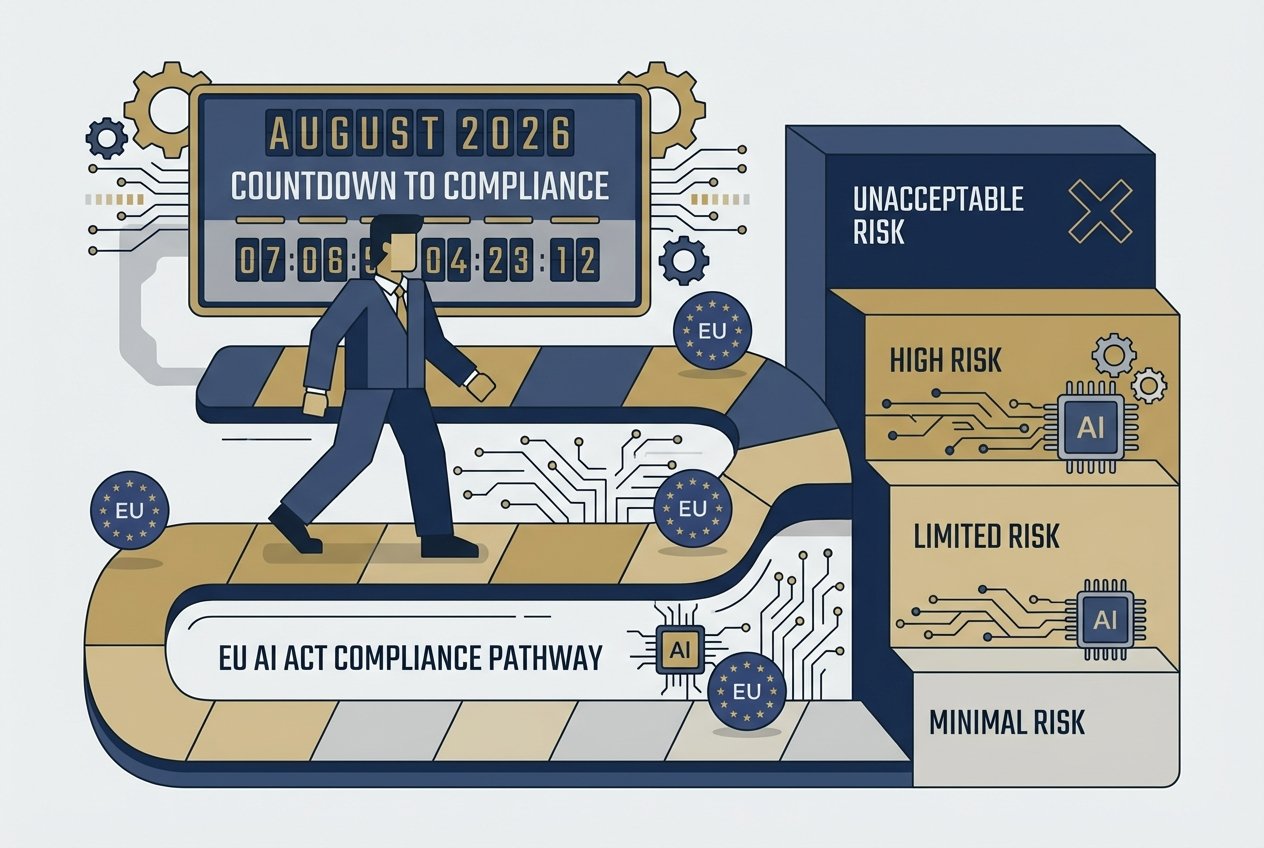
The AI law business compliance framework is built around four risk tiers. Getting your classification right is the foundation of every other compliance step:
Unacceptable Risk (Banned)
These AI applications are outright prohibited in the EU. They include social scoring systems, real-time biometric surveillance (with narrow exceptions), AI designed to manipulate human behaviour subconsciously, predictive policing based solely on profiling, untargeted facial image scraping, and emotion recognition systems in workplaces or educational settings.
High Risk (Heavily Regulated)
AI systems used in recruitment and HR decisions, creditworthiness assessment, educational access and scoring, essential public services, law enforcement, migration management, and democratic processes fall under this category. These systems must meet stringent regulatory requirements including risk management protocols, data quality standards, technical documentation, human oversight mechanisms, cybersecurity safeguards, post-market monitoring, conformity assessments, CE marking, and registration in the EU database.
Limited Risk (Transparency Obligations)
Systems like chatbots, deepfake generators, and emotion detection tools must clearly disclose their AI nature to users. From August 2026, synthetic content must be labelled appropriately.
Minimal Risk
Most everyday AI applications, such as spam filters and AI-powered games, face no specific obligations, though voluntary codes of conduct are encouraged.
The Penalties: What Non-Compliance Could Cost You
The EU AI Act carries some of the most severe penalties in regulatory history, surpassing even GDPR fines. According to Matproof’s March 2026 penalties guide, the fine structure is tiered as follows:
- Prohibited AI practices: Up to 35 million euros or 7% of total worldwide annual turnover, whichever is higher.
- High-risk system and GPAI obligations: Up to 15 million euros or 3% of global annual turnover.
- Providing misleading information to authorities: Up to 7.5 million euros or 1.5% of global annual turnover.
While the Act includes proportionality considerations for SMEs, these fines remain substantial enough to threaten the viability of any small business. The message is clear: ignorance is not a defence, and non-compliance carries existential financial risks.
The UK Regulatory Landscape: A Parallel Framework
As of March 2026, the UK does not have a single, dedicated AI law. Instead, the government operates a sector-led, principles-based approach coordinated by the Department for Science, Innovation and Technology (DSIT). Up Stride’s 2026 governance guide highlights that existing regulators apply five core principles covering safety, fairness, accountability, transparency, and contestability within their respective domains.
Key developments in the UK regulatory landscape for 2026 include mandatory risk assessments for customer-facing or decision-making AI tools, tightened ICO guidance aligning with UK GDPR provisions, the potential requirement to designate a named AI officer within organisations, and the expansion of regulatory sandboxes in healthcare and professional services. The Data (Use and Access) Act 2025 is also introducing new provisions around automated decision-making, shifting towards a permission-based model with built-in safeguards.
For UK small businesses, this means navigating two distinct compliance environments: a flexible, principles-based domestic framework and the prescriptive, rules-based EU AI Act for any European market activity.
A Practical Compliance Checklist for UK Small Businesses
With the 2 August 2026 deadline fast approaching, here is a step-by-step guide to achieving AI regulation compliance:
Step 1: Audit Your AI Systems
Catalogue every AI tool your business uses, from customer service chatbots to automated recruitment screening tools. Identify which systems interact with EU markets or affect EU citizens.
Step 2: Classify Your Risk Level
Map each AI system against the EU AI Act’s four-tier risk framework. Pay particular attention to any systems that fall under Annex III high-risk categories, especially those involved in HR, finance, or customer-facing decisions.
Step 3: Conduct Risk Assessments
For both domestic UK compliance and EU obligations, document potential harms, mitigation strategies, and assign a named responsible person for each AI system.
Step 4: Implement Governance Frameworks
Establish internal AI governance policies covering data quality, bias monitoring, human oversight protocols, and incident reporting procedures. This is where professional guidance can make a significant difference. Kaizen AI Consulting specialises in helping UK small businesses build robust AI governance frameworks that satisfy both domestic and EU regulatory requirements.
Step 5: Prepare Technical Documentation
High-risk systems require comprehensive technical documentation detailing system design, data training processes, performance metrics, and risk management measures. This documentation must be available for regulatory inspection.
Step 6: Establish Monitoring Processes
Implement post-market monitoring systems to continuously track AI performance, detect drift or bias, and report incidents to the relevant authorities.
Step 7: Review Third-Party AI Providers
If you use AI tools from external vendors, verify that those providers are themselves compliant with the EU AI Act. Contractual obligations should explicitly cover compliance responsibilities.
Why Professional Support Matters
The complexity of dual-jurisdiction compliance presents a genuine challenge for resource-constrained SMEs. With over 5,800 active AI firms in the UK and 95% of them classified as SMEs according to DSIT’s Artificial Intelligence Sector Study, the scale of the compliance challenge is enormous.
Navigating both the UK’s evolving principles-based framework and the EU’s prescriptive AI law business requirements demands specialist expertise. Kaizen AI Consulting works with UK small businesses to demystify AI regulation, conduct thorough compliance audits, and implement practical governance solutions tailored to each organisation’s specific needs and market exposure. From initial AI system classification through to ongoing monitoring and documentation, having an experienced partner can transform a daunting regulatory burden into a manageable, structured process.
Looking Ahead: What to Expect Beyond August 2026
The regulatory landscape will continue to evolve. Key developments to watch include the potential introduction of mandatory high-risk AI registration in the UK by 2027, further alignment between UK GDPR provisions and AI-specific transparency requirements, the expansion of EU AI regulatory sandboxes offering innovation-friendly testing environments, and ongoing discussions within the EU about transitional grace periods and delayed fines for certain transparency violations.
Businesses that establish strong compliance foundations now will be far better positioned to adapt to future regulatory changes with minimal disruption.
Take Action Before August 2026
The EU AI Act represents a fundamental shift in how artificial intelligence is governed, and its reach extends well beyond EU borders. For UK small businesses using or developing AI, the regulatory requirements are real, the deadlines are imminent, and the penalties for non-compliance are severe.
Do not wait until the last moment. Start your compliance journey today by auditing your AI systems, classifying your risk exposure, and building the governance frameworks that will protect your business. If you need expert guidance on navigating EU AI Act UK compliance, get in touch with the team at Kaizen AI Consulting for a tailored consultation. Our specialists can help you understand exactly what the new regulations mean for your business and create a clear, actionable roadmap to full compliance.
For more insights on how AI is transforming UK business operations, explore our guides on building successful AI-driven businesses and discover how proactive compliance can become a genuine competitive advantage.