AI Document Management for Construction: Permits, Contracts, and Compliance
The UK construction industry, valued at over £170 billion, is facing a defining moment. With output projected to grow 2.8% in 2026, the sector is expanding, but so too is its regulatory burden. From the Building Safety Act and Golden Thread requirements to evolving CDM regulations, the sheer volume of construction documents AI must help manage has never been greater. Yet a staggering 88% of UK construction firms report no meaningful AI deployment, with 45% reporting zero use at all.
For firms still relying on manual processes to handle permits, contracts, and compliance paperwork, the risks are mounting: missed deadlines, regulatory penalties, costly disputes, and projects that haemorrhage time and money. This guide explores how AI-powered document management is transforming the way construction businesses operate, and why adopting these tools is fast becoming a competitive necessity rather than a luxury.
The Document Crisis in UK Construction
A typical mid-sized construction project generates thousands of documents: planning applications, building control submissions, contracts, variation orders, risk assessments, method statements (RAMS), RFIs, inspection reports, and compliance certificates. Managing this volume manually is not just inefficient; it is genuinely dangerous in a sector where documentation errors can lead to safety failures, legal disputes, and regulatory enforcement action.
The problem is compounded by the UK Government’s increasingly stringent requirements. The Building Safety Act 2022 introduced the concept of the Golden Thread, a complete, accurate, and accessible digital record of building information that must be maintained throughout design, construction, and occupation. For higher-risk buildings (those at least 7 storeys or 18 metres high with two or more residential units), this is not optional. It is a legal obligation enforced by the Building Safety Regulator (BSR), which was formally established as an independent body in January 2026.
With upcoming milestones including Fire Safety Residential Evacuation Plans regulations taking effect on 6 April 2026 and the two-staircase mandate for residential buildings over 18 metres from 30 September 2026, the compliance landscape is growing more complex by the month. Construction documents AI solutions are no longer a futuristic concept; they are an essential tool for survival.
How AI is Revolutionising Permit Management
Planning permits and building control approvals are among the most time-consuming aspects of any construction project. Traditional permit management involves manually reviewing hundreds of pages of planning policy, cross-referencing local authority requirements, and ensuring every submission is complete and compliant. Errors or omissions can delay projects by weeks or months.
Intelligent Document Processing
AI-powered permit management systems use optical character recognition (OCR) and natural language processing (NLP) to extract, classify, and validate information from planning documents at remarkable speed. The UK Government’s own Extract tool, which has been rolling out nationwide in spring 2026, demonstrates the potential: it reduces planning document processing from 2 hours to just 3 minutes using generative AI. That represents a 97% reduction in processing time for every single application.
Automated Compliance Checking
Beyond simple document processing, AI systems can automatically cross-reference permit applications against local planning policies, building regulations, and environmental requirements. This ensures submissions are compliant before they reach the planning authority, dramatically reducing the rejection and resubmission cycle that plagues so many projects. For firms managing multiple concurrent projects, the cumulative time savings are transformative.
Real-Time Status Tracking
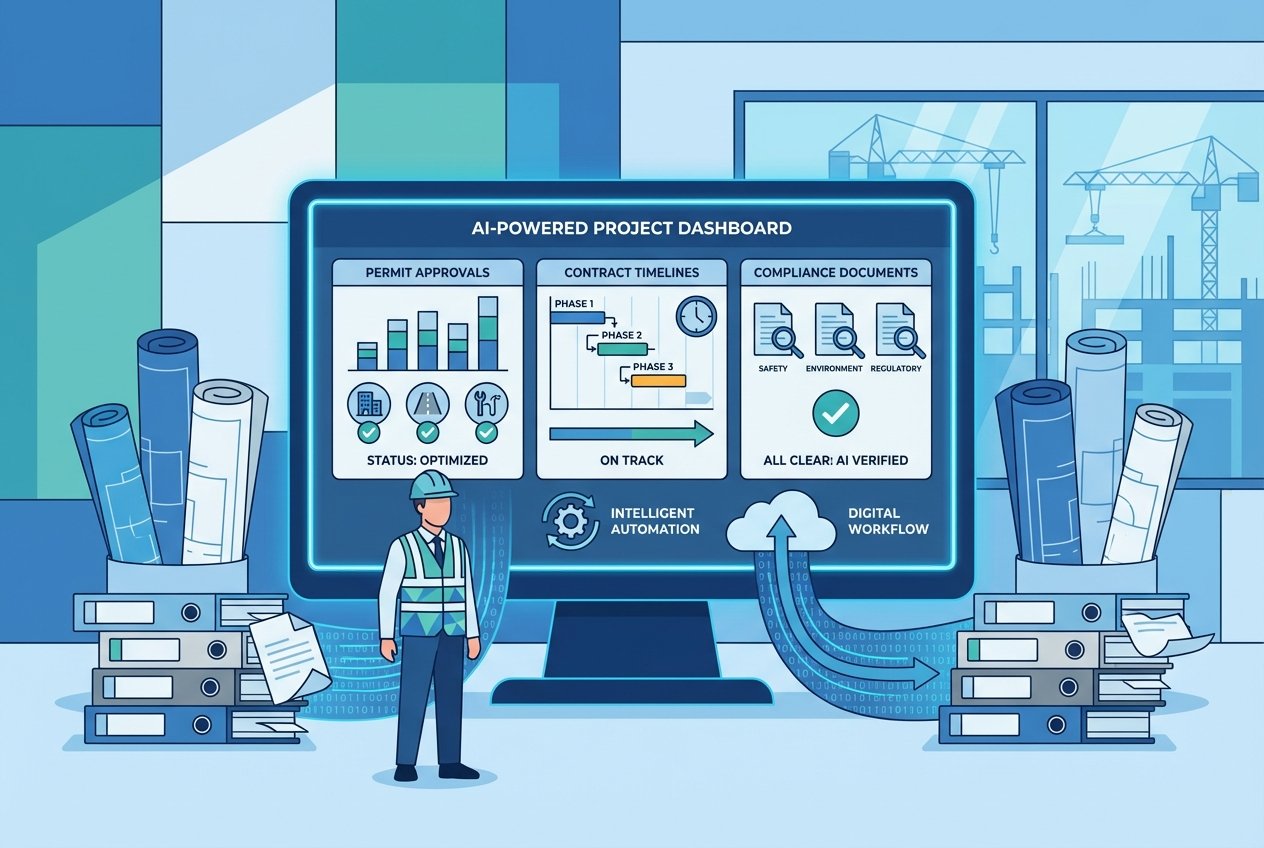
AI-driven permit management platforms provide real-time dashboards showing the status of every application across a portfolio. Automated alerts flag approaching deadlines, missing documents, and required actions, ensuring nothing falls through the cracks. This level of visibility is particularly valuable for developers managing complex, multi-phase projects where permit timelines directly impact construction schedules.
Contract Automation: Reducing Risk and Accelerating Delivery
Construction contracts are among the most complex commercial documents in any industry. Standard forms such as JCT and NEC are routinely amended, creating bespoke agreements where critical obligations, liability caps, and payment mechanisms can be buried deep within supplementary clauses. Manual review is slow, expensive, and prone to human error.
AI-Powered Contract Review and Analysis
Contract automation tools powered by AI can read, summarise, and analyse construction contracts in a fraction of the time required by a human reviewer. These systems use NLP to identify key clauses, highlight onerous obligations such as liquidated damages provisions, compare terms against standard forms to flag deviations, and surface potential risks before they become disputes. According to industry benchmarks from Sirion, AI contract review can deliver annual benefits exceeding £400,000 through time savings, error reduction, and reduced value leakage of up to 9%.
Automated Payment and Notice Management
One of the most impactful applications of contract automation in UK construction is the management of payment notices under the Construction Act 1996. Missed Pay Less Notices can expose firms to costly “smash and grab” adjudications. AI systems can track every payment cycle, generate compliant notices automatically, and alert project teams to upcoming deadlines, protecting cash flow and reducing dispute risk significantly.
Subcontractor and Supply Chain Management
AI contract automation extends beyond the main contract. Tools such as Constructionline’s Risk Radar now analyse over 7 billion data points to provide insolvency alerts and risk assessments for subcontractors, integrating with procurement and contract workflows to strengthen supply chain resilience. In a market where subcontractor insolvency remains a persistent risk, this kind of proactive intelligence is invaluable.
Compliance Tracking: Meeting the Golden Thread Standard
The Golden Thread requirements under the Building Safety Act demand that building information is accurate, complete, and digitally accessible at every stage. This is not simply about storing documents; it is about maintaining a living, auditable record that demonstrates compliance to the BSR at any point in time.
Centralised Document Repositories
AI-powered compliance tracking systems create centralised, searchable repositories where every document is automatically classified, tagged with metadata, and version-controlled. When the BSR requests evidence of compliance, whether during a gateway review or a Building Assessment Certificate inspection, firms can retrieve the relevant documentation in seconds rather than days.
Automated RAMS and Safety Documentation
Risk Assessments and Method Statements are fundamental to CDM compliance, yet they consume enormous amounts of project team time. AI tools can now generate compliant RAMS grounded in CDM regulations within minutes, drawing on project-specific data and historical templates. This frees site teams to focus on actual safety management rather than paperwork, while ensuring documentation is always current and complete.
Audit Trail and Regulatory Reporting
Perhaps the most critical benefit of AI compliance tracking is the creation of a comprehensive, tamper-proof audit trail. Every document change, approval, and access event is logged automatically, providing the evidence trail that regulators demand. For higher-risk buildings subject to the three-gateway approval process (planning, building control approval, and completion certificate), this level of traceability is essential.
The Business Case: ROI of AI Document Management
The financial case for adopting AI document management in construction is compelling. Research from NeuraMonks shows that projects using AI finish 20-25% closer to deadlines, while procurement automation cuts material waste by 15-22%. Firms report savings of £15,000 to £40,000 per project in reduced rework alone, with positive returns typically achieved within 12 to 18 months of implementation.
The time savings are equally striking. AI tools save an estimated 10-15 hours per week on site management and document tasks, while design analysis can reduce RFIs by up to 40%. For a sector where margins are notoriously thin, these efficiencies translate directly to improved profitability and competitiveness.
At Kaizen AI Consulting, we have seen first-hand how construction firms of all sizes benefit from tailored AI document management strategies. Whether you are a regional housebuilder grappling with Building Safety Act requirements or a tier-one contractor managing complex infrastructure programmes, the right AI solution can transform your document workflows while ensuring full regulatory compliance.
Getting Started: A Practical Roadmap
Implementing AI document management does not require a complete digital overhaul overnight. The most successful firms take a phased, strategic approach.
Step 1: Audit Your Current Document Processes
Begin by mapping your existing document workflows for permits, contracts, and compliance. Identify the bottlenecks: where does manual processing consume the most time? Where do errors most frequently occur? Where are the greatest regulatory risks? This audit provides the foundation for a targeted AI implementation strategy.
Step 2: Prioritise High-Impact Areas
Focus initial AI deployment on areas with the greatest return. For most construction firms, this means contract review automation (highest risk reduction), permit processing (greatest time savings), and compliance documentation (strongest regulatory imperative). The key is to demonstrate ROI quickly to build organisational confidence.
Step 3: Select the Right Technology Partners
The UK market now offers a growing range of construction-specific AI tools, from platforms like Construction AI (launched March 2026 specifically for UK SMEs) to established document management systems with AI capabilities. The critical factor is choosing solutions trained on UK standards, contracts, and regulations rather than generic international tools.
Step 4: Integrate and Scale
AI document management delivers the greatest value when integrated with your existing project management, financial, and BIM systems. This requires careful planning around data architecture, user training, and change management. Working with experienced AI consultants who understand both the technology and the construction sector can significantly accelerate this process and avoid costly implementation mistakes.
Why Professional Guidance Matters
While the benefits of AI document management are clear, implementation is not without its challenges. The construction sector’s traditionally low digital adoption rate, currently the lowest of any major UK industry, means many firms lack the internal expertise to evaluate, deploy, and optimise AI solutions effectively. Data fragmentation, as highlighted in a recent PBC Today analysis, remains a significant barrier: AI cannot deliver results if the underlying data is inconsistent or incomplete.
This is where specialist support makes a genuine difference. Kaizen AI Consulting works with construction businesses across the UK to develop bespoke AI strategies that address the specific challenges of permit management, contract automation, and compliance tracking. From initial process audits through to full implementation and training, our team ensures that your investment in AI delivers measurable, sustainable results. Get in touch today to discover how we can help your construction business work smarter, reduce risk, and stay ahead of the regulatory curve.
Looking Ahead: The Future of Construction Document Management
As 2026 progresses, the convergence of tighter regulation, rising project complexity, and improving AI capabilities will make intelligent document management the standard rather than the exception. The Arcadis UK Construction Market View for Spring 2026 notes that the sector faces an uneven recovery, with residential activity subdued by affordability pressures and new regulations, while infrastructure remains supported by major programmes. In this environment, operational efficiency is paramount.
Firms that invest in AI-powered document management now will be best positioned to navigate the Building Safety Act requirements, win work on complex projects where digital competency is increasingly a tender requirement, and protect their margins in a competitive market. The 88% of UK construction firms yet to adopt AI meaningfully represent an enormous opportunity for early movers to gain a decisive advantage.
The question is no longer whether AI will transform construction document management. It already is. The question is whether your business will lead that transformation or be left behind.