
How Electricians Can Use AI for Faster Fault Diagnosis
Electrical systems in homes, commercial sites and critical facilities are more complex than ever. At the same time, customers expect rapid callouts, first time fixes and clear documentation. That is why electrician AI is gaining traction. Applied well, AI can accelerate fault diagnosis, improve the quality of electrical troubleshooting and reduce repeat visits. This guide explains practical use cases, tool options and step by step workflows that UK electricians can adopt today, with a focus on trades diagnostic tools that respect safety and compliance.
Why 2026 is the year to pilot electrician AI
Adoption is moving from early experiments to day to day value. The British Chambers of Commerce reported in March 2026 that around half of UK SMEs are using AI in some capacity, up from 35 percent in 2025, though with limited impact on headcount so far source. Construction focused commentary notes that AI gained real momentum across project delivery through 2025 and into 2026, as firms apply it to scheduling, quality and on site insights source. Industry media likewise describes AI as setting UK construction up for its next leap in performance, while acknowledging data, skills and integration challenges that smaller firms feel most source. For sole traders and micro businesses, adoption is rising but still uneven, with enterprise contractors leading the way source.
Against this backdrop, demand for electrical skills keeps climbing. Wage trend analysis published in January 2026 shows steady pay growth for qualified electricians, underlining the value of time saved per job source. Training pipelines face pressure too, with coverage in February 2026 highlighting the widening skills gap and the importance of upskilling on new tools source. In short, doing more with the same team is a competitive necessity.
What AI actually does in electrical troubleshooting
AI does not replace the qualified electrician. It augments your judgement by turning unstructured inputs into structured guidance. For fault diagnosis, that typically means:
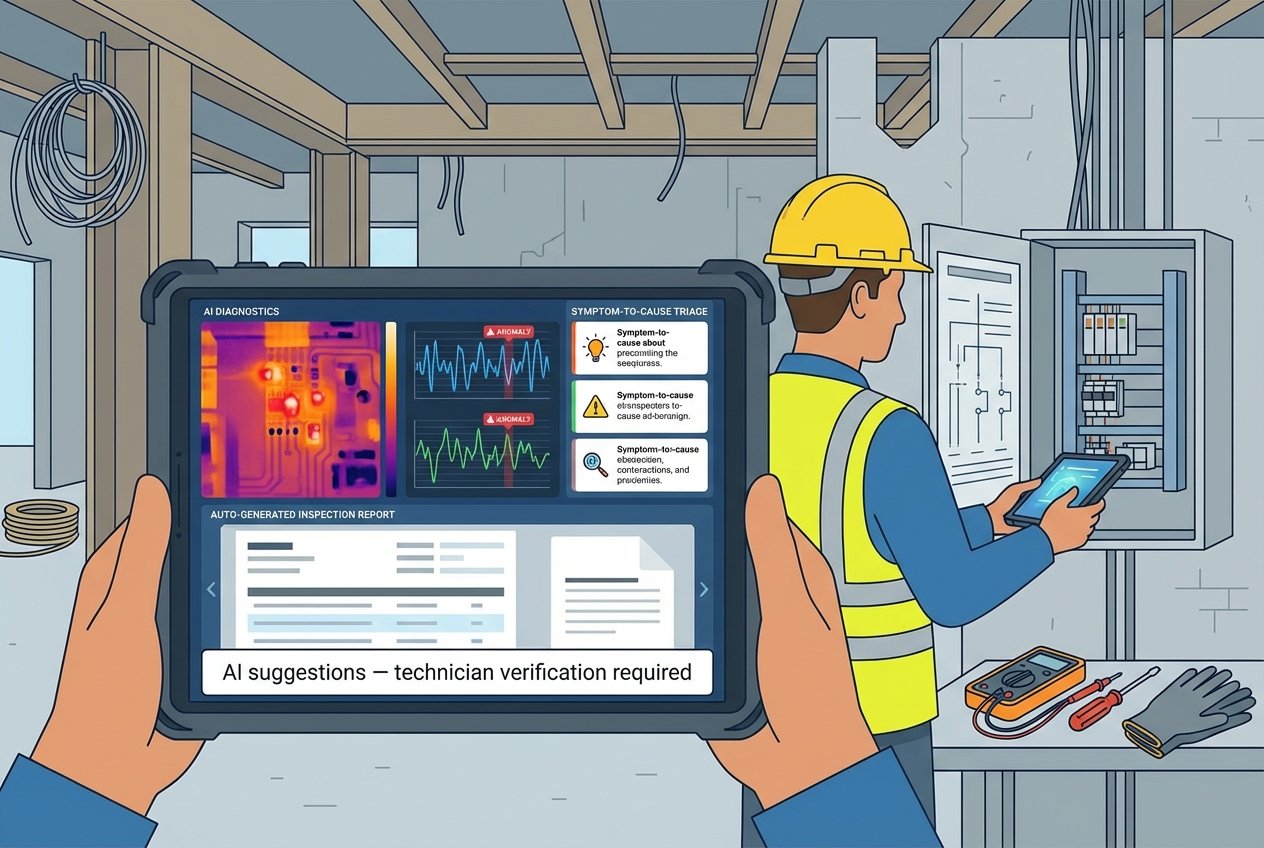
- Symptom triage – you describe symptoms, site context and readings, and the model ranks likely causes with recommended next tests based on probability.
- Pattern matching – the model compares measurements and observations against many similar historical cases and known fault signatures.
- Report generation – the model converts notes, photos and test results into clear, branded EICR style findings and remedial actions for the client file.
Across construction, firms report faster insights and fewer admin cycles when AI supports site tasks source. In the trades, commentators note accelerating adoption, especially where tools slot into existing apps and workflows source.
Seven practical electrician AI use cases you can deploy now
1. Symptom to cause triage
Enter symptoms like intermittent RCD trips, specific breaker behaviour, load conditions, recent works and location details. Add initial insulation resistance and continuity readings. The AI returns a ranked list of likely faults with a tree of next tests and safety notes. This shortens the time to a working hypothesis and helps junior team members structure their approach.
2. Thermal and visual analysis support
Upload panel photos or thermal images. The model highlights loose terminations, heat concentration, discolouration and labelling anomalies for closer inspection. You still verify with a torque driver and meter, but visual triage gets faster. Construction media expects continued growth in structured data capture and analytics for 2026, which aligns with this approach source.
3. Waveform and power quality pattern spotting
Feed in oscillograms or power quality logs from your analyser. AI can flag signatures consistent with harmonics, voltage sags, nuisance tripping or motor inrush issues and suggest where to instrument next. The backdrop to this is a UK grid under rising load from AI data centres, which puts a premium on clean, reliable power in commercial estates source and sparks debate about resilience needs source.
4. BS 7671 and EICR documentation assistance
Convert dictated notes and measurements into clear customer reports mapped to circuits and observations. AI drafting reduces admin time, while your qualified supervisor signs off. Media covering UK construction notes a shift toward AI supported documentation across 2025 to 2026 source.
5. Predictive maintenance prompts for commercial sites
Use historical measurements to schedule proactive inspections. AI recommends intervals and checks where trend lines suggest rising risk, ideal for multi site retail or light industrial clients. This is where trades diagnostic tools tie into service contracts.
6. Parts and remedial planning
From likely faults, AI can draft a parts and labour plan so you arrive once with the right kit. Coupled with good stock control, this reduces repeat visits and improves margins.
7. Safety checklists before energisation
Generate a job specific pre energisation checklist that no one can skip, then file the output to your job management system. It is a simple way to combine speed with safe systems of work.
Choosing trades diagnostic tools that fit UK workflows
There are dozens of options, from general AI interfaces to specialist electrician AI apps. In early 2026, round ups of AI tools for electricians highlight features like fault triage, image analysis and automated reporting that can slot into small firm workflows source. When evaluating, focus on:
- Data capture – can you attach photos, thermal images, PDFs and instrument logs easily from a phone on site
- Offline and on site use – does it work on a weak 4G signal and cache safely
- Privacy and security – does the tool keep client addresses and images confidential, and can you turn off training on your data
- BS 7671 context – does the assistant understand UK terminology and typical test sequences
- Export – does it output neat, branded reports for EICR jobs or job sheets
A 5 step workflow for faster, safer fault diagnosis with AI
Step 1 – Capture structured inputs
Before you ask for help, capture the right data. Use a standard template that records supply type, protective device details, circuit ID, load, environment, symptoms, and initial test readings. The more precise your prompts, the better the suggestions.
Step 2 – Run AI triage and propose next tests
Feed the template into your assistant and request a ranked list of likely root causes with probability and a next test tree. Ask it to include safety notes and isolation requirements.
Step 3 – Verify with instruments
Use the model as a guide, not gospel. Prove dead, test with your MFT and analyser, and record new readings in the template.
Step 4 – Summarise findings and options
Ask the model to produce a clear explanation for the client, with a quick summary, detailed observations, and recommended remedials with parts list. Keep technical detail for your report and a plain English version for the customer.
Step 5 – File the evidence
Export reports to your job system and back them up. Over time, your growing dataset of readings and outcomes will make future diagnoses even faster.
Compliance and safety guardrails
- Always verify – never energise based on an AI suggestion without appropriate testing and sign off.
- Reference UK standards – ensure outputs are checked against BS 7671 and local authority requirements for the job type.
- Data handling – gain client consent for photo analysis and anonymise addresses in prompts.
- Scope control – use AI within your competency and subcontract where needed.
Proving value – where the time savings show up
While every business is different, three areas repeatedly deliver gains:
- Faster hypothesis building – better first 15 minutes means fewer blind alleys and fewer repeat visits.
- Cleaner handovers – AI drafted reports reduce admin time and callbacks by making next steps obvious to clients and facilities teams.
- Better stock and scheduling – parts lists and clearer scope cut wasted trips and idle time.
Sector wide, independent commentary in early 2026 points to momentum behind AI enabled delivery in construction and a steady rise in adoption among SMEs, suggesting these operational gains are increasingly achievable for small firms too source source source.
Pilot plan – how to get started in 30 days
- Pick one repeat fault category – for example, nuisance RCD trips in small commercial sites.
- Standardise data capture – create a one page template and teach the team to fill it the same way every time.
- Choose a lightweight assistant – start with a secure, mobile friendly tool that handles images and text.
- Write three prompts – triage, client summary and parts plan. Save them as snippets.
- Measure the baseline – track time on site, repeat visits and reporting time for four weeks, then compare with the next four.
If you prefer a guided start, Kaizen AI Consulting can help scope the use case, select tools that fit BS 7671 terminology, configure safe prompts and train your team to use them on real jobs. See how we build practical AI roadmaps in our article From Startup to Success, or explore our services.
Integrations that make the difference
To keep momentum, connect your electrician AI assistant to the tools you already use:
- Job management – attach AI outputs directly to job cards so supervisors can review and sign off quickly.
- File storage – auto file photos, thermal scans and reports to a client folder structure.
- Checklists – embed pre energisation and site risk prompts into your standard checklists.
Construction tech commentators expect 2026 to deepen the shift toward structured data and analytics on site, which favours teams who standardise capture and integrate early source source.
Overcoming common barriers for small firms
SMEs often worry about data, cost and disruption. The good news is that you can start small, keep data private and build only what adds value.
- Skills – short, hands on training sessions get teams comfortable fast. Adoption among SMEs is already climbing in 2026 source.
- Data – stick to anonymised prompts and turn off data sharing in your tool settings. Obtain consent for photos.
- Cost – begin with a pilot on one fault type and a handful of seats. Prove the saving, then scale.
- Integration – pick tools that export clean PDFs and work on site. Commentators note that ease of fit is what drives trades adoption source.
How Kaizen AI Consulting supports electricians
We help UK electricians and contractors move from curiosity to results. Our team designs practical pilots, vets trades diagnostic tools, configures secure prompts that reflect BS 7671 and EICR workflows, and trains teams in short, on site friendly formats. We can also integrate outputs with your job system so reports land in the right place automatically. If you would like to discuss a tailored pilot for electrical troubleshooting or fault diagnosis, get in touch.
Not sure where to begin We can facilitate a half day discovery to map your top three fault patterns, set measurable goals and outline a 90 day plan. Read how we approach adoption in our business coaching perspective and browse our services.
Key sources and further reading
- Half of SMEs using AI with limited headcount impact so far – British Chambers of Commerce, 18 March 2026 link
- Artificial intelligence in UK construction – one year on, 11 February 2026 link
- UK Construction Perspective 2026 – JLL, updated 6 April 2026 link
- State of AI in Trades 2026 – 3 April 2026 link
- Annual UK electrician wage trends using ONS data – 9 January 2026 link
- Electrical contracting trends 2026 – 27 January 2026 link
- AI energy demand soars in the UK – RLAM, 21 January 2026 link
- Construction in 2026 – Elecosoft, updated 26 March 2026 link
Ready to trial electrician AI on real jobs Book a discovery call with Kaizen AI Consulting and we will help you choose the right trades diagnostic tools, set safe prompts and measure time saved from week one. Contact us.