BIM and AI: What Small Construction Businesses Need to Know in 2026
The UK construction industry is undergoing one of its most significant digital shifts in decades. Building information modelling (BIM) is no longer the exclusive domain of large contractors and tier-one developers. Coupled with artificial intelligence, it is rapidly becoming accessible, practical, and increasingly necessary for small builders, specialist subcontractors, and independent tradespeople who want to remain competitive in 2026 and beyond.
Whether you run a five-person groundworks team in Manchester, a small housebuilder in the South West, or a specialist fit-out company in London, understanding how BIM AI applies to your business could be the difference between winning contracts and being left behind. This guide breaks down everything you need to know in plain English.
What Is Building Information Modelling and Why Does It Matter for Small Builders?
Building information modelling is a digital process for creating and managing information about a construction project throughout its entire lifecycle. Rather than working from flat 2D drawings, BIM allows all parties on a project to collaborate around a shared 3D intelligent model that contains data on geometry, materials, costs, programme, and more.
The UK has been a global leader in BIM adoption. According to the 2025 NBS Digital Construction Report, 72.3% of construction professionals in the UK have now adopted BIM, up from 62% in 2017. Across European markets, the BIM sector is projected to grow from USD 2.44 billion in 2025 to USD 3.78 billion by 2030, at a compound annual growth rate of 9.2%, according to MarketsandMarkets.
Despite these headline figures, SME adoption lags considerably. Many small builders still believe BIM is too complex or too costly to implement, yet the tools available in 2026 are more accessible and affordable than ever before. Critically, if you want to work on publicly funded projects in the UK, compliance with BS EN ISO 19650, the international standard for managing information over the life cycle of built assets using BIM, is increasingly expected as a baseline requirement.
How AI Is Transforming Construction Technology in 2026
Artificial intelligence is not replacing construction workers. What it is doing is making the information that surrounds a build faster to interpret, more accurate, and far more actionable. When AI is layered on top of BIM models and project data, the results are genuinely transformative for businesses of all sizes.
The global AI in construction market was valued at USD 4.5 billion in 2025 and is forecast to reach USD 28.4 billion by 2035, growing at a CAGR of 19.3%, according to Future Market Insights. Even accounting for the dominance of large firms in this figure, the trickle-down to SMEs is already well underway.
According to the Civil Engineering Contractors Association (CECA), in their February 2026 review of AI in UK construction, AI is already being used across design optimisation, progress monitoring, resource scheduling, and compliance checking. However, the report also flagged the risk of a two-speed industry forming, where larger firms accelerate with AI while smaller businesses are left behind due to cost and skills barriers.
Practical AI Applications for Small Construction Businesses Right Now
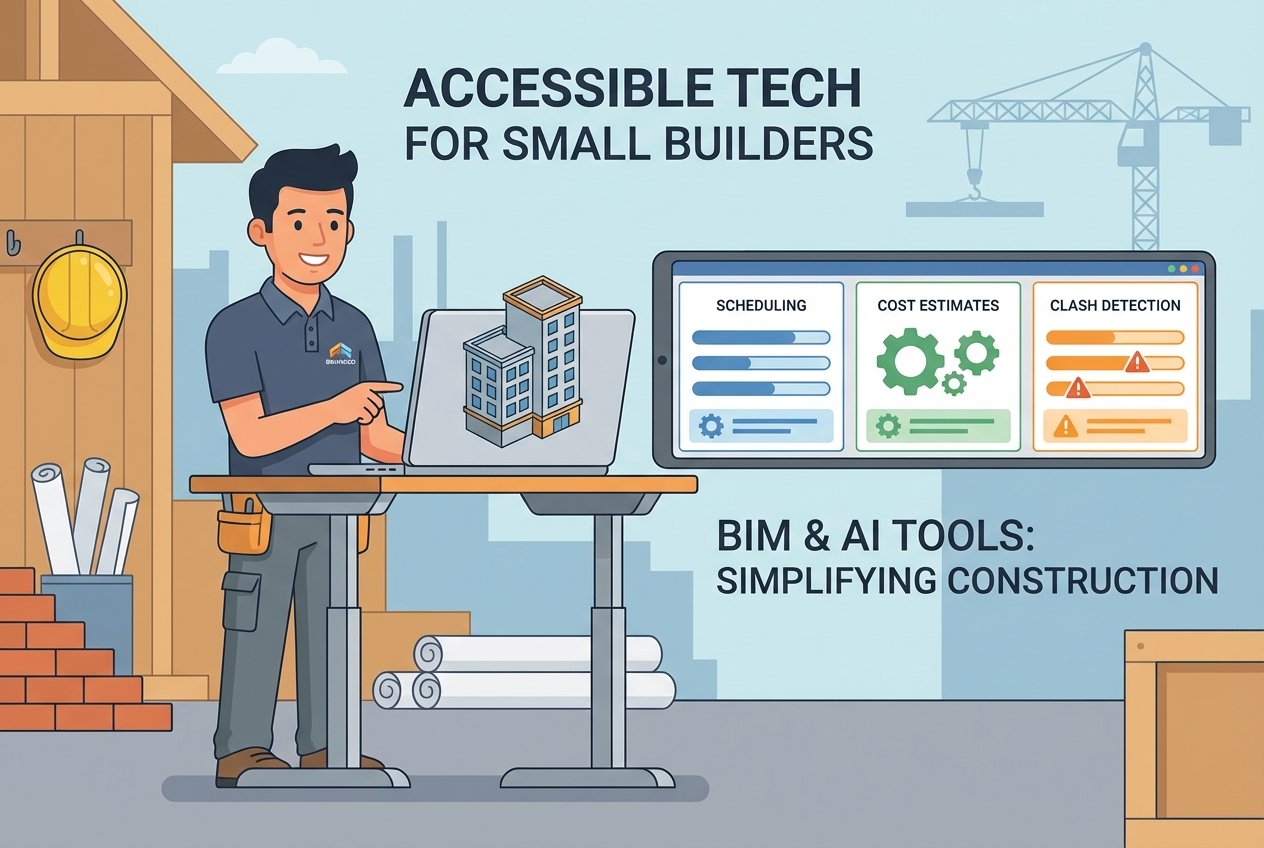
The good news for small builders is that you do not need a dedicated IT department or a six-figure software budget to start benefiting from construction technology in 2026. Here are the areas where AI is delivering the most immediate value:
1. AI-Powered Estimating and Takeoffs
Tools such as Beam and Bluebeam Revu use AI to scan drawings and automatically calculate material quantities and costs. For small builders spending hours producing manual takeoffs, this is an immediate time-saving win. Errors in estimating are one of the most common causes of margin erosion on small construction projects.
2. Predictive Scheduling and Risk Detection
AI-integrated project management platforms analyse historical project data and real-time site conditions to flag potential delays before they happen. According to Epicflow’s 2026 construction technology trends report, cloud-based BIM tools with AI scheduling capability can reduce project delays by up to 20%. For a small builder juggling multiple sites, that kind of foresight is invaluable.
3. BIM AI Clash Detection
One of the most powerful features within modern BIM platforms is automated clash detection. When structural, mechanical, and electrical models are combined, AI algorithms can identify conflicts between building elements before a single spade enters the ground. Research consistently shows that BIM reduces reworks on construction projects by as much as 31%. Rework is the silent profit killer for small contractors, so this capability alone justifies exploration.
4. Site Safety Monitoring
Computer vision AI tools can now analyse CCTV and drone footage in real time to detect safety hazards, missing PPE, and unsafe behaviours on site. For small businesses where the owner-director is often the site manager as well, having an AI-assisted safety layer offers genuine peace of mind and could reduce liability exposure.
5. Digital Document and Compliance Management
Platforms such as Procore and Fieldwire use AI to organise, version-control, and flag compliance issues across drawings, specifications, and O and M documentation. Keeping on top of documentation is a consistent pain point for small builders, particularly when working across multiple projects simultaneously.
The Best BIM and AI Tools for Small UK Builders in 2026
You do not need to commit to expensive enterprise software to get started with BIM AI. Below is a practical overview of the most relevant tools for small construction businesses in 2026:
- BuildersAI: A UK-built platform launching in 2025 with a free tier for up to five users. Combines AI-powered site coordination with construction management features, making it one of the most accessible entry points for small teams.
- Autodesk Revit with Forma: The industry-standard BIM authoring tool, now integrated with Autodesk Forma’s AI capabilities for site analysis including wind, noise, and daylight modelling. Better suited to design-and-build contractors.
- ArchiCAD: A more intuitive BIM platform than Revit for smaller teams, with a gentler learning curve and strong openBIM interoperability using IFC file formats.
- Procore: A comprehensive construction management platform with BIM viewing, AI-assisted scheduling, and document control. Pricing is enterprise-level but the return on investment is well-documented for businesses managing projects above £500K in value.
- Fieldwire: A mobile-first platform well suited to site teams, with a generous free tier and task management features. Ideal for small builders wanting a low-risk digital entry point.
- Bluebeam Revu and PlanSwift: Excellent takeoff and estimating tools for UK contractors, with strong AI-assisted measurement features that integrate with BIM workflows.
OpenBIM standards, built around interoperable IFC file formats, are particularly important for small builders who collaborate with larger contractors. Using openBIM-compliant tools means you are not locked into a single software vendor and can share models with main contractors regardless of what platform they use.
Understanding the Barriers and How to Overcome Them
Despite the compelling case for BIM AI adoption, small construction businesses face real barriers. The Munich Re HSB 2025 UK Construction Trends Report identified cost as the primary barrier for UK construction firms considering technology investment, with 26% citing implementation costs as the top obstacle. Skills gaps and the time required for staff training are close behind.
The UK construction industry also faces a significant recruitment challenge, with an estimated 937,000 new recruits needed over the next decade to meet growth projections. This skills shortage makes digital tools that improve individual productivity even more strategically important for small businesses.
Practical steps to overcome adoption barriers include:
- Start with one process: Rather than attempting a full digital transformation overnight, identify the single area where technology would make the biggest difference, whether that is estimating accuracy, document management, or site communication.
- Use free tiers and trials: Most of the tools mentioned above offer free plans or extended trials. Test before you invest.
- Leverage government resources: The UK BIM Framework, maintained by the British Standards Institution and the Centre for Digital Built Britain, provides free guidance documents and training resources specifically designed to support smaller businesses in adopting building information modelling.
- Invest in training: CITB (the Construction Industry Training Board) offers grants and funded training programmes for small construction businesses looking to upskill in digital construction.
How Kaizen AI Consulting Can Help Your Construction Business
Navigating the landscape of BIM AI tools, digital workflows, and construction technology can be genuinely overwhelming for busy small business owners who are already running sites, managing subcontractors, and chasing invoices. This is where specialist guidance makes a measurable difference.
At Kaizen AI Consulting, we work with UK businesses to cut through the noise and identify the AI and digital tools that will actually move the needle for your specific operation. We do not believe in technology for technology’s sake. Our approach is grounded in the Japanese philosophy of kaizen, continuous incremental improvement, which means we help you identify the small, high-impact changes that compound into significant competitive advantages over time.
Whether you are a small housebuilder trying to understand how building information modelling applies to your work, or a specialist subcontractor looking to win larger contracts that require BIM compliance, our team can help you build a practical, affordable digital strategy. Find out more about our AI consulting services and how we support businesses across the UK.
What the Future Holds: BIM AI Trends to Watch in 2026 and Beyond
The pace of change in construction technology is not slowing down. Based on the latest industry research, here are the BIM AI developments that small builders should monitor over the next 12 to 18 months:
Digital Twins
A digital twin is a live, data-connected virtual replica of a physical building or infrastructure asset. As sensor costs fall and connectivity improves, digital twins are moving from large infrastructure projects into residential and commercial construction. For small builders, the most relevant near-term application is using digital twins during the design and build phase to model performance before committing to construction.
Agentic AI in Construction Workflows
Agentic AI, where AI systems autonomously execute multi-step tasks rather than simply responding to prompts, is emerging as the next frontier in construction project management. According to Construction Briefing’s seven trends for 2026, agentic AI is expected to move from early pilots into real-world construction workflows this year, automating scheduling, procurement, and compliance tasks end-to-end.
Sustainability and BIM
With the UK government’s net zero commitments driving tighter building regulations, BIM’s ability to model energy performance, material carbon footprints, and whole-life costs is becoming increasingly valuable. Nearly 60% of UK contractors are already using BIM for energy coordination on projects, and this proportion is set to grow as Part L and Future Homes Standard requirements tighten.
Common Data Environments Becoming Standard
A Common Data Environment (CDE) is a single source of truth for all project information. What was once a requirement on government mega-projects is rapidly trickling down to mid-size and even smaller contracts. Small builders who familiarise themselves with CDE workflows now will be far better positioned to collaborate on higher-value projects.
Getting Started: Your Three-Step Action Plan
If you are a small construction business owner reading this and wondering where to begin, here is a simple three-step action plan:
- Audit your current processes: Identify where time is being lost, where errors are occurring, and where communication breaks down on your projects. These are your priority areas for digital intervention.
- Pick one tool and commit to it: Choose a single BIM or AI tool that addresses your biggest pain point, sign up for a free trial, and dedicate two weeks to genuinely testing it on a live or recent project.
- Seek expert guidance: The investment in a short strategy session with a specialist can save months of trial and error. Get in touch with Kaizen AI Consulting today for a no-obligation conversation about how AI and building information modelling can be practically applied to your construction business.
The construction businesses that thrive in the next decade will not necessarily be the largest or the most established. They will be the ones that embrace construction technology thoughtfully, improve their processes incrementally, and make smarter use of the data that already surrounds every project they deliver.
The tools are there. The opportunity is real. The question is simply whether you are ready to take the first step.