The Future of Trades: How AI is Changing the UK Construction Industry
The UK construction and trades sector is standing at a pivotal crossroads. On one side sits a persistent skills shortage, rising material costs, and shrinking productivity. On the other lies a rapidly advancing wave of artificial intelligence that is reshaping how buildings are designed, managed, and built. From sole-trader electricians in Manchester to large civil engineering firms working on major infrastructure projects in London, the future of trades is being rewritten by technology in ways that few could have predicted even five years ago.
This is not a distant prospect. According to Persistence Market Research, the global AI in construction market is projected to grow from USD $6.2 billion in 2026 to USD $32 billion by 2033, representing a compound annual growth rate of 26.4%. The European segment alone was valued at USD $1.43 billion in 2025 and is forecast to reach USD $1.80 billion in 2026, according to Market Data Forecast. For the UK building industry, the question is no longer whether AI will transform the sector, but how quickly businesses choose to act.
The State of the UK Building Industry in 2026
Before exploring the opportunities AI presents, it is important to understand the pressures the UK construction sector is currently navigating. According to the Office for National Statistics, total construction output fell by 2.0% in the three months to January 2026, the fourth consecutive quarterly decline, with private new housing particularly hard hit at -6.3%.
Compounding this output challenge is a severe and worsening labour shortage. Data from the BCIS shows that the construction workforce averaged just over 2 million workers across 2025, a 0.9% decrease on the previous year. More strikingly, Bricks and Bytes reports that 72% of UK construction firms are now affected by skilled labour shortages, up from 61% in the first half of 2025. With projections suggesting the industry needs an additional 239,000 workers by 2029, technology adoption is no longer a luxury. It is a strategic imperative.
It is precisely this backdrop that makes construction AI trends so compelling for business owners in the trades. AI does not replace skilled workers. It amplifies what skilled workers can do, helping businesses take on more jobs, reduce errors, improve safety, and win more contracts.
Key Ways AI is Transforming the UK Trades Sector
1. Predictive Scheduling and Project Management
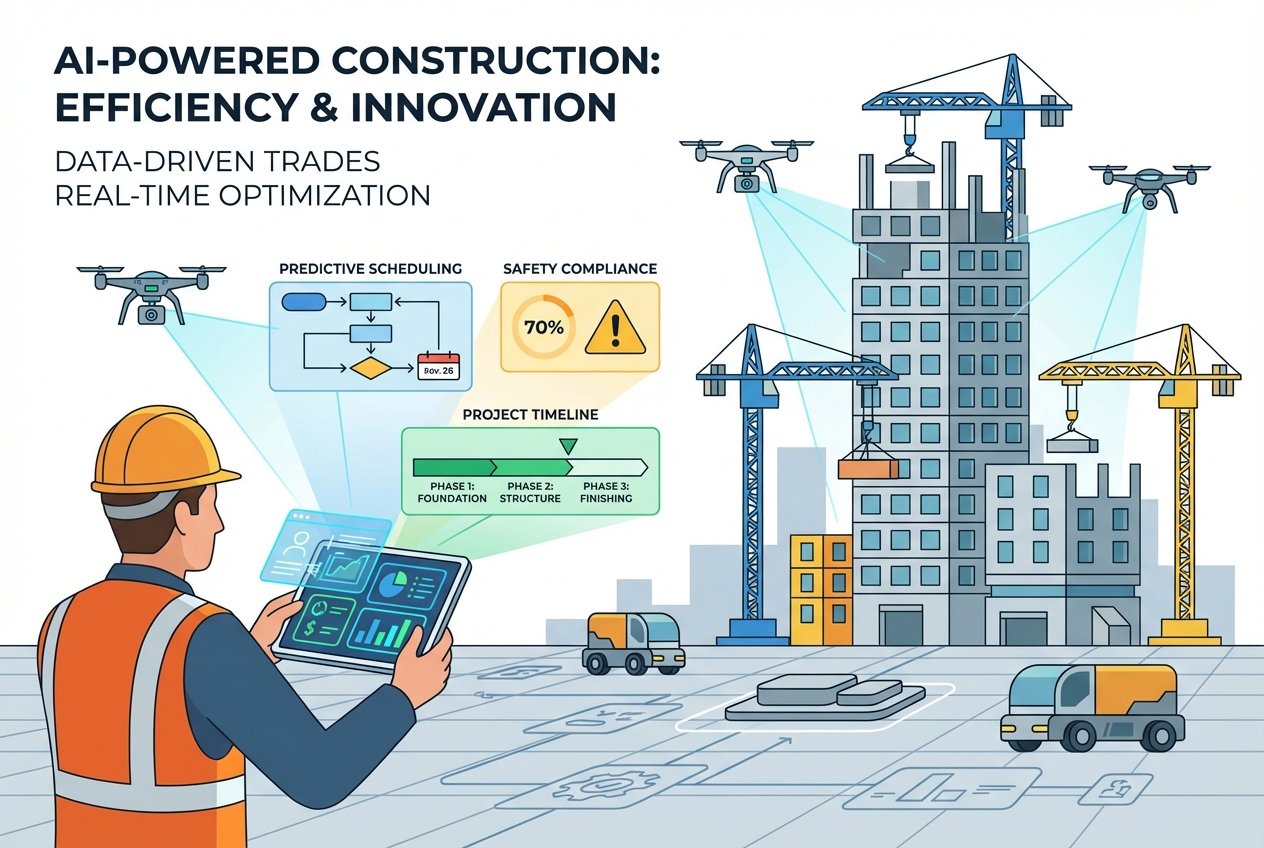
One of the most immediately impactful applications of AI in the UK building industry is predictive project scheduling. Traditional scheduling relies on experience and spreadsheets, leaving it vulnerable to human error, unforeseen delays, and resource conflicts. AI-powered scheduling tools analyse historical project data, weather forecasts, subcontractor availability, and supply chain information to produce optimised plans that can flag bottlenecks before they materialise.
According to Finlay Jude Associates, AI deployment for predictive scheduling and resource optimisation is already delivering up to 20% reductions in project timelines for firms that have adopted it. For a small building company juggling multiple residential jobs, that kind of efficiency gain translates directly into additional revenue and happier clients.
Platforms like BigChange are enabling UK tradespeople to automate job allocation, route planning, and appointment booking through intelligent systems that take into account engineer skills, location, and job urgency. BigChange notes that job management software powered by AI is now allowing tradespeople to optimise their working day in ways that were previously only available to large enterprise businesses.
2. AI-Powered Quoting, Estimating, and Invoicing
Quoting and estimating represent some of the most time-consuming administrative tasks for tradespeople. A busy sole-trader plumber or electrician might spend several hours each week producing quotes, following up on enquiries, and chasing invoices. AI is changing this entirely.
Tools such as Zynoff, highlighted by Zynoff UK, use AI to automate quote generation using real-time supplier pricing and van inventory data, ensuring accuracy while dramatically reducing preparation time. According to research published by Digital Ascendancy, small business owners using AI productivity tools are saving over 20 hours per week on administrative tasks, time that can be reinvested into taking on additional jobs or developing the business.
In preconstruction, AI-powered quantity takeoff tools are achieving over 90% accuracy when extracting measurements from PDFs and DWG drawings, as noted by CMiC. For larger building contractors, this level of accuracy reduces change orders and costly rework significantly.
3. Customer Communication and Lead Generation
Winning new work is the lifeblood of any trades business, yet many SME contractors still rely on word of mouth and reactive enquiry handling. AI is enabling a more proactive and professional approach to customer communication and trades technology for lead generation.
AI chatbots and automated communication systems can now handle inbound enquiries 24 hours a day, seven days a week, qualifying leads, booking appointments directly into a tradesperson’s calendar, and sending follow-up messages to prospects who have not yet committed. Powered Now reports that these tools can automate the entire customer journey from first enquiry to booked job, freeing tradespeople to focus on the actual work.
This kind of intelligent automation is exactly where expert guidance makes a real difference. At Kaizen AI Consulting, we work with UK trades and construction businesses to identify the highest-impact AI tools for their specific workflows, helping them implement customer communication systems that win more enquiries without adding to the administrative burden.
4. Health, Safety, and Compliance
Health and safety compliance is a major operational responsibility for any UK construction or trades business, and AI is proving to be a powerful ally in managing it more effectively. Computer vision systems mounted on site cameras can now automatically detect workers not wearing appropriate PPE, identify unsafe working practices, and alert site managers in real time.
According to the Civil Engineering Contractors Association (CECA) AI in UK Construction report, AI is being used to capture and analyse site data, intelligently flagging poor health and safety behaviours while highlighting potential risks to workers before incidents occur. For trades businesses that operate across multiple sites, AI-powered compliance monitoring reduces the risk of costly HSE enforcement actions and helps build a stronger safety culture.
Digital job management platforms are also automating the production of safety certificates, risk assessments, and compliance documentation, ensuring that tradespeople always have the correct paperwork in place without spending hours completing forms manually.
5. Robotics, BIM, and the Cutting Edge of Construction Technology
For larger contractors, the future of trades technology extends to robotics and digital twins. Bricklaying robots, autonomous rebar tying machines, and AI-guided drones for site surveys are moving from experimental pilots to practical site deployment. According to Autodesk’s 2026 AI Construction Trends report, which draws on insights from over 25 industry experts, AI systems are beginning to draw on spatial context captured from the built environment, enabling more intelligent design and site management decisions.
Building Information Modelling (BIM) combined with AI is enabling contractors to run digital twins of projects, simulating different scenarios before any physical work begins. This approach is already delivering up to 80% reductions in manual data entry according to Finlay Jude Associates, while also improving coordination between trades and reducing clashes that lead to expensive rework on site.
The Adoption Challenge: Where UK Firms Currently Stand
Despite the compelling evidence in favour of AI adoption, the UK construction sector remains cautious. The RICS Artificial Intelligence in Construction Report 2025 found that 45% of construction organisations surveyed reported no AI implementation at all, with only 15% indicating current adoption. Encouragingly, 56% of investors plan to increase AI spending, suggesting the gap is beginning to close.
Government policy is supporting this shift. The UK’s AI Opportunities Action Plan One Year On, published in January 2026, confirmed that 38 of the plan’s original 50 commitments have been delivered, including AI skills training programmes and new tools to accelerate planning and housing delivery. The government has identified AI as central to its growth agenda, with techUK estimating a £550 billion AI economic opportunity for the UK overall.
The barriers to adoption for many SME trades businesses are not technological. They are practical: knowing which tools to start with, how to integrate them into existing workflows, and how to train teams to use them effectively. Overcoming these barriers is where professional guidance proves invaluable, and it is something the team at Kaizen AI Consulting specialises in, having supported UK businesses across industries in making AI work practically and profitably.
What Does This Mean for Your Trades Business?
Whether you run a one-person electrical contracting business in Birmingham or manage a regional roofing and cladding company in the North West, the construction AI trends shaping the wider industry are increasingly accessible to businesses of every size. The entry cost for AI tools has fallen dramatically, and many of the platforms designed specifically for UK tradespeople are available on affordable monthly subscription models.
The businesses that will thrive in the future of trades are those that begin exploring and implementing AI tools now, before their competitors. Those that wait risk falling behind on efficiency, losing price-competitive tenders, and struggling to attract the technology-literate younger workforce that the industry urgently needs.
A sensible starting point is to audit your current workflows and identify the two or three areas where AI could have the greatest immediate impact, whether that is faster quoting, automated customer follow-up, improved safety compliance, or more accurate project scheduling. From there, a phased implementation plan ensures that technology is embedded effectively rather than abandoned after a poor first experience.
Take the Next Step with Expert AI Guidance
Understanding the opportunity is one thing. Knowing how to act on it is another. If you are a UK construction or trades business owner looking to understand how AI can be applied practically within your operations, Kaizen AI Consulting is here to help. Our team works with businesses across the UK building industry to design and implement AI strategies that deliver measurable results without overwhelming your team or disrupting your day-to-day operations.
Ready to future-proof your trades business? Get in touch with Kaizen AI Consulting today to arrange a no-obligation consultation and discover how the right AI tools can transform the way you work. You can also explore our insights on business growth and technology adoption to see how other UK businesses are benefiting from a smarter approach to AI implementation.
The UK building industry is changing fast. The businesses that embrace the future of trades technology today will be the ones leading their markets tomorrow.