For any UK business looking to grow in a competitive marketplace, online reviews are no longer a nice-to-have. They are a fundamental pillar of your digital presence, customer trust, and local search visibility. Yet despite their proven importance, the vast majority of businesses still rely on manual, ad hoc approaches to collecting feedback. That is where review automation powered by artificial intelligence is transforming the game.
In this guide, we explore how to build an automated review request system using AI, why it matters more than ever in 2026, and how your business can start generating a steady, consistent stream of authentic customer reviews without lifting a finger every time.
Why Customer Reviews Matter More Than Ever in 2026
The numbers are striking. According to Trustpilot’s UK Growth Research, 91% of UK businesses agree that positive online reviews can directly impact revenue growth, and 85% say reviews help build the kind of brand trust that converts browsers into buyers.
For consumers, the influence is equally powerful. Research published by SQ Magazine in 2026 found that consumers spend up to 31% more with businesses that have excellent reviews, and 93% say reviews directly influence their purchasing decisions. Furthermore, 41% of buyers specifically filter by recent reviews, meaning the age of your reviews matters just as much as the volume.
From an SEO perspective, the case is equally compelling. Google Reviews alone contribute approximately 15% to Local Pack rankings, with businesses that have higher review counts and better recency consistently appearing at the top of local search results across the UK. If you are investing in local SEO, ignoring review generation is leaving significant visibility on the table.
The Problem with Manual Review Collection
Most businesses understand the value of reviews. The challenge is consistency. Manually asking every customer for a review after every transaction is time-consuming, easy to forget during busy periods, and produces an unpredictable, sporadic trickle of feedback rather than a reliable stream.
This is a real problem, because 68% of shoppers filter search results by recency, meaning a business that gathered 50 reviews two years ago but has collected nothing since is actively losing trust signals compared to a competitor with 20 recent reviews from this month.
The solution is to remove the human bottleneck entirely by using an automated, AI-driven system that requests reviews at exactly the right moment, with personalised messaging, across the right channels.
How AI-Powered Review Automation Works
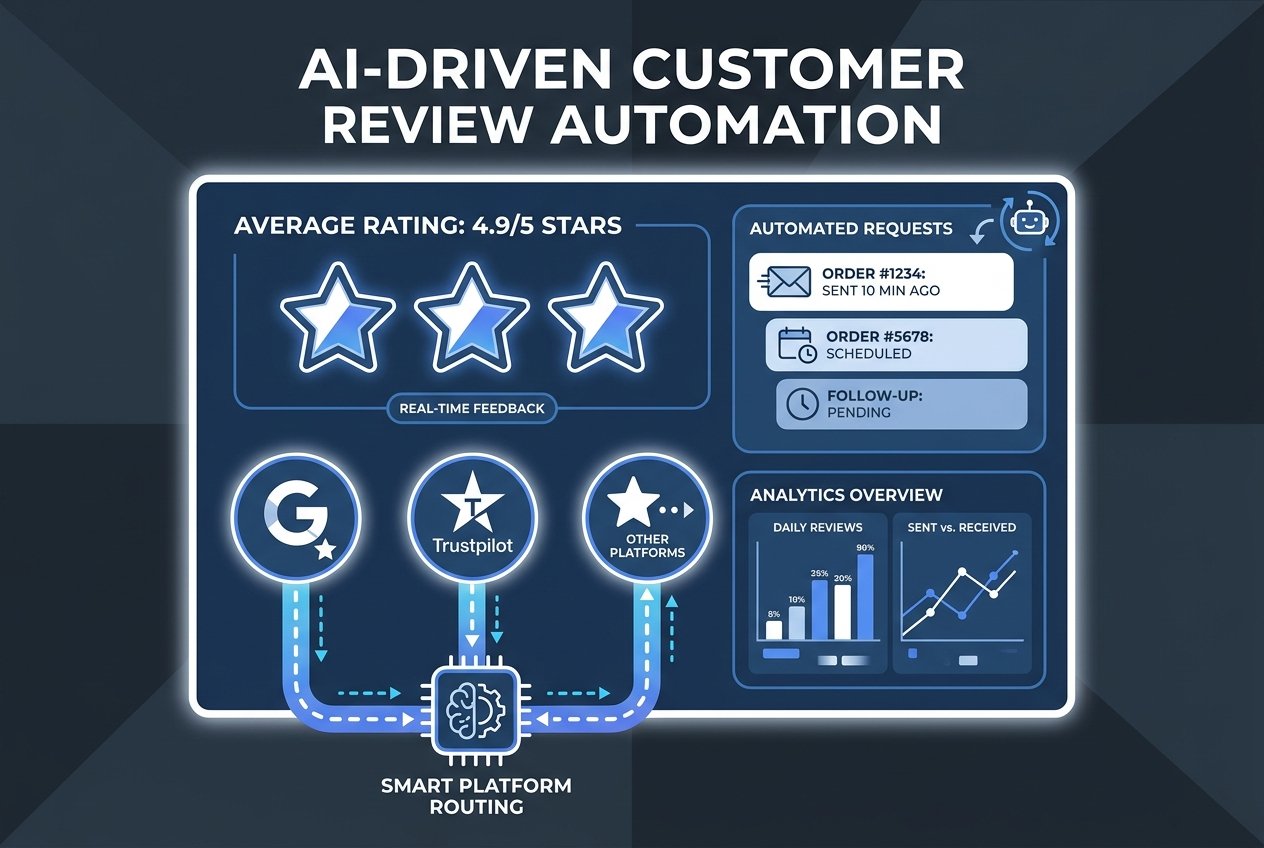
An AI-powered review request system works by connecting your business operations to your reputation management workflow through intelligent automation. Here is how a typical system functions step by step:
1. Trigger Events
The system monitors your business tools, whether that is your CRM, point-of-sale platform, appointment booking software, or invoicing system, for specific trigger events. These could include a completed appointment, a paid invoice, a delivered order, or a closed service ticket. The moment the trigger fires, the automated workflow begins.
2. AI-Personalised Messaging
Rather than sending a generic, one-size-fits-all message, AI analyses available customer data to personalise the review request. This might include referencing the specific service received, addressing the customer by name, and selecting the most appropriate communication channel, such as SMS, email, or WhatsApp. According to a 2026 guide by CAI Creative, personalised review requests sent shortly after a trigger event, typically within one to two hours, generate significantly higher response rates than generic messages sent days later.
3. Smart Timing and Follow-Ups
AI systems can optimise the exact time of day a message is delivered based on historical engagement patterns. If your customers are most responsive on a Tuesday morning, the system learns this and adjusts accordingly. If no review is left, a gentle follow-up is triggered automatically after a set number of days, without any manual input required from your team.
4. Platform Routing
Depending on your business goals, the system can direct customers to the most strategically valuable platform, whether that is your Google Business Profile to boost local SEO, your Trustpilot page to build ecommerce credibility, or an industry-specific review site relevant to your sector.
5. Sentiment Analysis and Reputation Protection
Advanced review automation systems incorporate AI-driven sentiment analysis. Before routing a customer to a public review platform, some systems present an internal satisfaction survey first. Customers who express dissatisfaction are directed to a private feedback channel where the issue can be resolved, while happy customers are seamlessly guided to leave a public review. This approach protects your public reputation while still capturing valuable internal feedback from less satisfied customers.
Integrating Review Automation into Your Existing Tools
One of the most practical advantages of modern feedback collection automation is how easily it integrates with tools UK businesses are already using. Platforms such as Zapier and Make.com allow businesses to build no-code automation workflows that connect their CRM, booking software, or e-commerce platform to their review management system without any technical development work required.
Common integrations include:
- Google Business Profile – for directing customers to leave Google reviews that boost local SEO rankings
- Trustpilot – for building verified review credentials that increase consumer confidence
- HubSpot or ActiveCampaign – for triggering automated email sequences post-purchase
- Calendly or Acuity – for sending review requests after completed appointments
- Xero or QuickBooks – for triggering requests upon invoice payment
At Kaizen AI Consulting, we specialise in building exactly these kinds of smart automation workflows for UK businesses. From mapping your customer journey to selecting the right platforms and configuring personalised messaging sequences, our team handles the full implementation so you can focus on delivering great service while the reviews flow in automatically.
GDPR Compliance and Review Collection in the UK
For UK businesses, any automated system that communicates with customers must comply with UK GDPR and the Privacy and Electronic Communications Regulations (PECR). When building a review automation workflow, there are several key compliance considerations to keep in mind:
- Lawful basis for contact – Review requests to existing customers typically fall under the soft opt-in rule for marketing, provided the request is directly related to a product or service they have purchased and they were given a clear opportunity to opt out at the time of sale.
- Opt-out mechanisms – Every automated message should include a clear and simple unsubscribe option.
- Data minimisation – Only use the customer data necessary to send the review request. Avoid storing unnecessary personal information within your automation platform.
- Third-party processors – If you are using an automation tool like Zapier or a CRM platform to process customer data, ensure appropriate data processing agreements are in place.
Working with an experienced AI consultant ensures your review automation system is built with compliance baked in from the start, rather than retrofitted as an afterthought.
The Impact on Your Reputation Management Strategy
Building an automated review request system is not just about collecting more reviews. It is a central component of a broader reputation management strategy that influences how your business is perceived across every digital touchpoint.
Research shows that 88% of consumers prefer businesses that respond to all their reviews, and businesses that actively manage their online reputation see up to 25% more revenue growth than those that do not. When combined with an AI-powered response system that drafts personalised responses to new reviews, the entire reputation management cycle becomes largely automated, freeing your team from hours of manual monitoring and writing.
Furthermore, a steady stream of recent, positive reviews strengthens your E-E-A-T signals (Experience, Expertise, Authoritativeness, and Trustworthiness), which Google increasingly uses as a ranking factor. This means that a well-executed customer reviews AI strategy simultaneously improves your search visibility, your conversion rate, and your brand credibility.
You can learn more about how AI fits into a wider growth strategy on our Kaizen AI Consulting homepage, where we outline the tools and frameworks we use to help UK businesses grow smarter.
Building Your Review Automation System: A Practical Starting Point
If you are ready to move from manual review requests to a fully automated system, here is a practical framework to follow:
- Audit your current review profile – Understand your starting position on Google, Trustpilot, and any industry-specific platforms. Identify gaps in recency and volume.
- Map your customer journey – Identify the key post-purchase or post-service moments where a review request would feel natural and timely.
- Choose your automation platform – Select a no-code tool such as Zapier, Make.com, or a dedicated review management platform that integrates with your existing business tools.
- Craft AI-personalised message templates – Write review request templates for each channel (email, SMS, WhatsApp) and use AI to personalise them with customer-specific variables.
- Set up sentiment routing – Configure your system to route unhappy customers to a private feedback form and satisfied customers to your chosen public review platform.
- Monitor, respond, and optimise – Use a reputation management dashboard to monitor incoming reviews, respond promptly, and use the data to continuously refine your messaging and timing.
Let Kaizen AI Consulting Build It for You
Creating and configuring an effective automated review request system requires a solid understanding of both AI tools and the specific nuances of your business and customer journey. Getting it wrong, such as sending review requests at the wrong time, using the wrong channel, or failing to comply with UK GDPR requirements, can undermine trust rather than build it.
The team at Kaizen AI Consulting has helped numerous UK businesses design, implement, and optimise automated review and reputation management systems that generate consistent five-star feedback and tangible improvements in local search visibility. Whether you are starting from scratch or looking to improve an existing process, we would love to help.
Ready to put your reputation management on autopilot? Contact Kaizen AI Consulting today for a free consultation and find out how we can build a custom review automation system tailored to your business.