AI for Recruitment: How Small Businesses Can Hire Faster and Smarter
Hiring the right people has always been one of the biggest challenges facing small businesses in the UK. Between writing job adverts, sifting through stacks of CVs, coordinating interviews, and chasing references, the recruitment process can consume weeks of time and thousands of pounds, resources that small business owners simply cannot afford to waste. Now, AI recruitment tools are changing the game, putting enterprise-grade hiring capabilities directly into the hands of SMEs at a fraction of the traditional cost.
According to a late-2025 survey of nearly 500 UK recruitment managers, the average time to hire in the UK is 4.9 weeks, with some roles taking as long as eight weeks from application to offer. For a small business with a lean team, every unfilled seat is a drag on productivity and growth. The good news? The same research found that organisations using AI-powered recruitment tools can reduce their time to hire by as much as 26%. That is the difference between a role sitting vacant for two months and having the right person at their desk in under six weeks.
In this guide, we break down exactly how AI recruitment UK tools work, which platforms are best suited to small businesses, and how you can start implementing hiring automation today, without a dedicated HR team or a corporate-sized budget.
The State of Small Business Hiring in 2026
Before diving into the technology, it is worth understanding the landscape. UK small businesses are facing a genuinely difficult hiring environment right now. According to Totaljobs’ 2026 Hiring Trends Update:
- 55% of UK employers cite longer time-to-hire as one of their top challenges.
- 56% of employers are dealing with decreasing hiring budgets.
- 58% of employers are struggling to fill roles because skills requirements keep evolving.
- 53% of employers face pressure to meet candidates’ salary and flexible-working expectations.
Meanwhile, the StandOut CV AI in Recruitment Statistics 2026 report highlights a stark divide: 70% of enterprise-sized businesses already use applicant tracking system (ATS) software to screen CVs, compared to just 20% of SMEs. This technology gap means small businesses are spending far more time on manual, repetitive hiring tasks than their larger competitors, while also losing top candidates to businesses that respond faster.
The opportunity here is enormous. 3 in 10 UK employers are now implementing AI in their recruitment process, and 70% of recruiters who have adopted AI tools say it has improved their hiring decisions. For small businesses, catching up is not just possible; it is now genuinely affordable.
What Is AI Recruitment and How Does It Work?
AI recruitment refers to the use of artificial intelligence and machine learning to automate or enhance various stages of the hiring process. Rather than replacing the human judgement at the heart of good hiring, candidate screening AI and related tools handle the time-consuming, repetitive tasks that slow businesses down, freeing up owners and managers to focus on the conversations that matter.
Modern HR AI tools can assist with:
- Job description writing: AI tools analyse your role requirements and generate optimised, inclusive job adverts in minutes, reducing unconscious bias and improving response rates.
- Multi-channel job posting: Automatically distribute your vacancies across dozens of job boards simultaneously, including Indeed, LinkedIn, Reed, and Totaljobs.
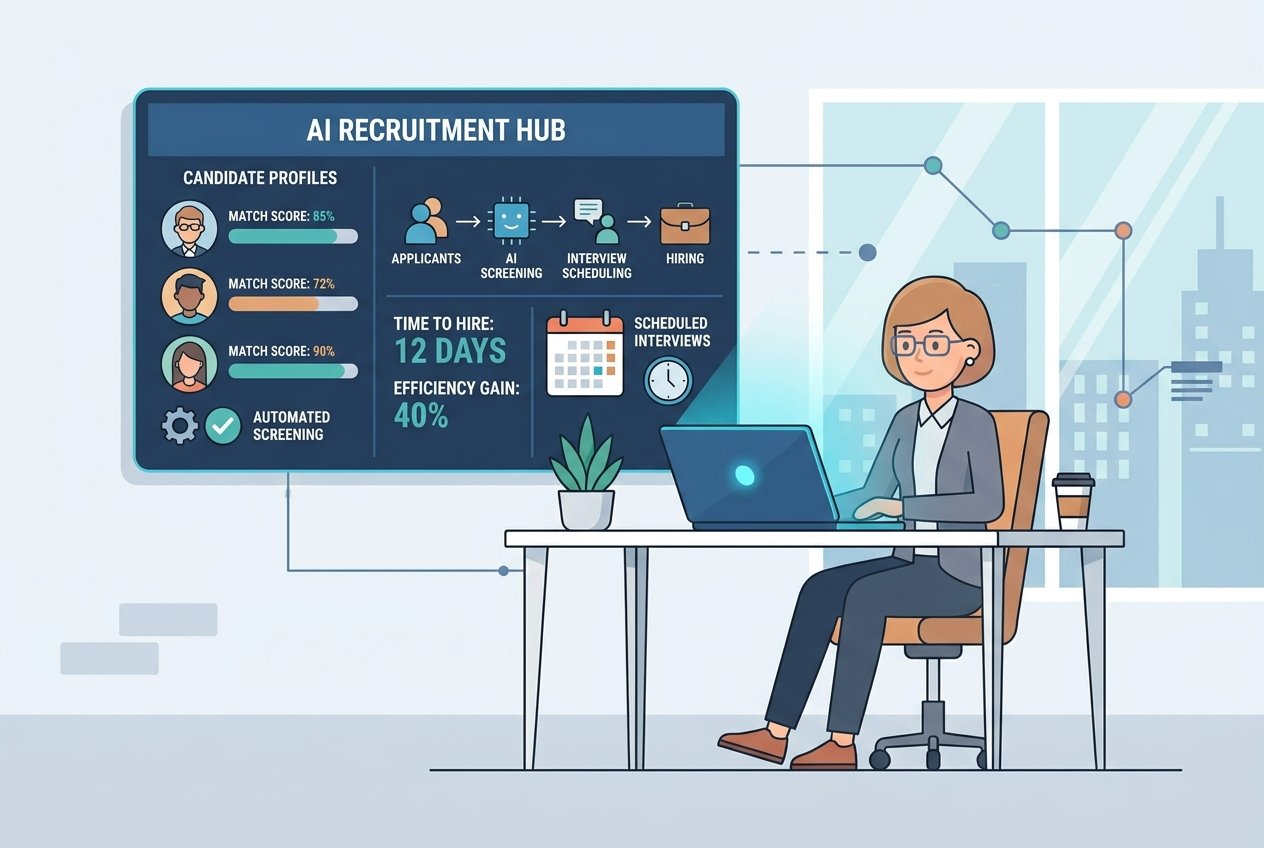
- CV and application screening: AI parses incoming CVs, scores candidates against your criteria, and ranks applicants so you review the most relevant profiles first.
- Candidate sourcing: Tools like Workable’s AI Recruiter search databases of over 400 million profiles to surface passive candidates who match your role, people who are not actively job hunting but would be a strong fit.
- Interview scheduling: Automated scheduling tools eliminate the back-and-forth of arranging interviews, saving hours of email coordination per hire.
- Candidate communication: AI chatbots keep applicants informed at every stage, improving candidate experience and reducing drop-off rates.
- Compliance and documentation: AI tools help ensure your hiring process stays compliant with UK employment law and GDPR requirements.
For small businesses, the cumulative time savings across these tasks are transformative. Research from Bullhorn UK found that high-growth recruitment firms using AI automation achieve 36% more placements per recruiter and a 22% higher fill rate. Even applying a fraction of those gains to a small business context represents a significant competitive advantage.
The Best AI Recruitment Tools for UK Small Businesses
Choosing the right tool depends on your hiring volume, budget, and specific pain points. Here is a breakdown of the most suitable platforms for UK SMEs in 2026.
Zoho Recruit: Best Budget All-Rounder
Zoho Recruit offers a free plan and paid options from around £25 to £30 per month, making it one of the most accessible entry points into AI recruitment for small businesses. It includes AI-powered CV parsing, automated workflows, applicant tracking, and structured hiring pipelines. If you are hiring occasionally across a small number of roles and want to reduce admin without a large investment, Zoho Recruit is an excellent starting point.
Workable: Best All-in-One Platform
For businesses that hire more regularly, Workable is widely regarded as one of the strongest all-in-one hiring tools available. Starting at around £149 per month, it combines AI candidate sourcing, job description assistance, CV screening, interview scheduling, and pipeline management in a single platform. Its AI Recruiter feature searches a database of over 400 million candidate profiles to find passive talent, a capability that would previously have required a dedicated recruitment agency.
Manatal: Best for AI Matching on a Budget
Manatal delivers strong AI candidate matching and resume parsing at a budget-friendly price point, making it a favourite for UK startups and growing small businesses. Its drag-and-drop pipelines and social profile enrichment features help small teams manage hiring professionally without the complexity of enterprise software.
Recooty: Best for Simplicity
If you want a straightforward ATS with built-in candidate screening AI and scheduling, Recooty is hard to beat. It offers AI resume parsing, candidate scoring, one-click job posting to multiple boards, and an integrated interview scheduler, all in a package designed for teams without a dedicated HR function.
Textio: Best for Job Description Quality
Research consistently shows that inclusive, well-written job adverts attract a wider and stronger pool of applicants. Textio uses AI to analyse your job descriptions, flag biased or exclusionary language, and suggest improvements that increase response rates. For UK SMEs struggling to attract diverse talent in a competitive market, this is a high-impact, low-cost intervention.
Practical Steps: Implementing AI Recruitment in Your Small Business
Getting started with small business recruitment automation does not require a large budget or technical expertise. Here is a practical framework for introducing AI into your hiring process.
Step 1: Audit Your Current Hiring Process
Before selecting any tools, map out where your time actually goes during a typical hire. Most small business owners find that the biggest time drains are CV screening, interview scheduling, and candidate communication. Identifying your specific bottlenecks helps you choose tools that solve real problems rather than adding unnecessary complexity.
Step 2: Start with an Affordable ATS
An applicant tracking system is the foundation of any automated recruitment process. Start with a free or low-cost option like Zoho Recruit or Recooty. Even a basic ATS will centralise your applications, eliminate email chaos, and give you a structured process to build on.
Step 3: Use AI to Improve Your Job Adverts
Before you post your next vacancy, run your job description through an AI writing tool or a specialist platform like Textio. Better adverts attract better candidates and reduce the volume of unsuitable applications you need to screen, saving time at every subsequent stage.
Step 4: Automate Candidate Communication
Set up automated acknowledgement emails and status updates so candidates are kept informed without requiring manual intervention. This improves your employer brand and reduces the number of candidates who drop out of your process due to poor communication, a significant issue given that 40% of employers now use AI chatbots to communicate with candidates.
Step 5: Layer in Sourcing When Ready
Once your inbound process is running smoothly, consider adding an AI sourcing tool like Workable to reach passive candidates. This is particularly valuable in skill-short sectors where the best candidates are already employed and not actively looking.
Navigating the Risks: What Small Businesses Need to Know
AI recruitment tools bring genuine benefits, but small business owners should also be aware of the risks and responsibilities involved.
Bias in AI systems: AI tools trained on historical hiring data can inadvertently perpetuate existing biases. Always review your screening criteria carefully and audit your AI tool’s recommendations periodically to ensure you are not inadvertently discriminating against protected groups under the Equality Act 2010.
Candidate experience: While 47% of UK job seekers have now been interviewed by an AI system, 30% have walked away from a hiring process they felt relied too heavily on AI. Use automation to handle admin and scheduling, but ensure real human interaction remains central to the candidate experience, especially for final-stage interviews.
Data protection: Any AI recruitment tool you use will process personal data on your behalf. Ensure your chosen platform is GDPR compliant, provides a Data Processing Agreement (DPA), and stores data within the UK or EEA where possible.
At Kaizen AI Consulting, we help UK small businesses navigate exactly these considerations, from selecting and configuring the right AI recruitment tools to ensuring your processes are legally compliant and genuinely effective. Our team of AI and business consultants understands the specific challenges facing UK SMEs, and we bring that expertise to every engagement. Explore our services to see how we can support your hiring strategy.
The Numbers That Make the Case
For any small business owner still weighing up whether the investment is justified, consider these figures:
- The average UK time to hire is currently 4.9 to 8 weeks, with an unfilled role costing businesses in lost productivity every single day.
- AI recruitment tools can reduce time to hire by up to 26%, potentially cutting weeks off every vacancy.
- According to the GOV.UK AI Adoption Research, only 16% of UK businesses are currently using AI technology, meaning early adopters have a significant competitive advantage in the war for talent.
- High-growth firms using AI are 4 times more likely to outperform their competitors on key recruitment metrics, according to Bullhorn UK.
- AI tools for small businesses typically cost between £25 and £150 per month, a fraction of the cost of a single agency fee for even a junior hire.
The ROI case for AI recruitment UK is compelling, and the barrier to entry has never been lower.
How Kaizen AI Consulting Can Help
Understanding which AI tools to use is one thing. Implementing them in a way that integrates seamlessly with your existing processes, complies with UK employment law, and genuinely improves your hiring outcomes is another challenge entirely. That is where specialist support makes a real difference.
At Kaizen AI Consulting, we work with UK small businesses to design and implement practical AI strategies that deliver measurable results. Whether you are hiring your first member of staff or scaling a team rapidly, we can help you build a recruitment process that is faster, smarter, and more cost-effective. From tool selection and configuration to process design and staff training, our consultants provide hands-on support at every step.
Ready to transform how you hire? Get in touch with our team today for a free consultation on how AI recruitment tools can work for your business.
Final Thoughts
The adoption of HR AI tools in recruitment is no longer a trend reserved for large corporations. In 2026, accessible, affordable, and highly effective AI recruitment platforms are available to every UK small business, and the evidence that they deliver real results is growing stronger by the month.
The businesses that move first will build faster, leaner, and more effective hiring processes while their competitors are still drowning in spreadsheets and email chains. With the right tools and the right guidance, small business recruitment in the UK does not have to be slow, expensive, or frustrating. It can be one of your most significant competitive advantages.
For more insights on how artificial intelligence can transform your business operations, explore our latest articles on AI strategy and implementation for UK SMEs.