Artificial intelligence is no longer the preserve of Silicon Valley giants. In 2026, it is firmly in the hands of UK shop owners, solicitors, marketing agencies, and tradespeople who want to work smarter, not harder. Building the right AI stack small business setup is now one of the most impactful strategic decisions a founder or director can make. Yet many SMEs still struggle to identify which AI tool combination will actually deliver measurable results rather than digital clutter.
This guide cuts through the noise. We outline the five essential tools that form a complete business AI setup for UK SMEs in 2026, explain how they connect, and show you how to start without overspending or overcomplicating your operations.
Why 2026 Is the Tipping Point for UK SME AI Adoption
Government figures show that around 16% of UK businesses are currently using at least one AI technology, with a further 5% planning to adopt within the coming months. Among small firms below 50 employees, research from the University of Cambridge analysing ONS data suggests adoption reached 26% by 2025. While this signals strong growth, it also means the majority of UK SMEs are still yet to harness AI’s potential.
The barriers are well documented. Industry surveys identify lack of expertise as the top obstacle at 35%, followed by high costs and uncertainty around return on investment. The good news is that the right AI toolkit UK approach directly addresses each of these concerns by starting small, integrating thoughtfully, and scaling only when value is proven.
At Kaizen AI Consulting, we work with UK SMEs to map practical AI workflows that fit existing teams and budgets. If you are unsure where to begin, our team can assess your current processes and recommend a tailored SME AI tools roadmap that avoids the common trap of buying software that sits unused.
The Five-Tool Business AI Setup Every UK SME Needs
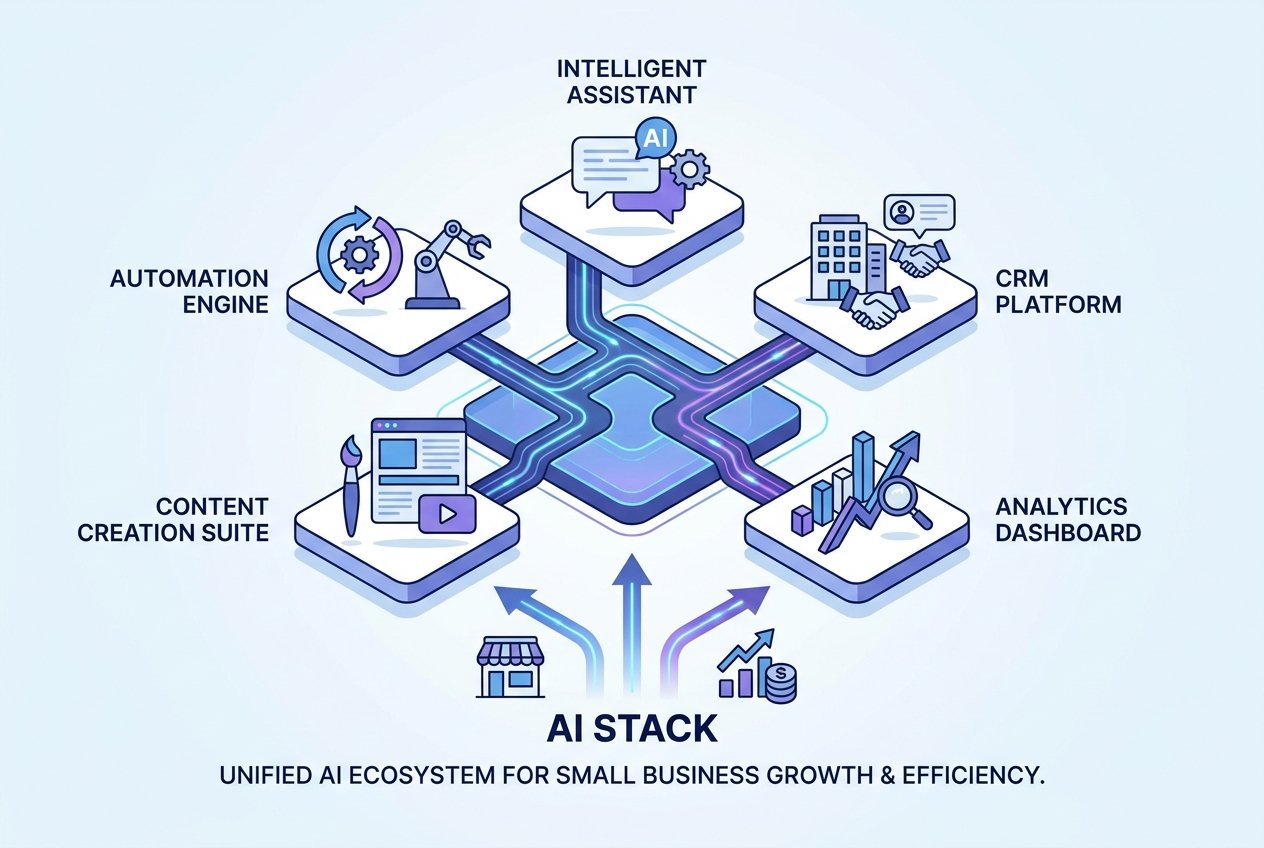
Based on the latest 2026 industry reviews and adoption patterns, the most effective AI stack small business framework combines five core capabilities. Each tool serves a distinct function, and together they create a unified operational backbone.
1. The Intelligent Assistant: ChatGPT, Claude, or Gemini
Every modern business AI setup starts with a large language model. ChatGPT, Claude, and Gemini have become the Swiss Army knives of small business operations. They draft emails, summarise meetings, write blog posts, generate code, and answer customer queries within seconds.
For UK SMEs, the entry cost is minimal. A ChatGPT Plus or Claude Pro subscription typically costs less than a monthly mobile phone bill, yet early 2026 guides confirm it remains the best first tool for small businesses because it requires no integration and covers drafting, brainstorming, and customer response tasks immediately.
Government research among AI-using businesses found that 77% reported that less than half of their staff used AI. This tells us that even basic assistant usage remains underexploited. Training your team to use an AI assistant for just three core tasks can unlock hours of recovered time each week.
2. The Automation Engine: Zapier or Make
Intelligence without automation is manual labour wearing a digital mask. Zapier and Make connect your apps so data flows between them without human intervention. When a lead fills in a website form, Zapier can add them to your CRM, trigger a welcome email, and notify your sales channel, all while you focus on higher-value work.
For a robust AI tool combination, pairing an intelligent assistant with an automation engine is widely regarded as the optimal starting point. 2026 reviews consistently recommend this pairing for teams under 25 people, noting that deep adoption of two well-matched tools usually outperforms shallow usage across five disconnected platforms.
3. The AI-Powered CRM: HubSpot or Salesforce
Customer relationships are the lifeblood of small business growth. Modern CRM platforms such as HubSpot now embed AI for lead scoring, email drafting, pipeline forecasting, and follow-up reminders. This transforms your sales process from reactive guesswork into a data-informed system.
A well-configured CRM sits at the centre of your AI toolkit UK architecture. It captures the leads generated by your marketing, tracks interactions automated through your workflow engine, and provides the analytics layer that tells you what is actually working. For professional services, trades, and retail businesses alike, this visibility is invaluable.
4. The Content Creation Suite: Canva AI, Jasper, or Copy.ai
Marketing remains essential for growth, yet many SMEs outsource content creation at significant cost. AI-powered design and copywriting tools have changed this equation dramatically. 2026 data suggests many small businesses reduce marketing contractor costs by 50 to 70 per cent after integrating AI into their content workflows.
Canva AI generates social graphics, presentations, and branded assets in seconds. Jasper and Copy.ai produce long-form blog posts, advert copy, and email sequences that maintain your brand voice. When connected to your CRM, the content you create can be automatically deployed across channels, measured for engagement, and refined based on performance data.
5. The Analytics and Reporting Layer
The fifth pillar of your SME AI tools stack is analytics. Whether you use built-in CRM dashboards, Google Analytics with AI summaries, or dedicated forecasting tools, you need visibility into outcomes. AI-enhanced analytics spot patterns humans miss, flag anomalies in cash flow, and predict seasonal demand fluctuations.
UK government research indicates that most AI users reported higher workforce productivity, yet not all saw revenue impact immediately. The difference often lies in whether businesses measure results. A dedicated analytics layer ensures your business AI setup is accountable and continuously improving.
How These Five Tools Work Together
The power of this AI stack small business framework lies in integration, not isolation. Consider a practical example. A potential customer visits your website and requests a quote. Your automation engine captures the data and creates a CRM record. Your AI assistant drafts a personalised response email. Your CRM schedules a follow-up. Your content tool generates a case study relevant to their industry. Your analytics layer tracks whether they open the email and visit your pricing page.
What once required three separate team members and several hours now happens in minutes. This is the compounding effect of a deliberate AI tool combination compared to ad-hoc software purchases.
For UK businesses seeking help with this integration, Kaizen AI Consulting designs and implements connected AI ecosystems that align with your existing software and team capabilities. We focus on practical outcomes rather than theoretical possibility.
UK Support and Funding for AI Adoption
Small businesses concerned about cost should note that government support is expanding. The AI Opportunities Action Plan: One Year On report confirms £150 million for six transformative AI and technology programmes, with additional help for professional and business services to adopt AI.
Innovate UK’s BridgeAI programme provides tailored guidance, funding, and expertise to help organisations across the UK assess and implement trusted AI solutions. The first round of the AI Assurance Innovation Fund is also scheduled to open in Spring 2026, supporting AI Adoption Hubs that can assist SMEs with practical implementation.
These programmes represent a clear signal that AI adoption is a national economic priority. SMEs that build capability now will be better positioned to access future funding and maintain competitive advantage.
The Measurable Impact on Your Bottom Line
Industry surveys from early 2026 consistently report compelling returns. One summary of McKinsey research indicates that average ROI on AI tool investment reaches 3.7x for small businesses. Other findings suggest that 72% of SMEs that adopted AI report measurable productivity improvements within six months, and 41% say AI has directly reduced the cost of at least one core business process.
Time savings are equally significant. Small business owners are reportedly saving an average of 5.6 hours per week through AI adoption, with managers saving over 7 hours. In an economy where labour costs continue to rise, these efficiencies translate directly to margin improvement and capacity for growth.
Getting Started Without Overwhelm
The most common mistake we see is the temptation to deploy all five tools simultaneously. A phased approach yields better results. Begin with the intelligent assistant and one high-impact workflow. Add automation next. Introduce the CRM once your lead volume justifies it. Layer in content creation when marketing demands increase. Activate analytics from day one so you can measure progress.
This incremental method controls cost, reduces training burden, and ensures each addition earns its place in your AI toolkit UK. It also allows your team to build confidence and competence before the next layer of complexity arrives.
Ready to build your AI stack? Contact Kaizen AI Consulting today for a free consultation. We help UK small businesses design, implement, and optimise AI tool combinations that deliver real results without the technical headaches. Whether you need a full business AI setup or guidance on your first step, our team is here to support your growth.