Choosing the right tool to build your next business application has never been more confusing, or more important. In 2026, the conversation among UK founders, product teams and engineering leaders keeps returning to three names: Cursor, Claude Code and Lovable. Each promises faster delivery, lower costs and the ability to turn ideas into working software at a pace that would have seemed impossible just two years ago. Yet they take very different approaches, and picking the wrong one can cost you months of wasted effort.
This guide breaks down the Cursor vs Claude Code debate, examines where Lovable fits in, and helps you decide between no-code vs AI code for your business app builder needs. Whether you are a non-technical founder or running an established development team, understanding these AI coding tools 2026 will help you make a smarter, more cost-effective decision.
Why AI Builders Matter More Than Ever in 2026
The numbers tell a remarkable story. The AI code generation market has grown to an estimated 12.8 billion dollars in 2026, up from 5.1 billion in 2024. Meanwhile, the global no-code and low-code market is projected to reach around 52 billion dollars in 2026, nearly four times larger than it was in 2020.
Adoption has become near universal. Roughly 84 percent of developers globally now use or plan to use AI coding tools, and in the UK that figure sits comfortably in the 75 to 80 percent range for mid-sized and larger tech-oriented firms. Nearly half of all code written in active files is now AI-generated. For UK businesses, the implication is clear: AI builders are no longer a novelty, they are a competitive necessity.
The challenge is that these three tools solve different problems. Getting the match right is exactly where many businesses stumble, and where expert guidance pays for itself many times over.
Cursor: The AI-First Code Editor
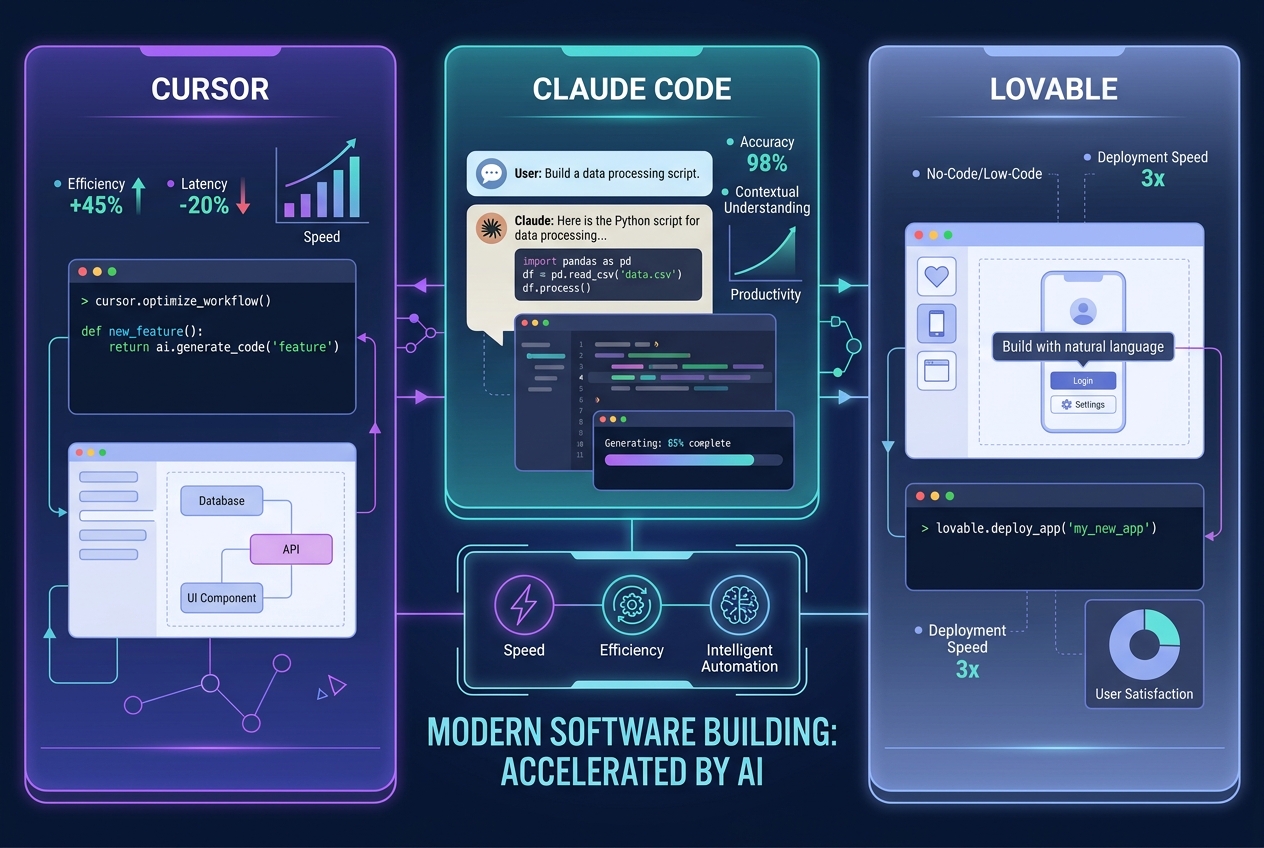
Cursor is a full integrated development environment built on a fork of VS Code, with artificial intelligence woven into every layer of the editing experience rather than bolted on as a plugin. By mid-2026 it has crossed one million users with around 360,000 paying customers, making it one of the fastest-growing developer tools in history.
What Cursor Does Well
The headline feature in 2026 is Agent Mode, where an autonomous agent reads your entire codebase, edits multiple files, runs terminal commands and iterates until a task is complete. Background Agents take this further by running tasks in cloud sandboxes and opening pull requests when finished. The optional BugBot add-on acts as an automated pull-request reviewer that catches regressions before human eyes ever see the code.
Cursor also supports multiple AI models, including the Claude family, GPT-class models and Gemini, so teams are never locked into a single provider. Native Model Context Protocol support lets agents connect to real systems such as Postgres, GitHub and Stripe.
Who Cursor Is For
Cursor is best suited to full-stack development teams who already write code and want to move dramatically faster. Pricing starts at 20 dollars per month for an individual Pro plan, with higher tiers ranging up to 200 dollars per month for heavy usage, plus an additional 40 dollars per user for BugBot. If you have developers on staff, Cursor is often the single biggest productivity multiplier you can give them.
Claude Code: Deep Power From the Command Line
Where Cursor reimagines the editor, Claude Code takes a model-centric approach. Built by Anthropic, it runs as a terminal-native agent that excels at large-context tasks, handling up to one million tokens of context on higher tiers. This makes it exceptional for sweeping refactors, technology migrations and documentation overhauls across enormous codebases.
The Cursor vs Claude Code Question
In practice, the Cursor vs Claude Code comparison is often a false choice. Many of the most productive teams in 2026 pair the two: Cursor serves as the daily editor while Claude Code handles heavy-lift agent work from the command line. Claude Code is Anthropic-only, so it is the natural choice for organisations already invested in the Claude ecosystem, particularly those tackling complex business logic where reasoning quality is paramount.
Pricing mirrors Cursor closely, with a Pro tier at 20 dollars per month rising to Max plans between 100 and 200 dollars for the most demanding workloads. The trade-off is a steeper learning curve, as it assumes comfort with terminal-based workflows.
Lovable: The AI App Builder for Everyone Else
Lovable sits in a completely different category. It is an AI app builder aimed at non-developers and semi-technical product teams. Instead of writing code, you describe what you want in plain English, and Lovable generates page layouts, forms, workflows and even backend services with connectors to tools like Stripe and Firebase.
This is the heart of the no-code vs AI code decision. Lovable lets product managers, designers and marketers ship working applications in hours rather than weeks. A typical Lovable comparison against traditional development shows it shining for MVPs, internal tools and simple customer-facing apps, with pricing generally ranging from 20 dollars for starter plans to 60 to 100 dollars per seat for business tiers.
The wider context supports this approach: organisations using no-code platforms report up to 90 percent reductions in development time and deliver 2.7 times faster than traditional methods. By 2026, around 70 percent of new enterprise applications are expected to use no-code or low-code approaches.
No-Code vs AI Code: Making the Right Call
The fundamental difference comes down to who is building and how much flexibility you need. No-code tools like Lovable empower citizen developers, business analysts and operations teams who have little or no programming background. AI-assisted coding tools like Cursor and Claude Code amplify professional developers, preserving full flexibility for performant, deeply integrated systems.
There is an important caveat. Research suggests AI-generated code can contain 2.74 times more security vulnerabilities than human-written code, and Gartner has warned that by 2028 a quarter of enterprise data breaches may trace back to AI agents. This is precisely why oversight, sound architecture and proper review processes matter so much, regardless of which tool you choose.
This is where having an experienced partner becomes invaluable. At Kaizen AI Consulting, we help UK businesses navigate exactly these decisions, matching the right tool to your team, your budget and your security requirements rather than chasing whichever platform is trending this month.
A Practical Framework for UK Businesses
To simplify the choice, consider your starting point:
If you have a development team: Start with Cursor at 20 dullars per month per developer and add BugBot for automated quality assurance. Pair it with Claude Code for the heaviest refactoring and migration work.
If you are non-technical or product-led: Begin with Lovable to prototype and ship simple apps quickly, keeping complex logic and security-sensitive components in the hands of professional developers.
If you are unsure: The most mature organisations in 2026 combine both worlds, using no-code builders for internal workflows and AI-assisted coding for core product and infrastructure. Getting this blend right is part art, part science.
Selecting and implementing these tools effectively requires more than a free trial. It demands a clear understanding of your goals, your existing systems and the risks involved. Our team at Kaizen AI Consulting specialises in helping businesses adopt AI coding tools 2026 safely and profitably, from initial strategy through to hands-on implementation and team training. Explore our AI consulting services to see how we can accelerate your journey.
The Bottom Line
There is no single winner in the Cursor vs Claude Code vs Lovable debate, because they are designed for different builders and different goals. Cursor is the AI-first editor for development teams. Claude Code is the deep-context powerhouse for complex engineering. Lovable is the AI app builder that puts software creation within reach of everyone. The no-code vs AI code question is ultimately about who is doing the building and how much control you need.
What matters most is making a deliberate, informed choice rather than following the crowd. The productivity gains are real, with teams reporting task completion up to 55 percent faster when AI tools are used well, but so are the risks if these tools are deployed without proper guidance.
Ready to choose the right AI builder for your business? Get in touch with Kaizen AI Consulting today for a free consultation. We will help you cut through the noise, select the perfect tool for your needs, and implement it with confidence so you can start building faster and smarter in 2026.