AI-Powered Review Management: Turning Customer Feedback into Five-Star Ratings
In 2026, your online reputation is not just a reflection of your business – it is your business. With 97% of consumers reading reviews before making a purchasing decision and 73% trusting only reviews less than 30 days old, the pressure to maintain a stellar rating has never been greater. For UK businesses navigating this landscape, AI review management has emerged as the essential tool for turning everyday customer feedback into a powerful growth engine.
But here is the challenge: managing reviews manually is no longer sustainable. The volume of feedback across Google, Trustpilot, Facebook, and industry-specific platforms has exploded, and customers expect swift, personalised responses. This is precisely where customer feedback automation and review response AI are transforming the game for businesses of all sizes.
The State of Online Reputation in 2026
The numbers paint a compelling picture. According to ReviewSense’s 2026 Guide, 78% of businesses now use AI for review responses. Meanwhile, research from Digital Applied reveals that 45% of consumers are now using AI tools such as ChatGPT and Google AI Mode to discover local businesses, a staggering rise from just 6% in 2025.
For UK businesses specifically, the stakes are even higher. A remarkable 82% of UK consumers report encountering fake or AI-generated reviews online, which has eroded trust and made authentic, well-managed review profiles more valuable than ever. The best-performing UK businesses now maintain average ratings of 4.8 stars or above, and achieving that benchmark requires a strategic, technology-driven approach.
Why Manual Review Management Falls Short
Consider a typical UK business receiving 50 to 100 reviews per month across multiple platforms. Responding to each review thoughtfully, analysing sentiment trends, flagging fake reviews, and adjusting strategy accordingly could easily consume 15 to 20 hours of staff time weekly. Multiply that across several locations or platforms, and the task becomes unmanageable.
Moreover, the consequences of slow or absent responses are severe. Research shows that businesses replying to at least 25% of their reviews earn 35% more revenue than those that do not. Meanwhile, 71% of consumers will not choose a business with an average rating below 3 stars. Every unanswered negative review is a missed opportunity to recover trust and demonstrate accountability.
How AI Review Management Works
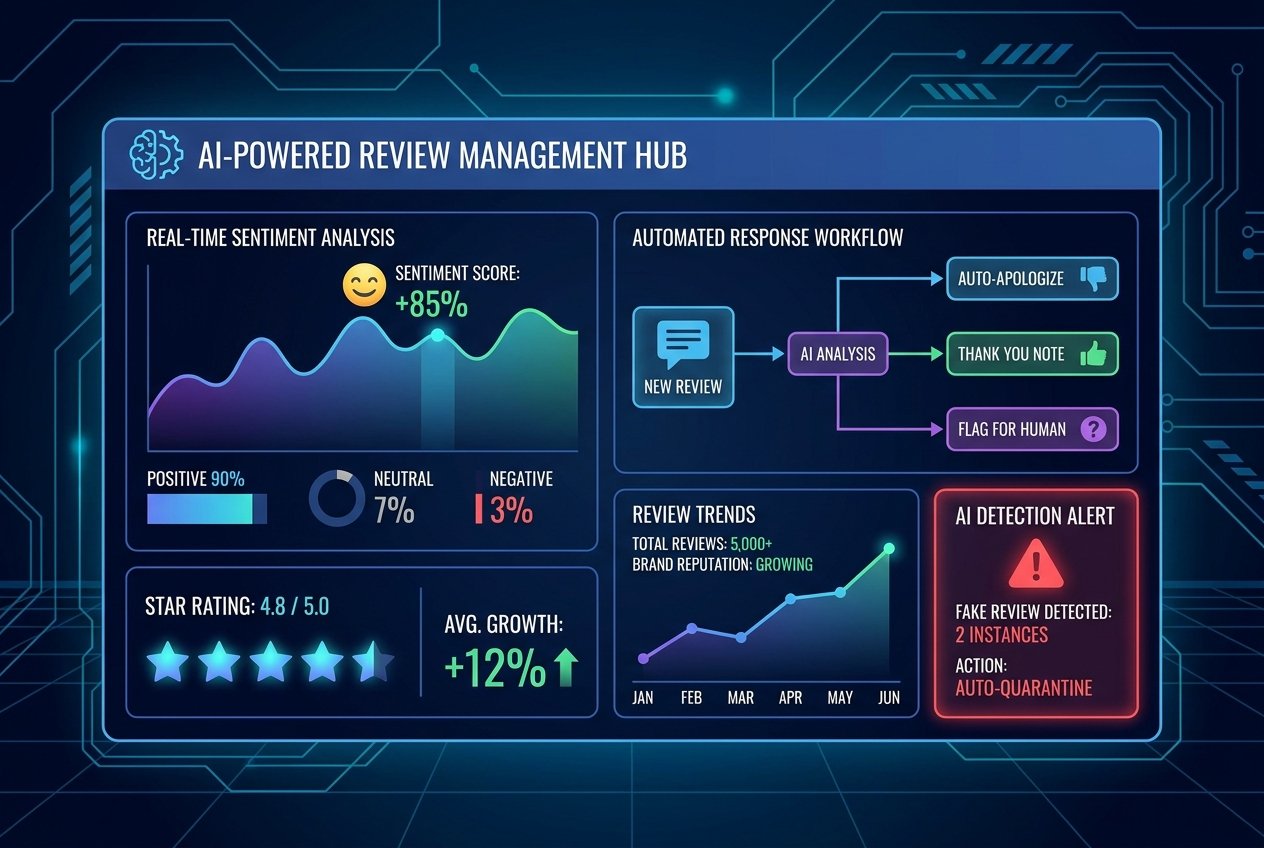
Reputation AI tools have evolved far beyond simple auto-reply templates. Modern AI-powered review management platforms use sophisticated natural language processing, sentiment analysis, and machine learning to deliver genuinely intelligent feedback management. Here is how the technology works in practice.
Sentiment Analysis and Root-Cause Detection
Advanced AI does not simply categorise reviews as positive or negative. Platforms such as Birdeye and Momos use native AI categorisation to identify specific root causes within feedback. For example, a restaurant review mentioning slow service, excellent food quality, and a noisy atmosphere will be broken down into three distinct sentiment categories, each tracked over time. This granular insight allows businesses to address specific operational issues rather than guessing at problems.
Personalised Review Responses at Scale
Review response AI has moved well beyond generic thank-you messages. Tools like Praising.ai now learn a brand’s unique voice and generate responses that feel authentically human. The AI adapts tone based on the sentiment detected, offering empathetic responses to complaints, enthusiastic replies to praise, and balanced acknowledgements for mixed feedback. For multi-location businesses, this means consistent brand communication across every branch without requiring a dedicated team at each site.
Automated Review Generation
Customer feedback automation is not just about responding to reviews – it is also about generating them. Modern platforms use behaviour-triggered requests, sending personalised SMS or email prompts to customers at the optimal moment after a purchase or service interaction. Reviewly, for instance, offers SMS-based review generation spanning over 100 countries, helping businesses build a steady stream of fresh, authentic feedback.
Fake Review Detection
With over 30% of reviews now estimated to be fake or AI-generated, detection has become critical. Google’s AI-powered filtering has driven a 600% surge in review deletions in 2026. Reputation AI tools now employ machine learning and neural networks to identify suspicious patterns, protecting your genuine rating from manipulation. According to industry data, 90% of caught fake reviews are now detected through automated AI systems, a 53% increase from 2023.
The Impact on Local SEO and AI Search Visibility
Here is a development many UK businesses have not yet grasped: reviews now directly influence your visibility in AI-powered search. Google’s AI Overviews, ChatGPT, and tools like Perplexity are pulling review snippets to answer consumer queries. When someone asks an AI assistant for the best plumber in Manchester or the top-rated restaurant in Bristol, the AI references your recent reviews to formulate its answer.
This means that AI review management is no longer just a reputation tool – it is an essential component of your digital transformation strategy. Businesses with consistently fresh, positive, well-responded-to reviews are more likely to appear in these AI-generated recommendations, creating a powerful competitive advantage.
At Kaizen AI Consulting, we help UK businesses integrate AI review management into their broader digital strategy, ensuring that every piece of customer feedback strengthens both your reputation and your search visibility.
Building an AI-Powered Review Management Strategy
Implementing reputation AI tools effectively requires more than simply subscribing to a platform. Here is a step-by-step framework for UK businesses looking to maximise the value of their customer feedback.
Step 1: Audit Your Current Review Landscape
Begin by mapping every platform where customers leave feedback about your business. For most UK companies, this includes Google Business Profile, Trustpilot, Facebook, industry directories, and potentially app stores. Identify your current average rating, response rate, and review volume on each platform. This baseline will help you measure the impact of your AI implementation.
Step 2: Choose the Right Platform
Select an AI review management tool that matches your business scale and needs. For local businesses and SMEs, platforms like Praising.ai offer excellent AI reply quality and automation at accessible price points. For multi-location enterprises, Birdeye’s agentic AI agents can autonomously manage reviews across 150 or more platforms. Consider factors such as sentiment analysis depth, integration capabilities, multi-language support, and pricing structure.
Step 3: Configure Your Brand Voice
The most effective review response AI learns your specific tone and communication style. Invest time in training the system with examples of ideal responses. Define guidelines for how different types of feedback should be handled – from glowing five-star reviews to detailed complaints. The goal is responses that feel genuinely personal while operating at scale.
Step 4: Automate Review Generation
Set up behaviour-triggered review requests that reach customers at the right moment. Research suggests that requests sent within two hours of a positive interaction yield the highest conversion rates. Use SMS where possible, as it consistently outperforms email for review generation. Ensure your requests comply with UK consumer protection regulations and platform guidelines.
Step 5: Monitor, Analyse, and Adapt
Use your platform’s analytics to track sentiment trends, identify recurring issues, and measure the impact of operational changes. Establish predictive reputation alerts that notify you when ratings begin to decline, allowing you to address problems before they escalate into full-blown crises. Review your AI response quality regularly and refine your settings based on customer reactions.
Avoiding Common Pitfalls
While AI review management offers tremendous benefits, businesses must navigate several risks carefully. Research from Optro reveals that 40% of organisations have reported inaccurate AI outputs in the past 12 months, and 22% have faced legal claims tied to AI use.
To mitigate these risks, keep human oversight in the loop. Use AI to draft responses but review sensitive replies before they are published. Be transparent with customers – avoid passing off AI-generated responses as entirely human-written if directly asked. Ensure your chosen platform complies with UK data protection requirements, including GDPR, and regularly audit the quality of automated responses.
Another critical consideration is the growing issue of shadow AI, where team members adopt AI tools without formal governance or oversight. Establishing clear policies around which tools are approved and how they should be used will protect your business from inconsistent messaging or data breaches.
The Competitive Advantage of Professional Implementation
The difference between a business that simply turns on an AI review tool and one that strategically integrates it into their operations is enormous. Professional implementation ensures that your customer feedback automation aligns with your broader business strategy, your brand voice remains consistent, and your AI governance framework meets UK regulatory standards.
Kaizen AI Consulting specialises in helping UK businesses implement and optimise AI-powered reputation management systems. From initial audit and platform selection through to ongoing strategy refinement, our team ensures that your online reputation becomes a genuine competitive advantage rather than a source of anxiety. Get in touch with our team today to discover how we can help you turn every customer review into a growth opportunity.
Looking Ahead: The Future of Online Reputation
As AI search tools continue to gain mainstream adoption – with 42% of consumers now trusting AI recommendations equally with traditional reviews – the businesses that thrive will be those with robust, authentic, and actively managed review profiles. The convergence of AI review management, local SEO, and AI-powered discovery means that your reputation strategy must evolve from reactive damage control to proactive brand building.
Investing in reputation AI tools today is not merely about maintaining your star rating. It is about ensuring your business remains visible, trusted, and chosen in an increasingly AI-mediated marketplace. For UK businesses ready to embrace this shift, the rewards are substantial: higher revenue, stronger customer loyalty, and a digital presence that works tirelessly on your behalf.