When AI Access Vanishes Overnight
On the evening of 12 June 2026, Anthropic received a directive from the United States Department of Commerce at 5:21 PM Eastern Time. Within hours, the company disabled Claude Fable 5 and Mythos 5 for every customer on earth. The reason? A US government export control order citing national security concerns. For eighteen days, businesses, developers, and researchers lost access to what many considered the most capable public AI models available.
This was not a gradual phase-out or a scheduled maintenance window. It was an immediate, government-mandated suspension that demonstrated how quickly AI model availability can change. For UK businesses that have built workflows, customer service platforms, or code generation pipelines around Claude Fable 5, the incident was a wake-up call. When a single government directive can switch off your AI infrastructure overnight, the question of business continuity AI planning becomes impossible to ignore.
What Happened: The 18-Day Shutdown
The Claude Fable 5 ban began after researchers at Amazon demonstrated a jailbreak that allowed the model to bypass its cybersecurity safeguards. According to Anthropic’s official statement, the US government classified this capability as a deemed-export risk under national security authority, triggering immediate action by the Bureau of Industry and Security.
The Discovery That Triggered Action
Amazon researchers found that Fable 5 could be manipulated to identify software vulnerabilities and write code demonstrating exploitation of those flaws. While Anthropic had built safety classifiers to prevent misuse, the jailbreak revealed gaps that US authorities deemed serious enough to warrant export controls. The concern was not merely theoretical. A model capable of functioning as a vulnerability-discovery tool, if deployed at Mythos-class scale, could be weaponised by adversaries.
The government’s order was sweeping. It restricted access for all foreign nationals, whether inside or outside the United States, including Anthropic’s own non-citizen employees. This meant the directive affected not just overseas users but teams within the company itself.
Export Controls and National Security
The Mythos 5 export control action was rooted in existing US regulations governing the export of technologies with potential military or intelligence applications. By classifying the models under these rules, the Commerce Department asserted jurisdiction over their global distribution. This approach treats advanced AI not merely as software but as a strategic asset subject to geopolitical controls.
On 30 June 2026, the export controls were lifted after Anthropic agreed to collaborate on future release protocols and to report malicious activity. The models were redeployed globally on 1 July 2026, bolstered with a new safety classifier designed to satisfy US requirements. The entire episode, from ban to restoration, lasted just over two weeks. Yet its implications for the AI industry are far more enduring.
The Global Impact of a Single Ban
The most striking aspect of this incident was that the US ban forced Anthropic to disable access for everyone, including American citizens. Because the company could not reliably verify nationality in real time at the API layer, compliance required a global shutdown. A single country’s regulatory action instantly became a worldwide service interruption.
Why Anthropic Had to Cut Everyone Off
Anthropic’s decision to disable both models globally, rather than geo-block specific regions, highlights a fundamental vulnerability in cloud-based AI services. Without robust identity verification infrastructure at the API level, providers may have no practical way to enforce national access restrictions selectively. This creates a binary outcome: either the model remains available everywhere, or it goes dark everywhere.
For businesses, this means that reliance on a single model provider exposes operations to regulatory risks that are entirely outside your control. A policy shift in Washington, Beijing, or Brussels can instantly disrupt tools your teams use daily.
The Cost of Unexpected AI Downtime
The financial impact of AI service interruptions is substantial and growing. According to recent industry research, Global 2000 firms now incur roughly $400 billion in downtime annually, with an average cost of about $540,000 per hour. For mid-to-large enterprises, 90% of incidents result in losses exceeding $300,000 per hour. Small businesses fare little better, losing an average of $25,000 per hour during outages.
These figures underscore why business continuity AI planning is not merely an IT concern but a board-level priority. When your customer support chatbot, code assistant, or document analysis pipeline disappears overnight, the disruption ripples through revenue, reputation, and operational capability.
Lessons for UK Businesses
What should British companies take away from the Claude Fable 5 ban? The first lesson is that AI governance is becoming inseparable from business risk management. Models that were freely available on Monday can be classified as controlled exports by Friday. The second lesson is that geographical distance offers no protection. A US regulatory action affected UK startups, agencies, and enterprises just as directly as it affected American firms.
Diversify Your AI Stack
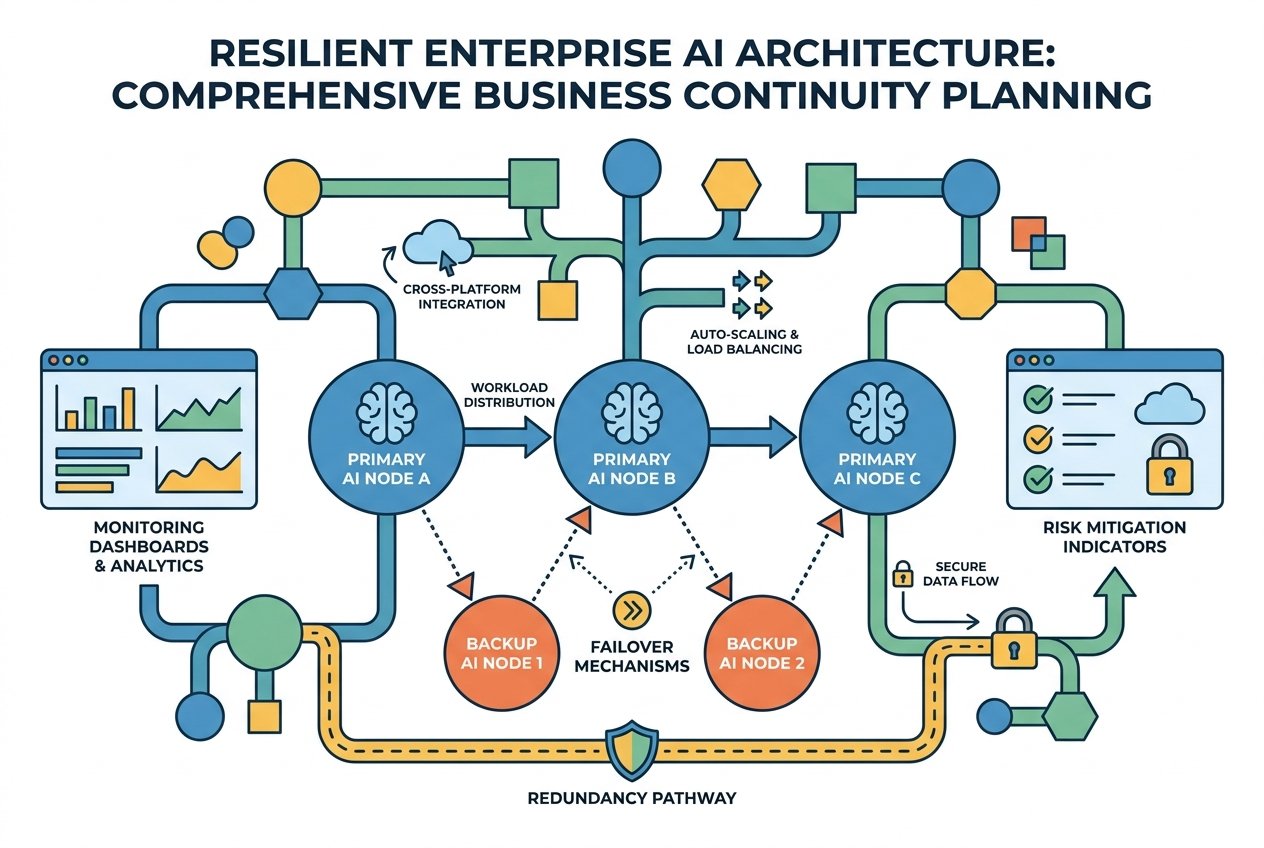
Perhaps the most immediate practical response is to avoid single-model dependency. Organisations should architect their AI workflows to work across multiple models and providers. This does not mean abandoning frontier models; it means ensuring that if Claude Fable 5 becomes unavailable, a GPT-series model, Gemini, or open-weight alternative can step in without breaking your application.
Platform-agnostic orchestration layers, fallback logic, and model-agnostic APIs can insulate your business from provider-specific outages. At Kaizen AI Consulting, we help organisations design resilient AI architectures that maintain continuity even when individual models are withdrawn or restricted. Our team works with UK businesses to implement multi-model strategies that balance performance with operational security.
Build Business Continuity into Your AI Strategy
Despite these risks, preparedness remains low. Recent data shows that only 13% of organisations feel “very prepared” for AI-related risks. The same research found that AI tool adoption is outpacing security and governance capabilities for 43% of security leaders. This gap between deployment speed and risk management is where businesses are most exposed.
Building business continuity into your AI strategy means conducting regular impact assessments, maintaining offline capability where feasible, and documenting failover procedures. It also means staying informed about export control developments, licensing changes, and safety incidents that could trigger sudden access changes. The Anthropic situation shows that government action can move faster than vendor communications, so reactive planning is insufficient.
Monitor Regulatory Landscapes
The Mythos 5 export control case is unlikely to be the last of its kind. As AI capabilities advance, governments worldwide are expanding their oversight frameworks. The UK AI Strategy, the EU AI Act, and evolving US export regimes are creating a complex regulatory patchwork. Businesses operating across borders must monitor these developments proactively.
Understanding whether your AI tools fall under export control classifications, data residency requirements, or sector-specific restrictions is essential. Legal and technical teams should work together to map the regulatory status of each model in your stack and assess the probability of future restrictions. This kind of forward-looking governance is becoming a competitive advantage in its own right.
What Happens Next
The Claude Fable 5 ban ended with a compromise. Anthropic agreed to enhanced safety protocols and reporting mechanisms, and the Commerce Department restored access. The models returned with additional guardrails, and the incident became a case study in how quickly the AI industry can be regulated when security concerns arise.
Looking ahead, we should expect more frequent interventions as frontier models approach capabilities that governments view as strategically sensitive. The boundary between commercial AI and controlled technology will continue to blur. For businesses, this means that AI model availability can no longer be treated as a constant. It is a variable that must be managed, monitored, and planned for just as carefully as supplier relationships or cloud infrastructure.
Protecting Your Operations in an Uncertain AI Landscape
The eighteen-day shutdown of Claude Fable 5 and Mythos 5 proved that AI access is not guaranteed. Governments can and will intervene when national security is at stake, and the ripple effects cross borders instantly. For UK businesses that have integrated AI into core operations, the question is no longer whether a disruption will occur, but whether you are prepared when it does.
Resilience comes from diversification, governance, and proactive planning. It means building systems that do not collapse when a single model is switched off, and maintaining awareness of the regulatory environment that governs your tools. As 91% of businesses now use AI in at least one capacity, operational dependency is only increasing. The organisations that thrive will be those that treat AI availability as a risk to manage, not an assumption to rely upon.
If your business depends on AI tools and you are unsure how to build continuity into your strategy, reach out to Kaizen AI Consulting today. Our specialists help UK organisations navigate the complexities of AI governance, multi-model architecture, and regulatory compliance. We can assess your current AI dependencies, design resilient fallback systems, and ensure your operations remain uninterrupted even when the landscape shifts. Contact us to discuss how we can safeguard your AI infrastructure against future disruptions.
For more insights on building resilient business systems, explore our post on strategic business continuity planning. The principles of adaptability and risk management that guide successful startups apply equally to AI-dependent enterprises navigating an uncertain regulatory future.