
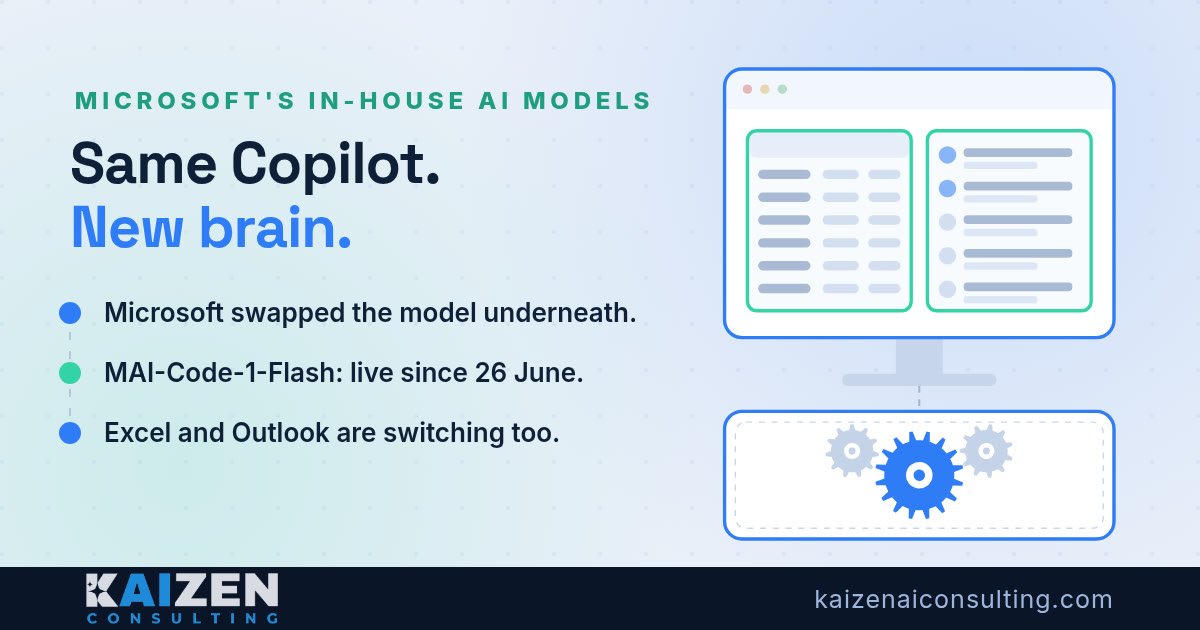
If your business runs on Microsoft 365, the AI inside your tools has quietly changed. At Build 2026 Microsoft unveiled seven in-house models under the MAI name, and through June and July it has started swapping them into the products you already pay for. The headline act for anyone who writes code, or pays someone who does, is MAI-Code-1-Flash. Here is what actually changed, what the numbers say, and what we think UK small businesses should do about it.
What is MAI-Code-1-Flash?
MAI-Code-1-Flash is Microsoft’s first coding model built entirely in house, trained from the ground up on what Microsoft describes as clean, traceable, enterprise-grade data, without distillation from third-party models. Until now, the intelligence behind GitHub Copilot and Microsoft 365 Copilot came largely from OpenAI, with Anthropic models handling some workloads. That arrangement is being wound down. Microsoft AI chief Mustafa Suleyman has said publicly that the company wants to reduce, and eventually eliminate, its spending on outside models.
The new model became generally available for GitHub Copilot Business and Enterprise customers on 26 June 2026, and it is now rolling out to individual Copilot users in Visual Studio Code, both in the model picker and through auto-selection. If you use Copilot and have not touched your settings, there is a reasonable chance some of your requests are already being answered by MAI rather than GPT.
The numbers that matter
Benchmarks are easy to cherry pick, so we will keep to the ones with a clear method behind them. On SWE-Bench Pro, a test that measures whether a model can resolve real software issues, MAI-Code-1-Flash scores 51.2 per cent, sixteen points ahead of Claude Haiku 4.5, the comparable fast model from Anthropic. It leads on instruction following by 28.9 points on IF Bench.
The figure we find most interesting for business users is efficiency. Microsoft reports that the model solves complex problems with up to 60 per cent fewer tokens than competing models. Tokens are the unit AI usage is metered in, so fewer tokens means faster responses and lower running costs. To be clear, that is a claim about what the tools cost to run, and it is Microsoft’s own measurement, but it explains the whole strategy. Every AI answer costs compute, and at Microsoft’s scale a 60 per cent saving is enormous.
It is not just about code
The same swap is happening across the wider Copilot family. Reports in early July confirmed that Microsoft has begun routing Excel and Outlook Copilot tasks to MAI models, with Teams transcription moving to MAI-Transcribe in the coming months. Microsoft’s official line is a multi-model platform, where a given task might be served by MAI, GPT or Claude depending on what suits it. OpenAI, for its part, was quick to point out that GPT 5.6 remains the preferred model for Microsoft 365 Copilot. The direction of travel, though, is plain: Microsoft is putting its own engine into the products it owns.
For the user, nothing visible changes. The button still says Copilot. What changes is the brain underneath, the speed of the answer, and who Microsoft pays for it.
Why this matters for UK small businesses
The British Chambers of Commerce, working with Atos, reported this year that 54 per cent of UK SMEs are now actively using AI, up from 35 per cent in 2025. Adoption has more than doubled in two years. The same research carries a less comfortable finding: adoption is uneven, with larger SMEs and professional services firms pulling ahead while smaller and consumer-facing businesses lag. The gap between firms that use these tools well and firms that do not is widening, and the engine swap makes the tools cheaper for Microsoft to run and more capable at the everyday tasks SMEs actually use.
We build automations for UK founders, small businesses and trades, and we see three practical consequences.
First, if you already pay for Copilot, you should check what you are getting. On Business and Enterprise plans an administrator has to enable the MAI-Code-1-Flash policy before anyone can use it. We have sat in audits where a business was paying for AI licences and using a fraction of what was switched on.
Second, faster and cheaper models change what is worth automating. A task that was marginal at last year’s prices, drafting quote responses, triaging a shared inbox, summarising site notes, may now clear the bar. When the cost per task falls by more than half, the list of automations that pay for themselves gets longer.
Third, model churn is now normal. The AI inside your tools will be swapped, renamed and re-routed without asking you. That is an argument for building your processes around outcomes, not around any single model, and for having someone who watches this on your behalf.
What we would do this month
Pick one workflow that touches Microsoft 365 every day, email triage in Outlook or reporting in Excel, and test whether Copilot as it stands today handles it reliably. Measure the time it saves against what the licence costs. If the numbers work, roll it out properly with a written process. If they do not, note what failed and retest in a quarter, because the model underneath will have changed again by then.
The quiet engine swap inside Copilot is good news for small businesses on balance: better answers, lower running costs, and more competition between the labs. But the benefit only lands if someone in your business is paying attention. We offer a free 30 minute AI audit for exactly that reason. We will look at what you are paying for, what is switched on, and where the quickest win is hiding.