We run this stack every day, so we are not guessing
We get asked a version of this question most weeks now: is Higgsfield reliable enough to put real client budget behind? We are in a good position to answer honestly, because we are not reviewing Higgsfield from a demo account. We run it inside our own daily content pipeline, animating the illustration behind every video we publish, and our build logs from the last fortnight tell the story better than any marketing page could.
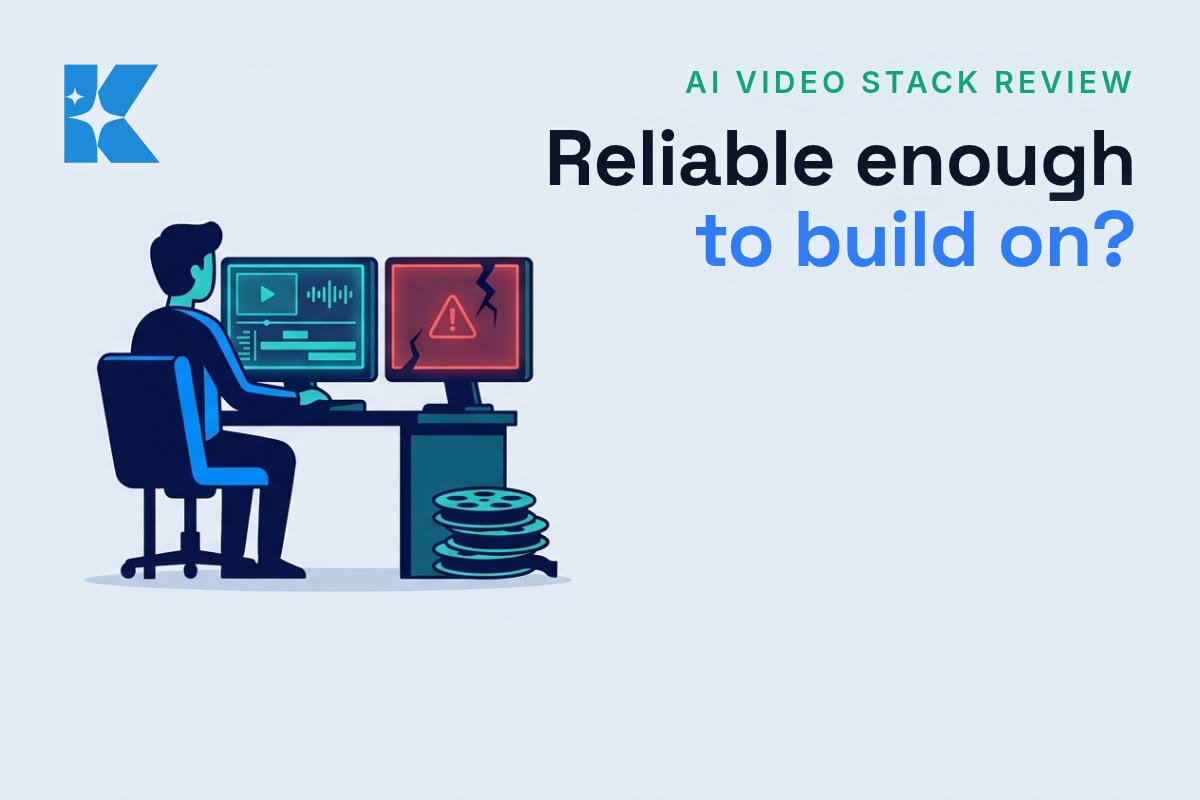
On 18 August, our image-to-video call to Higgsfield failed with a persistent SignatureDoesNotMatch error on the upload step, three attempts running, not a one-off blip. We routed around it with a workaround upload path and shipped the day’s video anyway. On 19 August, the same underlying call failed again, and this time the workaround itself broke at the confirmation step, three times, with no further detail than “something went wrong.” We fell back to a static build rather than lose the day. Two failures in two days is a small sample, but it matches what the wider market is reporting, and it is worth setting out plainly for anyone weighing Higgsfield for their own marketing.
Where the tool earns its reputation
The praise is not undeserved. For short, controlled shots, quiet product scenes, a single subject with restrained camera movement, the output is genuinely cinematic, and it is one of the few AI video tools that holds a consistent visual style across a run. That is exactly why so many small teams, us included, have built it into a production line rather than treating it as a novelty.
It also helps explain why the company is growing so fast despite the problems below. Higgsfield reportedly passed $500 million in annualised revenue this year and is said to be courting a funding round that would value it above $5 billion. Growth on that scale, reached in barely a year, tends to outrun the support and moderation teams needed to keep pace with it, and that gap is exactly what shows up in the complaints we cover next.
Where it breaks in practice
The cracks show up once you push volume through it rather than a single showcase clip. Motion quality drops off sharply on anything with real complexity in the scene, and independent review aggregation puts the one-star share of Higgsfield reviews at roughly 20% against 63% five-star, a wide spread that traces mostly to billing surprises rather than disappointing footage, according to pricing analysis from vo3ai. Uptime tracking tells a similar story: StatusGator’s monitoring recorded a surge in user-submitted outage reports on 18 August 2026 alone, on top of a pattern of brief, unacknowledged micro-outages and dashboard loading failures running through June. If a platform sits underneath a daily publishing commitment, that is the risk that actually bites, not the quality of any single generation.
The reputational problem is bigger than downtime
The most serious findings are not about reliability at all. A February 2026 Forbes investigation found that some creator marketing kits Higgsfield distributed contained clips that were not AI generated at all, footage that appeared to be pulled from a stock library with Higgsfield’s own branding pasted over it, alongside Google Drive folders of racist and obscene content and nonconsensual deepfakes of public figures. Higgsfield’s own X account was suspended in the aftermath, and the company responded in March 2026 by launching a Similarity Scoring tool that flags likely matches to known faces and logos before content ships. That is a genuine fix, but it tells you the moderation gap was real, and it is a reason on its own to keep human review in the loop on anything client-facing, whatever platform you use.
The billing detail that catches people out
Higgsfield’s paid tiers run from roughly $15 to $129 a month depending on volume, billed in US dollars, so UK subscribers are also carrying whatever exchange rate and card fee their bank applies that month, on top of the sticker price. Credit packs are available above the plan allowance at around $5 per 100 credits. The part worth flagging to any small business owner is that those top-up credits expire after 90 days. Bought in a burst ahead of a busy quarter, unused credits are simply gone by the next one. Treat them as perishable stock, not a banked balance, and buy only what the next few weeks of production will actually use.
What this means if you are weighing it for your own business
We are not walking away from Higgsfield, and we would not tell a client to either. It remains one of the stronger image-to-video engines available, and for illustration-led content like ours it does the job well most days. But “most days” is the operative phrase, and the business decision is what you do on the days it does not. Three things worth building in from day one: a fallback render path that does not depend on the same vendor, so a failed call costs you a compromise rather than a missed publish; a moderation step you control, given the documented gaps in Higgsfield’s own; and a credit-buying rhythm tied to actual weekly output rather than a lump-sum top-up that expires before you use it.
This is not a Higgsfield-specific lesson, either. UK adoption of AI video tools is climbing fast, with roughly a third of UK small businesses now using AI in some part of their operations according to BCC and Paragon Bank’s March 2026 figures, cited by Spicy Advisory’s 2026 adoption guide, and marketing is the single biggest use case. Every one of those businesses is going to hit the same question we did this week: what happens on the day the vendor’s API does not answer. Build the answer to that question before you need it, not after your publishing schedule depends on it.