
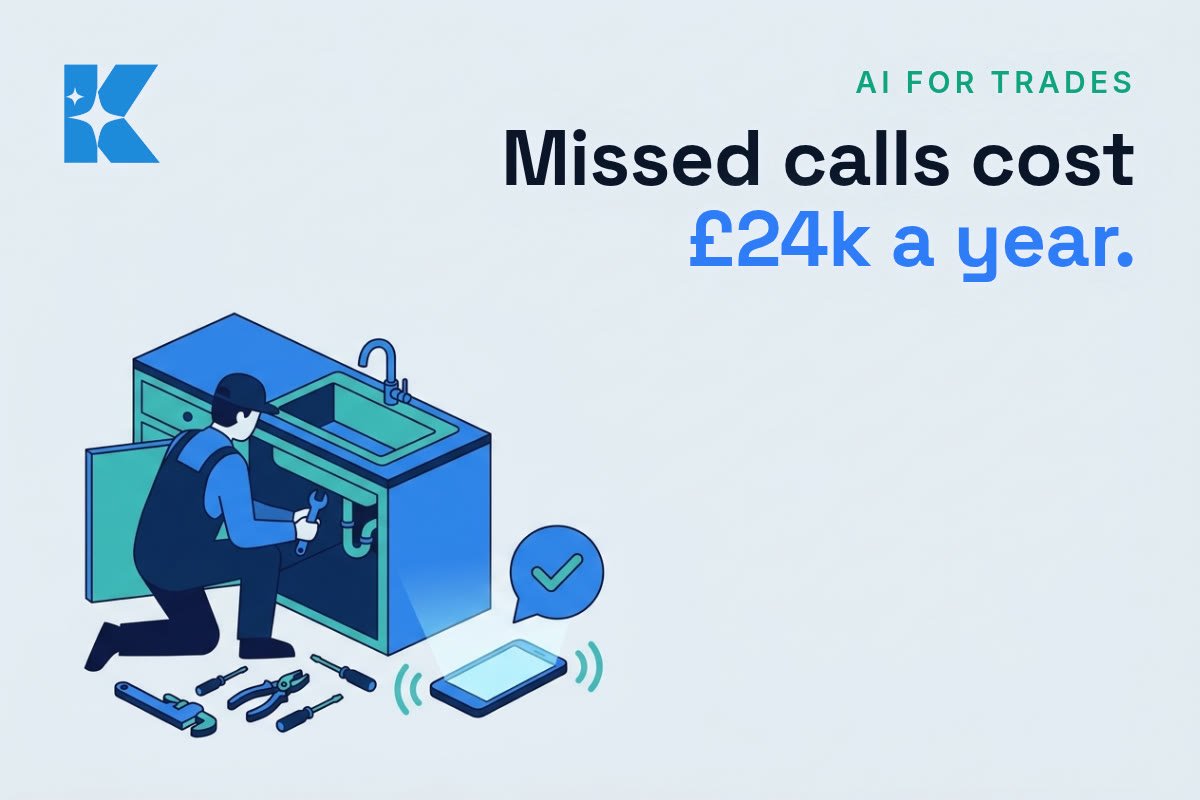
Every trade business owner knows the feeling: you are up a ladder, under a sink, or mid-job with dust on your hands, and the phone rings. You cannot answer it. Most of the time that is fine. Increasingly, it is not.
New UK research puts a hard number on what that costs. A 2026 industry study found that owner operators, builders, electricians and plumbers among them, are losing an average of £24,000 a year in revenue because of missed calls and slow response times, with over 60 per cent of inbound calls to trades businesses going unanswered during working hours (Digital X Marketing). For electricians specifically, the average missed-call loss runs even higher, closer to £33,000 a year (ClearCall).
This is the gap that AI phone agents are now built to close, and we are seeing UK trades adopt them fast: the same research shows the number of trades firms using AI call handling has grown from under 100 businesses in 2024 to more than 1,000 by mid-2026. That is not a niche experiment any more. It is becoming standard kit, in the same category as a van livery or a Google Business Profile.
Why a missed call costs more than one job
The maths behind that £24,000 figure is uncomfortable but worth sitting with. Around 85 per cent of callers who hit voicemail simply will not leave a message, they hang up and ring the next name on the list (RadiusBoost). And 78 per cent of customers say they go with whichever tradesperson actually picks up first, regardless of price or reviews (ClearCall). Speed beats reputation.
It compounds further than the single lost job. A lead that gets a response within five minutes is 21 times more likely to convert than one left for half an hour (RadiusBoost). Every missed caller who books with a competitor instead also tends to take future referrals with them, friends, family, neighbours who would have called the same number. One missed call rarely costs just one job.
What an AI phone agent actually does
This is not a phone tree or an answering machine with better manners. A modern AI voice agent answers in natural conversation, understands what the caller needs (a burst pipe versus a routine boiler service are very different calls), checks a real diary, and books the appointment there and then, all before the tradesperson has picked up a tool. Out of hours, at 7pm on a Sunday, or mid-job on a Tuesday afternoon, the caller gets the same experience: someone answers, listens, and gets them booked in.
The tools behind this have matured quickly. Platforms built specifically for inbound service calls, rather than outbound sales dialling, now respond in well under a second and hand off cleanly to a real diary system rather than leaving a message for someone to chase later. For a UK trades business, that usually means the AI agent is connected directly to the same booking calendar the office already uses, so a job goes straight into the schedule instead of sitting in a voicemail inbox until Monday morning.
What it costs versus what it saves
The tool cost for an AI phone agent aimed at a small trades business typically sits between £60 and £250 a month, depending on call volume and how many integrations it needs. Set against an average missed-call loss of £24,000 to £33,000 a year, the arithmetic is not subtle: capturing one extra job every fortnight is usually enough to cover the monthly cost outright. Trades businesses that have switched to AI call handling report booked jobs rising by 30 to 50 per cent, on top of whatever the office was already managing to answer (ClearCall).
To be clear, this is a statement about what the tools cost to run, not a promise about what any business will earn. Results depend on call volume, how the agent is configured, and how quickly follow-up quotes and visits actually happen after the call. An AI agent that books a job still needs a tradesperson to turn up and do good work. It removes the bottleneck at the phone, not the rest of the business.
Where this fits for a small trades business
The businesses getting the most out of this are not necessarily the biggest ones. A sole trader who is the only person answering the phone, and who is also usually the person up the ladder, has the most to gain from something else picking up reliably. Multi-person firms benefit too, particularly for out-of-hours and weekend calls that would otherwise sit unanswered until the office reopens.
The practical starting point is not to replace how the phone is answered during normal hours if that is already working. Most trades businesses start by routing only the calls nobody is free to take, evenings, weekends, and moments when the whole team is on site, to the AI agent, then expand from there once they can see it booking real jobs correctly. Getting the diary integration right matters more than picking the flashiest voice; a fast, accurate booking beats a smooth-sounding assistant that gets the address wrong.
Missed calls used to be an accepted cost of running a trades business, a few jobs a month that simply went to someone else. That assumption is what is changing. The businesses adopting AI call handling now are not chasing a gimmick, they are closing a gap that has been quietly costing them thousands of pounds a year, and the tools to close it have gone from expensive and clunky to genuinely affordable in the space of about two years.