
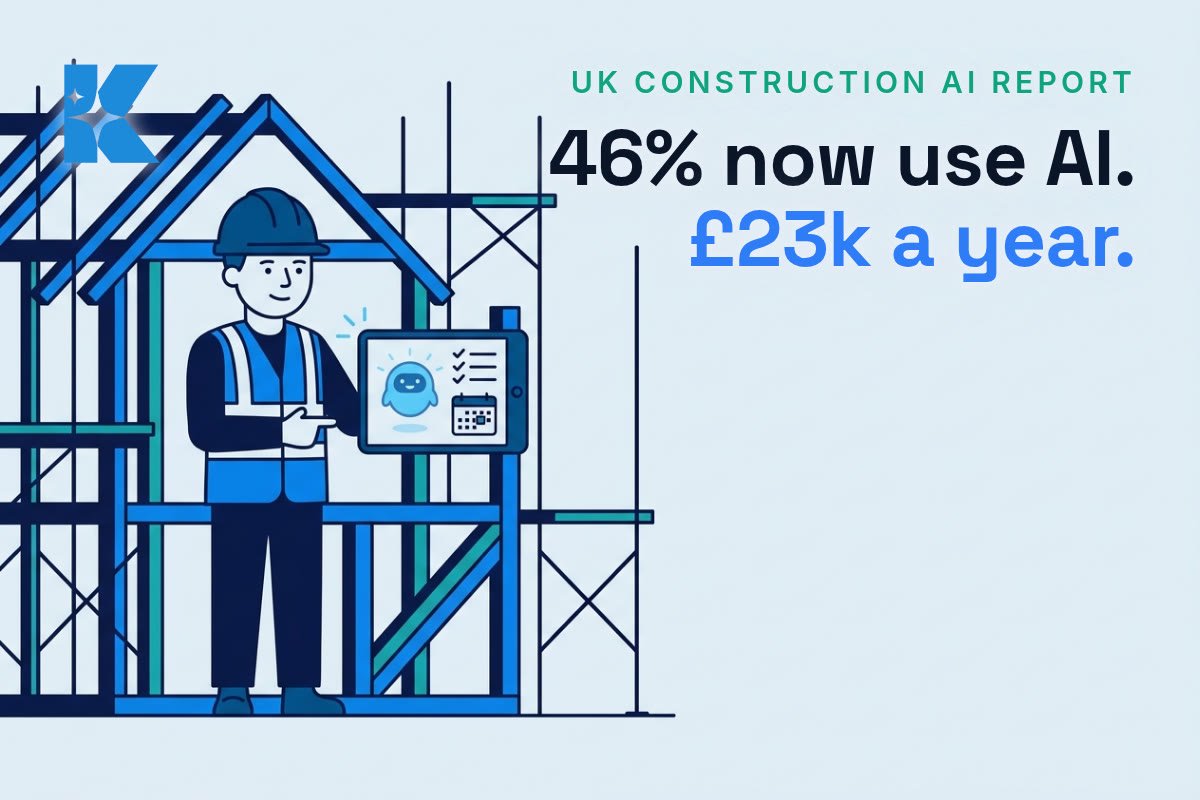
Nearly half of construction and design professionals in the UK are now using AI in their business, according to the first Houzz UK State of AI in Construction and Design Report, published this month. The 46% who have adopted it are saving an average of more than three hours a week each, which works out to over £23,000 a year in productivity gains per business.
We work with trades and small construction firms every week, and the number that stands out to us is not the 46%. It is the other 54%. More than half of the industry is still sitting this out, and the report makes clear that is not because they have not heard of AI. It is because nobody has shown them where to start.
The headline number, and where it actually comes from
The Houzz report, based on a survey of more than 145 UK construction and design professionals, found that 72% are familiar with AI technology generally, and the same proportion are aware that tools now exist built specifically for their trade. Awareness, in other words, is not the problem. Adoption is roughly two thirds of that, at 46%.
Of the businesses that have made the jump, three hours a week is the average time saved. Scaled across a working year, that is the £23,000 figure, and it is not a hypothetical number. It is what the businesses already using AI are reporting back.
Where the time is actually going
The Houzz data shows the biggest single use case is administrative work, particularly AI-assisted note-taking, which 79% of adopters use, rising to 89% among construction professionals specifically. That is meetings, site visits and client calls turned into usable notes without someone typing them up afterwards.
Estimates, takeoffs and scheduling come next. AI tools that turn a described project into a costed proposal, and a proposal into a phased schedule, are increasingly built into the project management software trades already use rather than sold as a separate product. That distinction matters more than it sounds. A tool that only works if you learn a new interface competes with the working day. A tool that sits inside software you already open every morning does not.
The uncomfortable part
Sixty per cent of respondents believe AI will transform the industry within five years. That is a strong majority expecting real change, sitting alongside a majority who have not yet acted on it themselves. The report’s own explanation for the gap is not cost and it is not scepticism about whether AI works. It is training.
One interior designer quoted in the report put it plainly: tools require a level of training and experimentation that is not realistic when you are running projects day to day, and what actually moves the needle is AI built into the software people already use, so the benefit starts on day one rather than after a course. A separate RICS report on AI in construction and commercial property published the same year found the same pattern industry-wide: strong belief that AI will change how projects are delivered, held back mainly by a lack of practical, hands-on guidance rather than doubt about the technology itself.
We would add a second, harder point. £23,000 a year is what the early movers are gaining. Every month spent undecided is not neutral. It is roughly £2,000 of admin time that a competitor down the road is already getting back, and using to quote faster, follow up sooner, or simply go home earlier.
What this actually looks like for a small construction or trades business
None of this requires a full technology overhaul. The pattern in the data is specific: the tools getting used are the ones that slot into an existing workflow rather than replacing it.
For a small building or trades firm, that usually means three things, roughly in this order:
- Note-taking and call handling. If site visits, client calls or supplier conversations are still relying on memory or a notebook, an AI note-taker or call assistant is the lowest-effort starting point, and it is where 79% of adopters already are.
- Estimating and quoting. Turning a project description into a costed line-item estimate is one of the slowest manual tasks in the trade, and it is one of the first things modern AI-assisted estimating tools do well.
- Scheduling. Once an estimate exists, the same information can drive a phased schedule automatically, rather than being rebuilt by hand in a separate spreadsheet or planner.
The tools themselves are not expensive relative to the time they save. Most of the estimating and scheduling features referenced in the Houzz report are add-ons to project management software already priced for small firms, typically in the tens of pounds a month, not a five-figure system rollout. The real cost most firms are paying is not subscription fees. It is the three-plus hours a week they are still spending doing by hand what 46% of the industry has already automated.
That is also where most firms go wrong when they finally do try AI: they pick the most impressive-looking tool rather than the one that fits their existing paperwork and software. The wider coverage of the Houzz findings makes the same point from a different angle: satisfaction among the businesses already using AI is high, which suggests the tools work well once chosen correctly. The failure mode is not the technology. It is starting with the wrong tool, getting no result in week one, and writing off AI as not for trades when the actual problem was the choice of tool.
The bottom line
The construction and design industry is not divided into AI sceptics and AI believers. Sixty per cent of the whole sample think it will reshape the trade within five years, adopters and non-adopters alike. The real divide is between the 46% who have found a tool that fits inside their existing day, and the 54% who are still waiting for the right moment to try.
There is rarely a right moment. There is usually just a first small tool, chosen well, that starts paying for itself in the first week.