If you run a small business, you need to see this. UK businesses have tripled their use of AI in under three years, and almost none of them are using it properly. That gap between adopting AI and actually getting something out of it is where most of the opportunity sits right now, and it is where we spend most of our time with clients.
The number: from 12% to 35% in three years
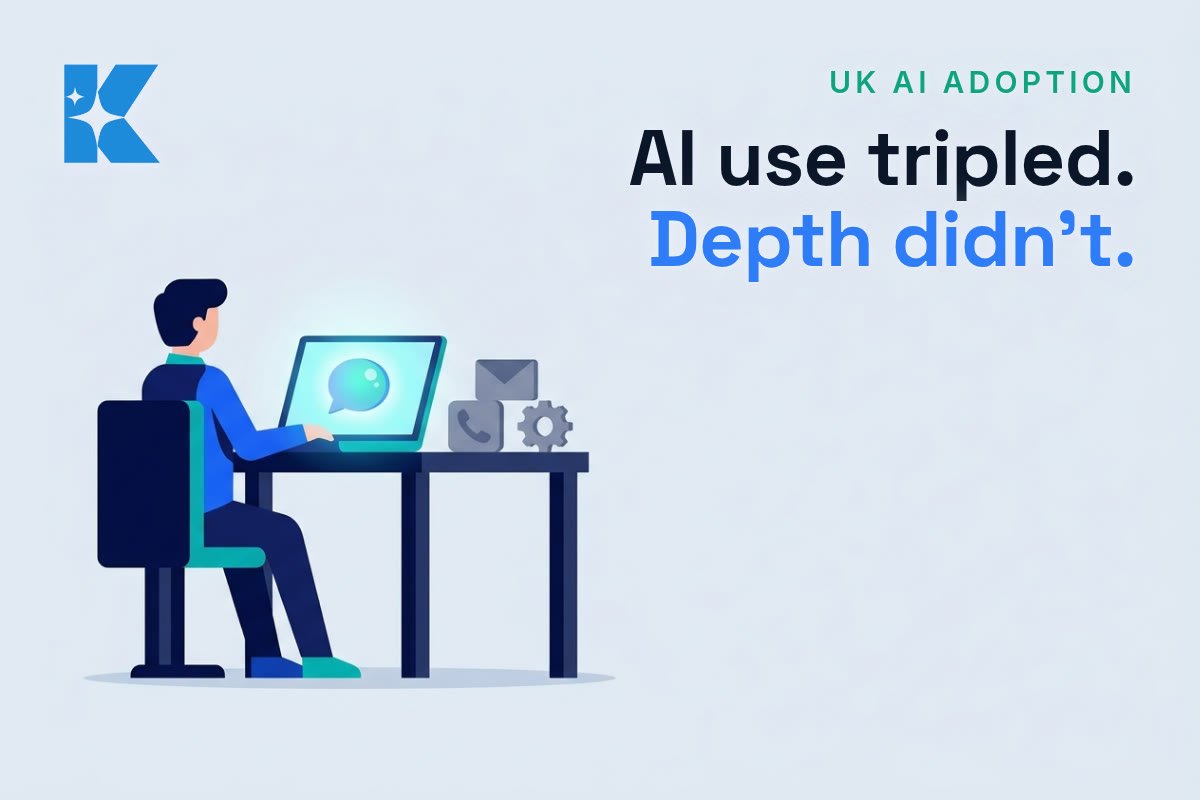
The Office for National Statistics published new figures in July 2026 tracking AI use among UK businesses with 10 or more employees. In September 2023, 12% of them used at least one AI technology. By June 2026, that had risen to 35%, a near-tripling in under three years, based on the ONS’s Artificial intelligence in UK businesses: 2023 to 2026 report.
On the surface, that is a genuinely fast adoption curve. Large language models are the most common technology in use, at around 18% of businesses, followed by visual content creation tools at 16%, machine learning for data processing at 12%, and image processing at 6%. Close to 60% of businesses using AI say they are using it to improve their existing operations. Fewer than one in five are using it to build new products, services, or reach new markets.
The uncomfortable bit: depth hasn’t kept up with adoption
Here is the number we think matters more than the headline one. The average business that has adopted AI is using just 1.6 AI tools, only a modest rise from 1.4 in September 2023. And only 10% of adopters told the ONS they use AI extensively.
Put plainly, most businesses that say they “use AI” have installed one tool, plugged it into one task, and stopped there. That is not a criticism. It is exactly what we see when we sit down with business owners for the first time. Someone on the team started using a chatbot to draft emails, or a design tool picked up an AI feature nobody asked for, and that becomes the whole AI strategy by default. The tool gets used a handful of times a week for one narrow job, while everything else, quoting, scheduling, chasing invoices, following up leads, carries on exactly as it did before.
Tripling adoption sounds like a business story. It is really a story about how thin most of that adoption is, or as one analysis of the same figures put it, UK AI use is widening far faster than it is deepening.
Micro and small firms are further behind than the headline suggests
The ONS figures cover businesses with 10 or more employees, which already leaves out most of the smallest firms in the country. Separate government-commissioned research, the Department for Science, Innovation and Technology’s AI Adoption Research, based on interviews with 3,500 UK businesses in early 2025, put the picture in size terms: just 14% of microbusinesses were using AI, against 23% of medium-sized firms and 36% of large ones.
That is a real gap, not a rounding error. If you run a business with a handful of staff, the honest odds are that you are behind the businesses this survey describes as typical, not ahead of them. That is worth naming directly, because a lot of the coverage around this data reads as universally optimistic when the smallest businesses are the ones with the least support to close the gap.
What actually moves the needle
We built our own workflows around this exact problem before we ever advised a client on it. The businesses getting real value out of AI right now are not the ones with the most tools. They are the ones that picked one process that actually costs them time or money, quoting, invoicing, customer follow-up, scheduling, and built AI properly into that one thing until it stuck.
That is a very different exercise to installing a chatbot and hoping. It means mapping the actual steps in a process, working out where an AI tool can remove real hours rather than just feel modern, and then checking a few weeks later that people are still using it. Most of the 35% adoption figure never gets that second step, which is exactly why the depth numbers are so flat.
If you are one of the 65% who have not started, the lesson from this data is not to panic and adopt five tools at once. Pick the one task in your business that eats the most time every week, and solve that properly before touching anything else. If you are inside the 35% already, the same logic applies in reverse: look honestly at whether your “AI use” is one tool doing one small job, and ask what it would take to get real depth out of it instead.
We offer a free 30-minute AI audit for exactly this reason, to look at where your business actually loses time and work out whether AI can close that gap properly, rather than adding another underused tool to the pile.
A quick way to check where you actually stand
Before you read another AI product launch this month, it is worth answering three honest questions about your own business. First, how many AI tools are actually switched on and being used weekly, not just installed once and forgotten. Second, is that tool touching the process that costs you the most time, or just the process that happened to have the shiniest AI feature bolted on. Third, if you removed that tool tomorrow, would anyone notice within a week.
Most business owners answering those three questions honestly land somewhere close to the ONS’s national picture: one tool, doing one small job, not tied to the part of the business that actually needs the hours back. That is not a failure. It is simply where the country is right now, three years into a genuine adoption curve. The businesses that pull ahead from here will not be the ones that add a second or third tool for its own sake. They will be the ones that go back and get real depth out of the one they already have, then repeat that properly for the next process, rather than chasing headlines about what everyone else is supposedly doing.