The UK construction industry is under pressure. With the market forecast to reach £168.6 billion in output and tender price inflation running at 2-4% for buildings and rising to 4-6% for infrastructure projects, contractors and estimators cannot afford to waste time or money on inaccurate bids. Yet 95% of UK construction projects experienced delays in 2025, with cost overruns of 20-30% commonly linked to those delays. At the heart of this crisis sits one persistent problem: manual estimating.
AI estimating software for construction is rapidly changing this reality. Across the UK, forward-thinking contractors, quantity surveyors, and project managers are turning to automated quotes and pricing automation tools to win more bids, protect their margins, and reclaim hours lost to spreadsheets. This guide covers everything you need to know about AI construction estimating software in 2026, from how it works to which tools are best suited for UK businesses.
What Is AI Estimating Software for Construction?
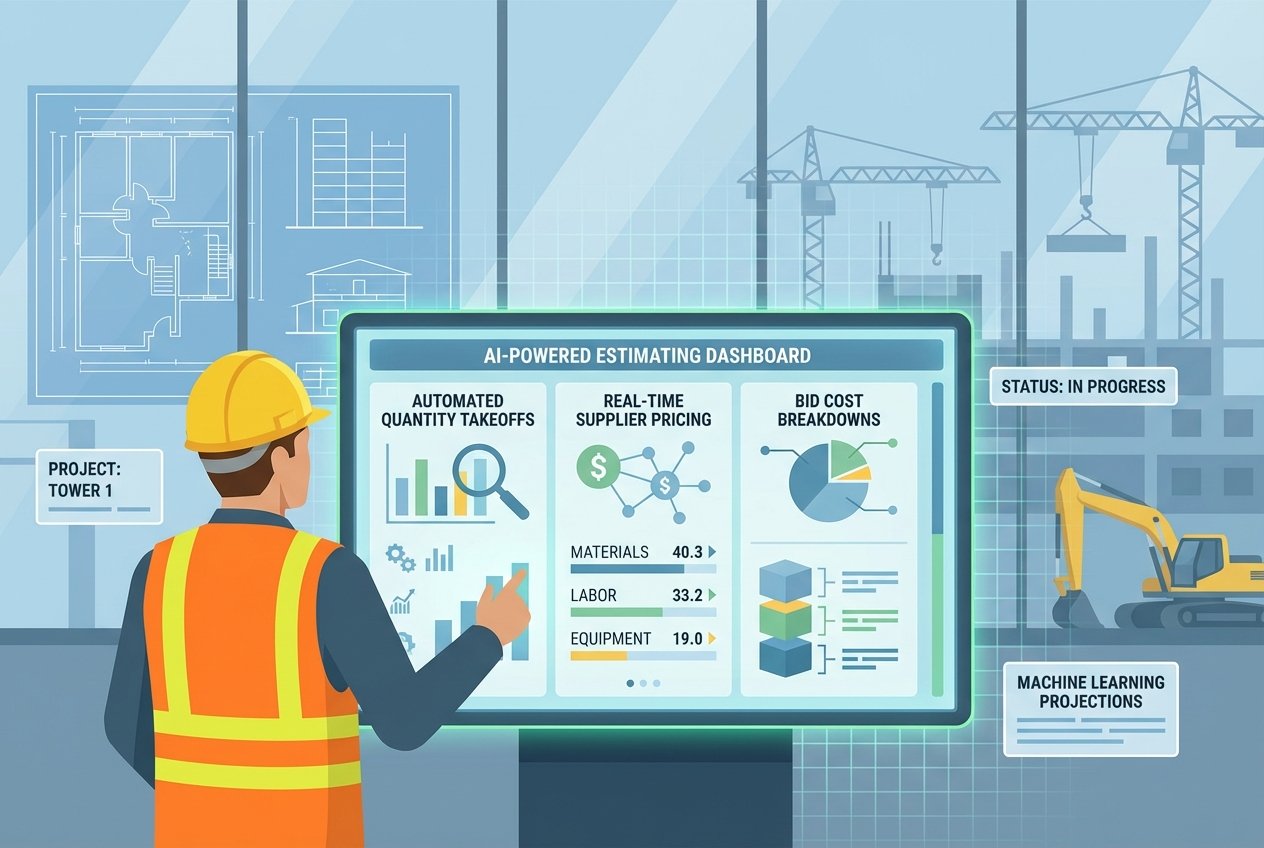
AI estimating software uses machine learning, computer vision, and data automation to streamline the process of quantifying materials, labour, and costs from construction drawings and project documents. Rather than manually measuring floor plans and counting items line by line, estimators can upload a PDF, DWG, or BIM file and let the software perform automated takeoffs within minutes.
Modern AI construction estimating tools go far beyond simple quantity takeoffs. Today’s platforms integrate real-time supplier pricing, historical cost databases, labour rate benchmarks, and even subcontractor quote management. The result is a faster, more accurate, and more scalable estimating process that allows construction businesses to bid on more projects without adding headcount.
As Autodesk’s 2026 AI Trends Report notes, AI in construction has moved from a “nice-to-have” to a normal operational practice, driving smarter planning, automated progress updates, and more competitive bidding across the sector.
Why UK Construction Companies Need Pricing Automation Now
Manual estimating is one of the most time-consuming and error-prone activities in any construction business. Estimators spend hours measuring drawings, cross-referencing supplier catalogues, adjusting for waste factors, and compiling spreadsheets, only for a single pricing error or missed item to erode an entire project’s profit margin.
The challenges facing UK construction SMEs with manual processes include:
- High error rates from manual measurements and formula errors in spreadsheets
- Slow turnaround times that mean missing tender deadlines or submitting rushed, underdeveloped bids
- No version control for changes to drawings or specifications mid-tender
- Inconsistent pricing across different estimators in the same business
- Limited scalability, making it difficult to pursue volume bidding strategies without growing headcount
- Reactive rather than strategic bidding, with no data-driven insight into which job types are most profitable
The good news is that AI-powered construction estimating software addresses every single one of these pain points. According to data from Varseno’s 2026 industry analysis, AI tools are cutting bid preparation time by 40-60% compared to traditional manual methods, with significant improvements in accuracy and consistency.
Key Benefits of AI Construction Estimating Software
1. Faster Automated Takeoffs
AI-powered takeoff tools use computer vision to read PDF and DWG drawings and automatically identify and measure quantities of materials such as concrete, steel, timber, and finishes. What previously took a skilled estimator several days can now be completed in a matter of hours or even minutes. Tools such as Togal.AI have demonstrated time savings of 40-80% on takeoff tasks alone, with one documented case study showing savings of over $1 million through faster and more accurate estimating workflows.
2. Improved Accuracy and Reduced Costly Errors
AI systems learn from every project they process. Using machine learning, these platforms improve their own accuracy over time, reducing the risk of missed items, incorrect measurements, or misapplied waste factors. For UK contractors operating on tight margins in a market with 2-4% tender price inflation, this level of precision can be the difference between a profitable project and a loss-making one.
3. Real-Time Pricing and Supplier Integration
Pricing automation tools connect directly with supplier databases and material cost indices to ensure that your estimates always reflect current market prices. Rather than manually checking supplier catalogues or relying on outdated price books, the software pulls live pricing data into your build-up. This is particularly valuable in the current UK market, where Arcadis forecasts building cost inflation rising to 4-6% for infrastructure in 2026, making accurate real-time pricing essential.
4. Scalable Bidding Without Extra Headcount
One of the most compelling benefits of AI estimating is the ability to bid on more work without proportionally increasing your estimating team. Contractors using AI tools report being able to process significantly more tenders per estimator, increasing their bid volume and, consequently, their pipeline of secured work.
5. Data-Driven Bid Strategy
Advanced AI construction estimating platforms track your historical bidding data, win rates, and margin performance by project type, client, and geography. This allows businesses to make strategic decisions about which tenders to pursue, where to sharpen their pricing, and which types of work are consistently most profitable.
Top AI Estimating Software Tools for UK Construction in 2026
With dozens of platforms now available, choosing the right construction estimating software for your business requires careful evaluation. Here are the leading options relevant to the UK market in 2026:
Togal.AI
Togal.AI is one of the most talked-about AI takeoff tools in 2026, using computer vision to automatically identify and quantify items from uploaded drawings. It supports PDF, DWG, and RVT file formats and improves its accuracy with each user correction. Pricing starts at approximately £1,570 per year for the essential tier, making it suitable for mid-sized contractors with high bid volumes. One documented case study showed it delivering over $1 million in savings through faster and more accurate automated takeoffs.
Buildxact
Buildxact is a cloud-based construction estimating and job management platform that has built strong traction with UK residential builders and smaller commercial contractors. It offers AI-assisted estimating, digital takeoffs, automated quote generation, and client communication tools in a single platform. Its focus on allowances management helps SMEs handle variable cost items without manual recalculation.
STACK Estimating
STACK is a cloud-based platform suited to trade contractors and specialist subcontractors. It provides AI-assisted automated takeoffs, cost libraries, and team collaboration tools. Pricing is approximately £170 per month, and its integration capabilities with project management tools make it a solid choice for UK contractors who need estimating to flow into broader project workflows.
Procore
Procore is an enterprise-grade construction management platform with strong AI-powered estimating and preconstruction modules. Its Construction IQ feature uses predictive analytics to flag cost and schedule risks early. With over 2,600 user reviews and a rating of 4.5 out of 5 on major review platforms, Procore is well-regarded for larger UK construction businesses and those working on complex multi-trade projects. It is typically custom-priced for enterprise clients.
Autodesk Construction Cloud
Autodesk Construction Cloud brings together BIM, preconstruction estimating, and AI-driven risk analytics. Its tight integration with AutoCAD and Revit workflows makes it particularly suited to design-and-build contractors and those working with BIM-mandated public sector projects. The platform’s AI tools provide cost and schedule predictions based on historical project data from thousands of construction projects globally.
How to Choose the Right AI Estimating Software for Your Business
Not every AI estimating tool will be the right fit for every construction business. When evaluating platforms, UK contractors should consider:
- Business size and bid volume: Higher-cost platforms with powerful AI features make economic sense only if you are processing enough tenders to justify the investment
- Project type and trade: Some tools are better suited to groundworks and civils, others to fit-out or residential new build
- Integration requirements: Does the software connect with your existing accounting, project management, and procurement systems?
- UK-specific features: Look for tools that handle VAT, PAYE labour rates, UK material price databases, and RICS-aligned cost structures
- Training and onboarding support: AI tools require an initial investment in user training to achieve full accuracy and productivity benefits
- Data security and compliance: Ensure the platform meets UK GDPR requirements for the storage and processing of client and project data
This is where specialist guidance can make a significant difference. At Kaizen AI Consulting, we work with UK construction businesses to assess their existing workflows, identify the right AI tools for their specific operations, and manage the implementation process from evaluation through to onboarding. Rather than spending months trialling software that may not fit, our consultants help you make confident, evidence-based technology decisions from the outset.
Overcoming the Barriers to AI Adoption in UK Construction
Despite the clear benefits, AI adoption in UK construction continues to lag behind other sectors. PBC Today’s 2026 analysis confirms that construction remains behind the wider economy in AI uptake, with official government data showing that only 1 in 6 UK businesses currently use AI tools in their operations.
The primary barriers include:
- Resistance to change: Experienced estimators may be sceptical of AI tools and concerned about their impact on existing roles
- Data quality issues: AI systems perform best when trained on clean, consistent historical project data, which many SMEs lack
- Integration complexity: Connecting new AI estimating tools with legacy accounting or ERP systems can be technically challenging
- Upfront investment concerns: Without a clear ROI calculation, business owners may hesitate to commit to subscription costs
- Skills gaps: Staff may lack the technical confidence to adopt and champion new digital tools
Encouragingly, the data on productivity gains is compelling. NCS London’s 2026 research found that 75% of UK businesses that have adopted AI report genuine workforce productivity gains, with 57% seeing measurable process improvements. Early AI adopters in construction are reclaiming 500-1,000 hours annually on tasks such as scheduling, planning, document analysis, and estimating.
The Future of Construction Estimating Software in the UK
Looking ahead, the direction of travel for AI estimating is clear. In 2026 and beyond, we can expect to see:
- Voice-to-estimate capabilities: Estimators describing scope items verbally for instant cost generation
- Real-time supplier pricing integration: Dynamic pricing pulled from live procurement platforms and supplier APIs
- Digital twin connectivity: Estimates feeding directly into live project models that update as costs change during construction
- Predictive bid analytics: AI recommending optimal bid strategies based on market conditions, competitor activity, and your own historical win rates
- Building Safety Act compliance automation: AI tools embedding Golden Thread data requirements directly into preconstruction estimating workflows
As Construction Magazine UK reported in February 2026, AI project management and estimating tools are increasingly becoming a compliance requirement rather than a competitive differentiator, particularly for contractors delivering projects under the Building Safety Act’s new regulatory framework.
Getting Started with AI Estimating: A Practical Roadmap
If you are considering introducing AI estimating software into your construction business, a structured approach will deliver the best results:
- Audit your current estimating process: Map how estimates are currently produced, where errors occur, and where time is being lost
- Define your requirements: Establish which project types, file formats, and integrations you need to support
- Evaluate shortlisted platforms: Run structured trials with real project data from your own portfolio
- Build a business case: Calculate the ROI based on current estimating costs, error rates, and bid volume targets
- Plan implementation and training: Roll out the software with proper onboarding, not just a login and a tutorial video
- Measure and optimise: Track time savings, accuracy improvements, and win rate changes to continuously refine your approach
The construction businesses that are pulling ahead of their competitors in 2026 are those that have moved beyond scepticism and begun treating AI not as a threat to their skilled estimators, but as a powerful tool that makes those estimators significantly more productive and effective.
If you are ready to explore how AI estimating and pricing automation can transform your construction business, the team at Kaizen AI Consulting is here to help. We specialise in helping UK businesses implement AI tools that deliver measurable results, from initial strategy through to full deployment. Get in touch with our team today for a no-obligation consultation and find out how AI estimating software could help your construction business win more work, protect its margins, and scale with confidence.