AI-Powered Material Ordering: Reducing Waste and Saving Money on Site
The UK construction industry is facing a crisis hiding in plain sight. Every year, construction sites across the country generate approximately 100 million tonnes of waste, accounting for a staggering 62% of the nation’s total waste output. A significant portion of this is not demolition rubble or unavoidable off-cuts – it is perfectly usable material that was simply ordered in excess, ordered at the wrong time, or ordered without adequate visibility into what was already on site. The financial and environmental cost is enormous, and it is largely preventable.
The good news is that a new generation of AI-powered material ordering and construction procurement tools is changing the equation entirely. By combining predictive analytics, real-time inventory tracking, and intelligent supply chain automation, construction businesses of all sizes are beginning to claw back margins, cut waste, and deliver projects with greater precision than ever before. This guide explores how these technologies work, what the data says about their impact, and how your business can start benefiting today.
The True Cost of Inefficient Material Ordering in UK Construction
Before understanding the solution, it helps to understand the scale of the problem. Material management inefficiency in UK construction is not a minor inconvenience – it is a structural drain on profitability. Research consistently shows that up to 30% of materials delivered to construction sites ultimately become waste. When you factor in the cost of the materials themselves, transportation, handling, storage, and finally disposal, the losses compound rapidly.
Those disposal costs have only risen sharply. From 1 April 2025, the UK government increased the standard rate of Landfill Tax to £126.15 per tonne, up from £103.70 per tonne the previous year. And from April 2026, rates are set to rise again. For a mid-sized housebuilder generating thousands of tonnes of avoidable waste annually, this single regulatory change can add hundreds of thousands of pounds to project costs.
Beyond disposal, the hidden costs of poor construction procurement are equally damaging:
- Labour downtime caused by material shortages or delivery delays can cost between £500 and £1,000 per day on a mid-sized site
- Emergency re-orders at premium prices erode margins and disrupt project scheduling
- Storage and handling of excess materials ties up capital and introduces damage risk
- Administrative burden from manual ordering processes, invoice reconciliation, and supplier management consumes skilled time that could be spent elsewhere
The result is a sector where cost overruns are normalised and where procurement is often treated as an afterthought rather than a strategic lever. AI is beginning to change that fundamentally.
How AI-Powered Material Ordering Works in Practice
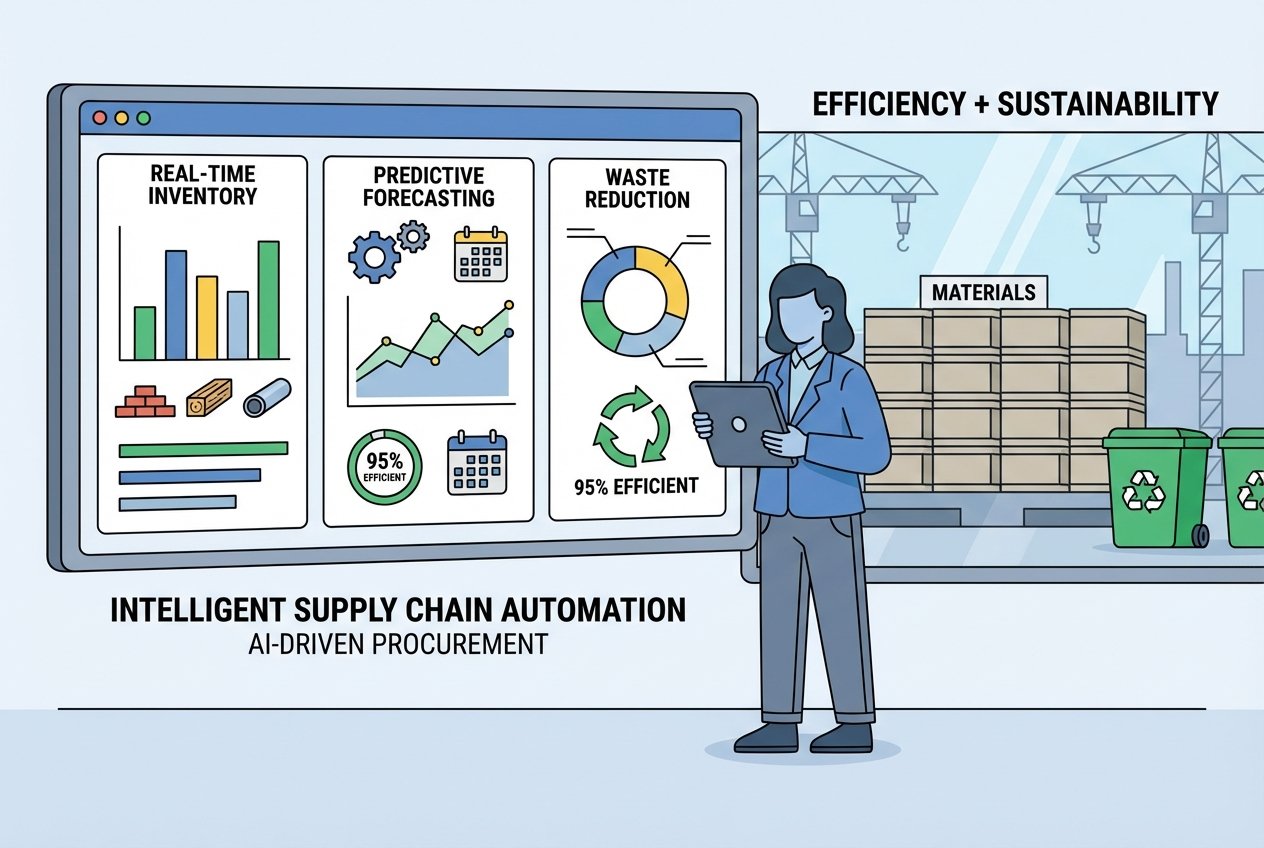
At its core, material ordering AI applies machine learning and predictive analytics to the procurement process. Rather than relying on estimators manually calculating quantities from drawings and experience, or site managers placing orders based on gut feel, AI systems ingest data from multiple sources and make intelligent, data-driven ordering decisions.
Demand Forecasting and Predictive Ordering
Modern AI platforms analyse historical project data, current site progress, weather forecasts, supplier lead times, and even real-time BIM (Building Information Modelling) outputs to generate accurate material demand forecasts. The system predicts not just what will be needed, but when it will be needed, accounting for sequencing, phase transitions, and potential delays. This eliminates the guesswork that leads to both over-ordering and costly last-minute shortages.
According to research by Remarcable, 37% of construction businesses now use AI in some capacity – up from just 26% in 2023. Platforms in this space are already capable of flagging duplicate orders, identifying pricing anomalies across suppliers, and alerting procurement teams to unusual consumption patterns that might indicate waste or theft on site.
Real-Time Inventory Visibility
One of the most common drivers of over-ordering is simply not knowing what is already on site. Without real-time inventory visibility, site managers order more of what they think they need, only to discover pallets of the same material sitting in a different area of the site. AI-powered inventory systems use barcode scanning, RFID tagging, and increasingly computer vision to maintain a live, accurate picture of stock levels across multiple locations.
This real-time view does not just prevent duplicate orders – it also enables smarter allocation across a contractor’s portfolio of projects. Surplus materials from one site can be transferred to another rather than being returned (at cost) to a supplier or skipped entirely.
Supplier Intelligence and Supply Chain Automation
AI-driven supply chain automation brings another layer of intelligence to the procurement process. Rather than relying on static approved supplier lists and manual quote comparisons, AI platforms continuously monitor supplier performance data, price movements, and availability. They can automatically trigger purchase orders when stock falls below defined thresholds, route orders to the best-value compliant supplier, and flag any pricing deviations from agreed contract terms.
The financial impact of this kind of supply chain automation is well documented across industries. Research from Procurement Tactics found that AI adoption in supply chain management can cut logistics costs by 15% and reduce inventory carrying costs by 35%, while boosting service efficiency by 65%. For UK construction firms operating on margins that frequently sit in the 2-5% range, improvements of this magnitude are transformative.
The Business Case: Efficiency Gains and Waste Reduction at Scale
The efficiency argument for AI in construction procurement is compelling, and the data increasingly backs it up. A 2026 report by Operations Council found that agentic AI in procurement can deliver efficiency improvements of between 25 and 40 percent. Meanwhile, the 2026 State of AI in Procurement report found that weekly use of generative AI within purchasing and procurement functions increased by 44 percentage points in a single year, driven by demonstrable savings and efficiency gains.
For construction specifically, the waste reduction case is equally powerful. Consider the numbers:
- UK construction produces 62% of the country’s total waste and 32% of all landfill waste
- Disposing of inert waste now costs up to £126.15 per tonne in landfill tax alone
- Unused concrete alone can cost between £100 and £200 per cubic metre in wasted material, plus disposal costs of up to £70 per tonne
- The UK Green Building Council notes that construction accounts for 60% of all material use and waste generation in the UK
When AI-powered material ordering reduces over-ordering by even 10-15%, the savings across a portfolio of projects quickly reach six or seven figures annually for a mid-sized contractor. This is not theoretical – it is an increasingly documented reality as more firms implement these systems.
Beyond cost savings, there is a growing reputational and regulatory dimension. UK construction firms bidding for public sector contracts are increasingly required to demonstrate sustainability credentials, including measurable waste reduction targets. AI-powered procurement systems provide the granular data trail needed to demonstrate compliance and report accurately on material efficiency – something that is virtually impossible with manual processes.
Overcoming the Barriers to Adoption
Despite the clear benefits, adoption of material ordering AI across UK construction remains uneven. Common barriers include concerns about integration with existing enterprise resource planning (ERP) systems, a lack of clean historical data to train algorithms on, uncertainty about which platforms to trust, and – perhaps most importantly – a cultural reluctance to hand purchasing decisions to automated systems.
These concerns are legitimate and should not be dismissed. The reality is that implementing AI in construction procurement is not a plug-and-play exercise. It requires careful planning, data readiness assessment, supplier engagement, and change management. Getting it right from the outset – rather than embarking on a costly failed implementation – is where specialist expertise pays dividends.
This is precisely where Kaizen AI Consulting adds real value. With deep expertise in AI strategy and implementation across construction and other asset-intensive industries, the team helps businesses navigate the complexity of procurement automation – from selecting the right technology stack to ensuring data quality, managing supplier onboarding, and embedding new processes within existing workflows. Rather than replacing your team’s expertise, the goal is to amplify it with intelligent tools that make better decisions faster.
Choosing the Right AI Solution for Your Construction Business
Not all material ordering AI platforms are created equal, and the right solution for a national housebuilder will look very different from the right solution for a regional groundworks contractor. When evaluating options, construction businesses should consider the following:
Integration Capability
The platform must integrate cleanly with your existing project management software, accounting systems, and supplier portals. Siloed systems that require manual data entry to function defeat much of the efficiency purpose. Look for open APIs and proven integrations with common construction ERP platforms.
Transparency and Explainability
Procurement teams need to trust the recommendations AI systems make. Platforms that can explain why they are suggesting a particular order quantity, from a particular supplier, at a particular time, are far more likely to achieve internal buy-in than black-box systems that simply generate outputs without rationale.
Scalability and Configurability
Your business will grow and your projects will vary. The right platform should scale with you and be configurable to the specific requirements of different project types, whether that is new residential development, commercial fit-out, civil engineering, or infrastructure work.
Data Security and Compliance
Construction procurement data contains commercially sensitive information about supplier relationships, pricing agreements, and project details. Any AI platform handling this data must comply with UK GDPR requirements and offer robust security controls.
The Sustainability Dividend: AI, Waste Reduction and Net Zero
The environmental case for AI-powered material ordering deserves particular attention as the UK construction industry faces growing pressure to reduce its carbon footprint. With construction accounting for 60% of all material use in the UK, reducing over-ordering is not just a commercial imperative – it is an environmental one. Every tonne of material that is ordered but never used represents embedded carbon that has been extracted, processed, transported, and ultimately wasted.
AI-driven demand forecasting directly addresses this by ensuring that materials are ordered as close to actual need as possible, reducing storage times, minimising damage and deterioration, and eliminating the cycle of over-order, waste, and re-order. The result is a measurable reduction in scope 3 carbon emissions – increasingly important for contractors seeking to maintain relationships with large clients who have their own net zero commitments.
This is the broader opportunity that AI in construction procurement represents: not just a tool for cutting costs in the short term, but a foundation for building a more efficient, more sustainable, and more competitive business over the long term.
Getting Started: Practical Next Steps for UK Construction Firms
If you are considering introducing AI-powered material ordering to your construction business, a structured approach will maximise your chances of a successful implementation:
- Audit your current procurement process – identify where waste, duplication, and inefficiency are occurring and quantify the cost
- Assess your data readiness – AI systems need good historical data to learn from; understand what data you have and what gaps need to be filled
- Engage your supply chain – the most effective procurement automation works collaboratively with suppliers; early engagement helps smooth implementation
- Start with a pilot – rather than attempting a business-wide rollout, pilot AI ordering on a single project or product category first to demonstrate value and build confidence
- Measure and iterate – define clear KPIs from the outset (waste volumes, cost per unit, order accuracy) and use early results to refine the approach
If you would like expert guidance tailored specifically to your business, the team at Kaizen AI Consulting is ready to help. From initial scoping and technology selection through to implementation, training, and ongoing optimisation, we work alongside UK construction businesses to make AI-powered procurement a practical, profitable reality – not just a theoretical ambition. Get in touch today to discuss how we can help reduce waste, cut costs, and give your supply chain the intelligent edge it needs.
The construction industry has always been built on tight margins, hard graft, and hard-won expertise. AI-powered material ordering does not replace any of that – it supercharges it, putting the right materials in the right place at the right time, every time. In a market where margins are razor-thin and waste disposal costs are rising year on year, that is no longer a nice-to-have. It is a competitive necessity.