Construction sites remain among the most hazardous workplaces in Britain. According to the Health and Safety Executive’s 2024/25 annual statistics, 35 construction workers lost their lives in work-related incidents during the year, accounting for 28% of all worker fatalities across every industry in Great Britain. Meanwhile, the sector recorded approximately 2,500 injuries per 100,000 workers, making construction the second most dangerous sector for non-fatal injuries. Workplace ill health and injury cost the UK economy an estimated £22.9 billion in 2023/24, with 40.1 million working days lost overall.
For small contractors operating with lean teams and tight margins, a single serious incident can be financially devastating, legally complex, and reputationally ruinous. The good news is that artificial intelligence is making sophisticated safety monitoring more accessible and affordable than ever before. This guide explains what AI-powered construction site monitoring actually is, how it works in practice, and what small UK contractors need to know to stay compliant and keep their workers safe.
Why Construction Safety Remains a Critical Challenge in 2026
Falls from height have been the leading cause of construction fatalities every single year since at least 2001/02, accounting for more than half of all construction deaths over the five-year period between 2020/21 and 2024/25. Struck-by incidents involving vehicles and moving plant also feature prominently in the HSE’s enforcement records. These are not new problems, yet they persist with alarming consistency.
Part of the reason is scale and resource. Large principal contractors have dedicated health and safety managers, compliance teams, and the budget to invest in technology. Small contractors, often working on domestic extensions, local commercial fit-outs, or subcontracting on larger schemes, frequently rely on periodic paper-based inspections and manual toolbox talks. Human oversight alone, however well intentioned, has inherent gaps. Site conditions change rapidly, workers move between tasks, and hazards can emerge within seconds.
The HSE achieved a 96% conviction rate in 2024/25 across 246 criminal prosecutions, securing over £33 million in fines. Individual fines in 2024 reached as high as £2.345 million for companies in breach of basic site safety obligations. For a small contractor, even a fraction of that figure could mean the end of the business. The regulatory incentive to invest in better monitoring has never been stronger.
What Is AI Safety Monitoring and How Does It Work?
AI safety monitoring on construction sites typically combines several layers of technology to provide continuous, real-time oversight of site conditions and worker behaviour. At its core, it uses computer vision, which is the ability of software to interpret and analyse live video footage, combined with machine learning algorithms trained on thousands of real construction site scenarios.
Computer Vision and PPE Detection
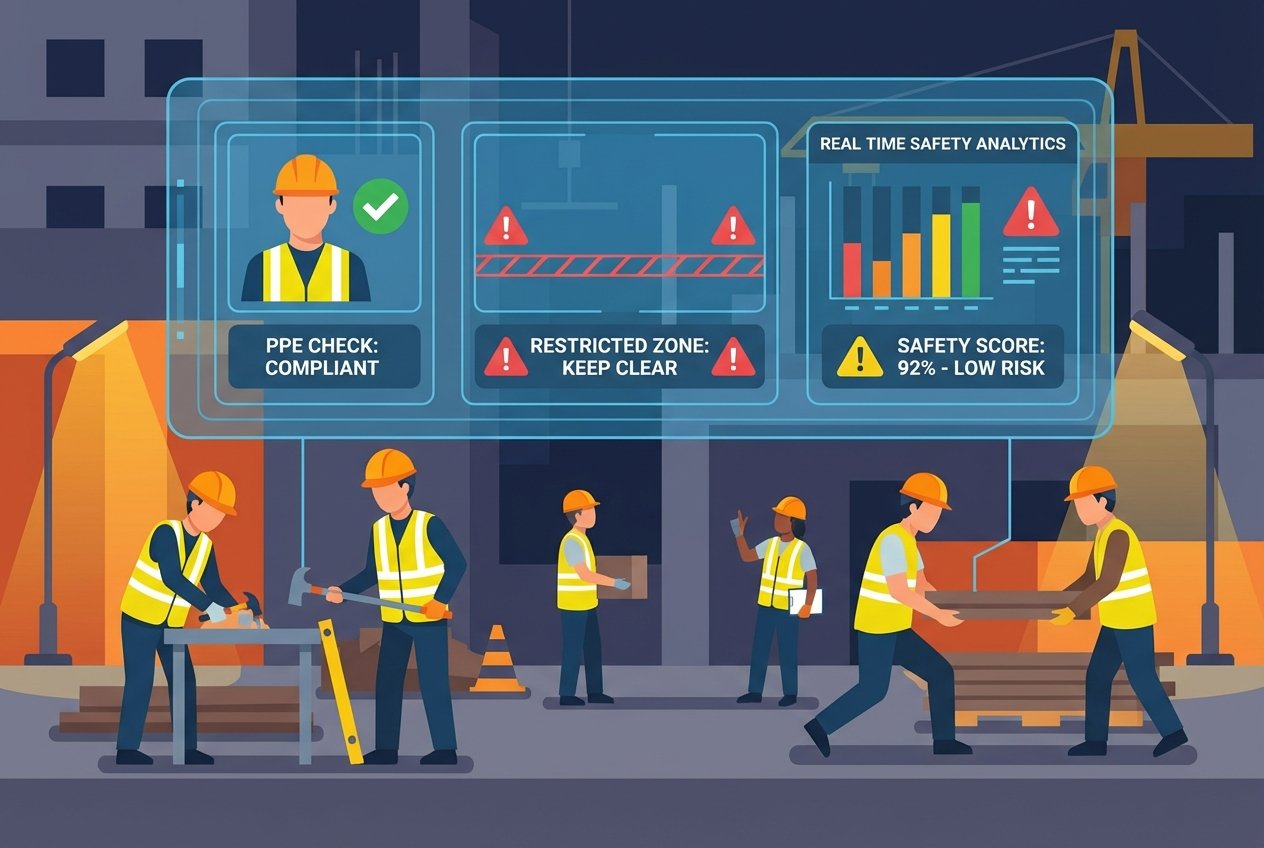
One of the most immediately practical applications is automated PPE detection. UK-based providers such as WCCTV and VIS Systems deploy camera systems that have been trained specifically for construction environments. These systems can detect, in real time, whether workers are wearing hard hats, high-visibility vests, safety glasses, gloves, and harnesses. When a violation is detected, the system sends an immediate alert to a site manager or HSQE team, enabling rapid intervention rather than after-the-fact reporting.
Modern AI systems can achieve over 95% detection accuracy for PPE compliance in real industrial environments, monitoring multiple workers simultaneously across a large site. This is a step change from periodic visual checks that can realistically only cover a fraction of on-site activity at any given moment.
Behavioural Safety and Near-Miss Analysis
Beyond PPE, AI platforms can monitor for unsafe behaviours: workers entering restricted zones, proximity of pedestrians to moving plant, fall-risk positioning near unguarded edges, and even signs of worker fatigue. Critically, these systems can aggregate data over time to identify patterns, flagging areas or tasks where near-misses cluster before a serious incident occurs.
As discussed at the EcoOnline UK Construction Leaders Forum in March 2026, industry leaders from major contractors including AtkinsRealis, Colas Ltd, and Winvic are actively shifting towards data-led prevention, using AI-enhanced near-miss reporting and Serious Injury/Fatality (SIF) focus rather than lagging indicators like Total Recordable Injury Frequency. This proactive philosophy is exactly what AI monitoring enables, and it is increasingly accessible to smaller contractors too.
Wearable Technology and Environmental Sensors
Camera-based systems can be complemented by wearable devices that monitor individual worker biometrics, including heart rate, body temperature, and movement patterns, to detect early signs of heat stress, fatigue, or a fall. Environmental sensors can monitor air quality, noise levels, and structural vibration in real time, providing alerts when conditions exceed safe thresholds.
The CECA AI in UK Construction Report highlights telematics with AI as enabling predictive maintenance on plant equipment, reducing both mechanical failures and the safety risks associated with unplanned breakdowns. For small contractors running a small fleet of plant, this kind of predictive intelligence can be transformative.
CDM Regulations and What Small Contractors Must Know
The Construction (Design and Management) Regulations 2015 remain the primary legal framework governing health and safety in UK construction. The CDM Regulations apply to all construction work, regardless of the size of the contractor or the scale of the project. Even sole traders carrying out domestic work have legal duties under CDM 2015.
For small contractors, the key obligations include carrying out and documenting suitable risk assessments, providing adequate welfare facilities, co-operating with other duty holders on site, following the construction phase plan, and reporting relevant incidents to the HSE under RIDDOR. Critically, the regulations require that hazards are identified and controlled proactively, not just reacted to after an incident occurs.
This is precisely where AI-powered construction site monitoring provides a compelling compliance tool. Automated, time-stamped records of site conditions, PPE compliance rates, near-miss events, and worker behaviour patterns create an audit trail that demonstrates due diligence to the HSE. In the event of an investigation, this documentation can be invaluable. According to the Health and Safety Event 2026 research, almost half (47%) of organisations say they are now ready to adopt AI in safety processes, and nearly a third (32%) report it is already in use.
Practical Considerations for Small Contractors Adopting AI Monitoring
Start With a Needs Assessment
Not every site requires the same level of monitoring. A small residential refurbishment with two workers on site has different risk priorities from a commercial groundworks project with multiple subcontractors, HGV deliveries, and members of the public nearby. Begin by identifying your highest-risk activities and locations. Falls from height, vehicle movements, and work in confined spaces are typically the areas where AI monitoring delivers the greatest return on investment in terms of both safety and compliance.
Understand Data Privacy Obligations
AI camera systems and wearables collect personal data about workers. Under UK GDPR and the Data Protection Act 2018, you must have a lawful basis for this processing, inform workers clearly about the monitoring, and ensure data is stored securely and only retained for as long as necessary. Workers should not be surprised by monitoring systems; transparency is both a legal requirement and good practice for maintaining trust on site.
Combine Technology With Human Oversight
A consistent message from UK construction leaders is that AI should augment, not replace, human safety management. Systems should be set up and interpreted by qualified safety professionals who understand both the technology and the specific hazards of your type of work. There is a genuine risk, highlighted by the CECA report, of creating a false sense of security if contractors over-rely on automated alerts without maintaining active supervision and safety culture. At Kaizen AI Consulting, we help businesses identify the right AI tools for their specific operational context, ensuring technology is implemented in a way that genuinely reduces risk rather than simply adding a layer of complexity.
Consider the Total Cost of Inaction
AI safety monitoring systems do carry upfront costs, though these are falling rapidly as the technology matures. When evaluating affordability, small contractors should weigh the cost of implementation against the financial consequences of a serious incident: HSE investigation costs, potential fines reaching hundreds of thousands of pounds, civil litigation, insurance premium increases, and the very real possibility of business closure. For many small contractors, the question is not whether they can afford to invest in health and safety technology, but whether they can afford not to.
The Broader Business Case: Beyond Compliance
There is a compelling commercial argument for AI safety monitoring that goes beyond simply avoiding enforcement action. Clients, particularly in the public sector and on larger commercial schemes, are increasingly asking subcontractors to demonstrate robust safety management systems as part of tender evaluation. Principal contractors under CDM 2015 have a duty to appoint only those contractors with the skills, knowledge, and resources to carry out work safely, meaning that documented AI-assisted safety monitoring can become a genuine competitive differentiator for smaller firms.
Insurance providers are also beginning to recognise AI safety monitoring as a risk-reduction measure, with some offering preferential premium rates for contractors who can demonstrate real-time site monitoring capability. The long-term financial case for investment is therefore strong.
If you are considering how AI could support your construction business, whether for safety monitoring, operational efficiency, or broader digital transformation, our team at Kaizen AI Consulting offers tailored advice for UK businesses of all sizes. We understand the practical realities facing small and medium-sized contractors and can help you navigate the growing landscape of AI tools without unnecessary jargon or expense.
Getting Started: A Practical Roadmap for Small Contractors
If you are ready to explore AI safety monitoring for your construction business, here is a practical starting framework:
- Audit your current safety processes – Identify where your monitoring gaps are and which incidents or near-misses have occurred most frequently in the past 12 months.
- Research UK-based AI safety vendors – Look for providers with proven construction sector experience and the ability to support CDM compliance documentation, such as WCCTV and VIS Systems.
- Pilot on one site or project type – Before committing to a company-wide rollout, test the technology in a controlled environment and measure its impact on compliance and incident rates.
- Train your team – Ensure all workers and supervisors understand how the monitoring system works, what it is monitoring, and how to respond to alerts.
- Review and iterate – Use the data generated by your AI system to continuously improve your safety approach, updating your construction phase plan and risk assessments accordingly.
The construction industry has a genuine opportunity to significantly reduce its injury and fatality rate through the intelligent application of AI monitoring technology. The tools are available, the cost barriers are falling, and the regulatory environment increasingly rewards proactive investment in worker safety.
Ready to explore how AI can strengthen your construction business’s health and safety compliance? Get in touch with the team at Kaizen AI Consulting today for a no-obligation conversation about the right approach for your business.