
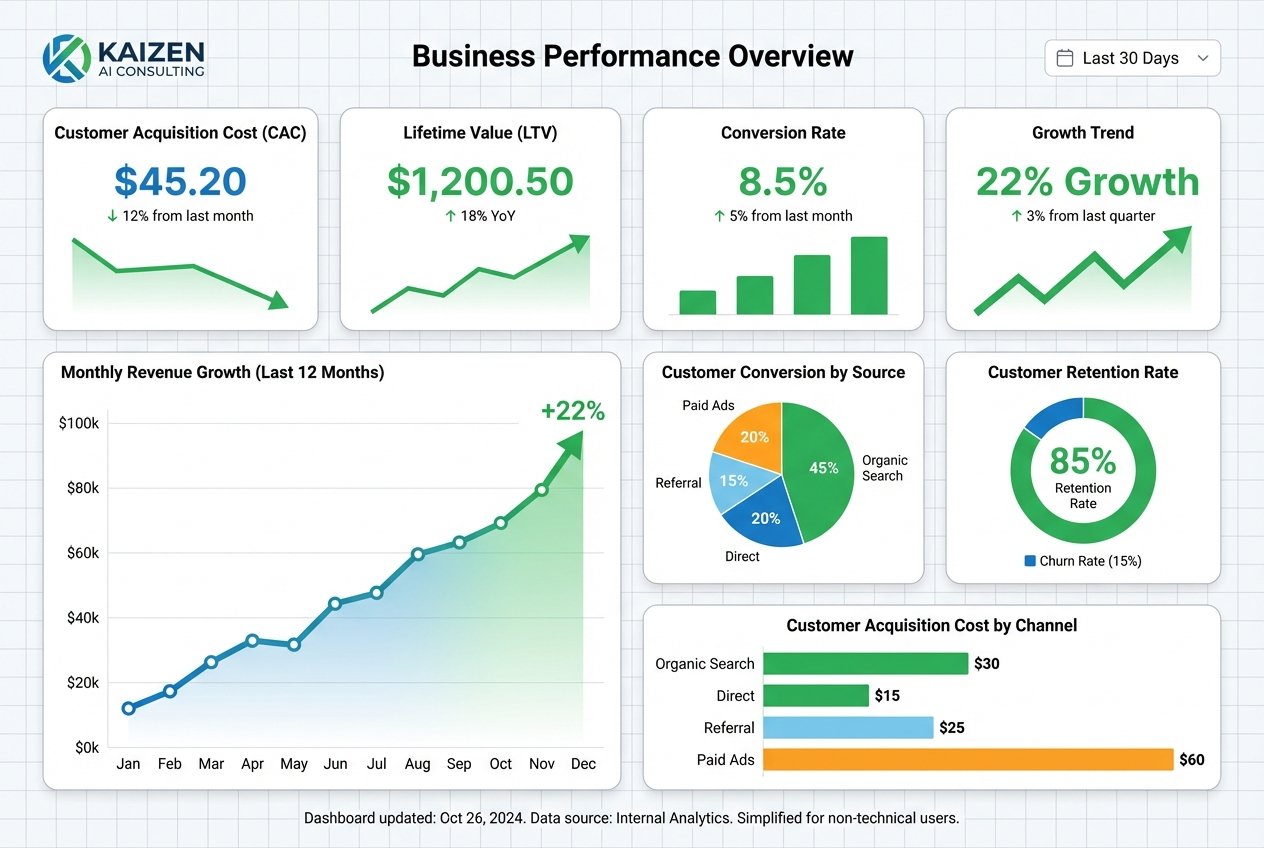
Data analytics doesn’t have to be complicated. Behind every spreadsheet, dashboard, and report lies a simple truth: your numbers are trying to tell you a story about your business. The challenge for most UK business owners isn’t collecting data – it’s understanding what it means and how to use it.
According to government statistics, businesses that actively use data analytics are 5 times more likely to make faster decisions than their competitors. Yet a 2023 survey found that 60% of small to medium enterprises struggle to interpret their business data effectively.
This guide strips away the technical jargon to help you understand what your numbers are really saying – and more importantly, how to act on those insights.
Why Data Analytics Basics Matter for Your Business
Every business generates data, whether you realise it or not. Your till receipts, website traffic, customer enquiries, inventory levels, and social media engagement all create a digital footprint. Understanding data isn’t just for tech giants or data scientists – it’s essential for any business owner who wants to grow.
Think of data analytics as your business’s health check. Just as your doctor uses blood pressure and cholesterol levels to assess your wellbeing, business metrics reveal the vital signs of your company. Are sales increasing? Which products are most profitable? Where are customers dropping off? These insights transform guesswork into informed decision-making.
For UK businesses facing economic uncertainty, leveraging analytics simplified approaches can mean the difference between surviving and thriving. When margins are tight, every pound matters – and data helps you spend wisely.
The Essential Business Metrics You Should Track
Let’s break down the key numbers every business owner should monitor, explained in plain English:
Revenue Metrics: Following the Money
Monthly Recurring Revenue (MRR) is simply how much money comes in regularly each month. For subscription businesses or those with retainer clients, this number tells you what you can count on.
Customer Acquisition Cost (CAC) answers the question: how much do you spend to get one new customer? Add up your marketing and sales costs, then divide by the number of customers you gained. If you’re spending £500 on advertising and gain 10 customers, your CAC is £50.
Average Order Value (AOV) shows how much customers typically spend per transaction. Divide your total revenue by the number of orders. A rising AOV often indicates successful upselling or that you’re attracting higher-value customers.
Customer Metrics: Understanding Your Audience
Customer Lifetime Value (CLV) estimates how much revenue a customer will generate throughout their relationship with you. Research from Invesp shows that increasing customer retention by just 5% can boost profits by 25-95%.
Churn Rate measures how many customers you’re losing. If you start the month with 100 customers and lose 5, your churn rate is 5%. For most UK businesses, keeping this number low is more cost-effective than constantly acquiring new customers.
Net Promoter Score (NPS) reveals customer satisfaction by asking: “How likely are you to recommend us?” Scores range from -100 to 100, with anything above 0 considered good and above 50 excellent.
Operational Metrics: Running Efficiently
Conversion Rate tells you how many people take your desired action. Whether that’s website visitors making a purchase, email subscribers booking consultations, or social media followers clicking through – this percentage reveals how effective your processes are.
Stock Turnover shows how quickly you sell inventory. Divide your cost of goods sold by your average inventory value. Faster turnover usually means better cash flow and fresher products.
What Your Numbers Are Really Telling You
Raw numbers don’t mean much without context. Here’s how to interpret what you’re seeing:
Trends Over Time
Don’t obsess over daily fluctuations. Look at your business metrics over weeks and months to spot genuine patterns. Is revenue climbing steadily? Are customer complaints trending downward? Seasonal businesses especially need to compare year-on-year rather than month-on-month.
Relationships Between Metrics
Understanding data means seeing connections. If your traffic is up but conversions are down, your marketing might be attracting the wrong audience. If customer acquisition costs are rising while lifetime value stays flat, your business model needs attention.
A McKinsey study found that organisations using business intelligence to connect different data points are 23 times more likely to acquire customers and 6 times more likely to retain them.
Benchmarks and Comparisons
Your numbers need context. Is a 2% conversion rate good? It depends on your industry. UK e-commerce averages around 2-3%, whilst B2B services might see 1-2%. Research industry standards for your sector to understand where you stand.
Common Data Mistakes to Avoid
Even with analytics simplified, businesses often stumble. Here are pitfalls to watch for:
Vanity Metrics – These numbers look impressive but don’t drive decisions. Social media followers mean little if they don’t convert. Focus on metrics tied to business outcomes.
Analysis Paralysis – Some businesses drown in data, tracking everything but acting on nothing. Identify your 5-7 most important metrics and monitor those consistently.
Ignoring Negative Trends – It’s tempting to dismiss bad numbers as temporary blips. Often, they’re early warnings. Address declining metrics quickly before they become crises.
Making Decisions Too Quickly – One week of data rarely tells the full story. Gather sufficient information before making major changes, especially for UK businesses affected by seasonal variations.
Getting Started: Your Data Analytics Action Plan
Ready to make sense of your numbers? Here’s a practical roadmap:
Step 1: Identify Your Goals
What do you want to achieve? Increased sales? Better customer retention? Lower costs? Your goals determine which metrics matter most. A business consultant can help align your data strategy with your objectives.
Step 2: Collect the Right Data
You probably have more data than you realise. Your accounting software, website analytics, CRM system, and email marketing platform all generate valuable information. Start by gathering what you already have before investing in new tools.
For UK businesses, ensuring GDPR compliance whilst collecting data is essential. Customer trust depends on transparent, lawful data handling.
Step 3: Choose Simple Tools
You don’t need expensive enterprise software to begin. Google Analytics (free) tracks website behaviour. Spreadsheets can analyse sales patterns. Many CRM and accounting platforms include built-in reporting.
As your confidence grows, tools like Microsoft Power BI or Tableau offer more sophisticated visualisation, but start simple.
Step 4: Create a Regular Review Routine
Set aside time weekly or monthly to review your key metrics. Look for trends, anomalies, and opportunities. This discipline transforms data from background noise into actionable intelligence.
Step 5: Test and Learn
Use your insights to make small changes, then measure the results. Adjust your pricing, tweak your website, or refine your marketing message. Understanding data means continuous experimentation and improvement.
When to Bring in Expert Support
Whilst data analytics basics are accessible to everyone, there comes a point where professional guidance accelerates your progress. Complex analysis, predictive modelling, or integrating multiple data sources often requires specialist knowledge.
This is where Kaizen AI Consulting helps UK businesses bridge the gap between data and decisions. Our team translates your business metrics into clear, actionable strategies – without the technical jargon. Whether you’re just starting your data journey or looking to extract more value from existing analytics, expert support ensures you’re focusing on what truly matters for your business.
According to TechUK research, UK businesses working with AI and analytics consultants see an average productivity increase of 30% within the first year.
Turning Insights into Action
The ultimate goal of business intelligence isn’t prettier graphs or more detailed reports – it’s better decisions. Here’s how to move from analysis to action:
Prioritise High-Impact Changes – Not every insight deserves immediate action. Focus on opportunities with the biggest potential return or risks requiring urgent attention.
Set Specific Targets – Instead of “improve conversion rate,” aim for “increase checkout conversion from 2% to 3% within three months.” Specific goals make progress measurable.
Communicate Insights Across Your Team – Data isn’t just for managers. When your entire team understands the numbers, everyone can contribute to improvement.
Track Your Changes – When you make a data-driven decision, monitor whether it achieves the expected result. This builds your analytical skills and business acumen over time.
The Future Is Data-Informed
Understanding data isn’t about becoming a statistician or learning complex formulas. It’s about asking better questions and finding answers in the information your business already creates.
UK businesses that embrace analytics simplified approaches don’t just survive uncertainty – they spot opportunities their competitors miss. They allocate budgets more effectively, understand their customers more deeply, and adapt faster to market changes.
Your numbers are already telling you stories about what’s working and what isn’t. The question is: are you listening?
If you’re ready to transform your business data into genuine competitive advantage, Kaizen AI Consulting specialises in making analytics accessible and actionable for UK businesses. We cut through the complexity to deliver insights you can actually use – helping you make smarter decisions without needing a degree in data science.
Get in touch with our team today to discover what your numbers are really telling you and how to turn those insights into measurable business growth. Let’s make your data work as hard as you do.