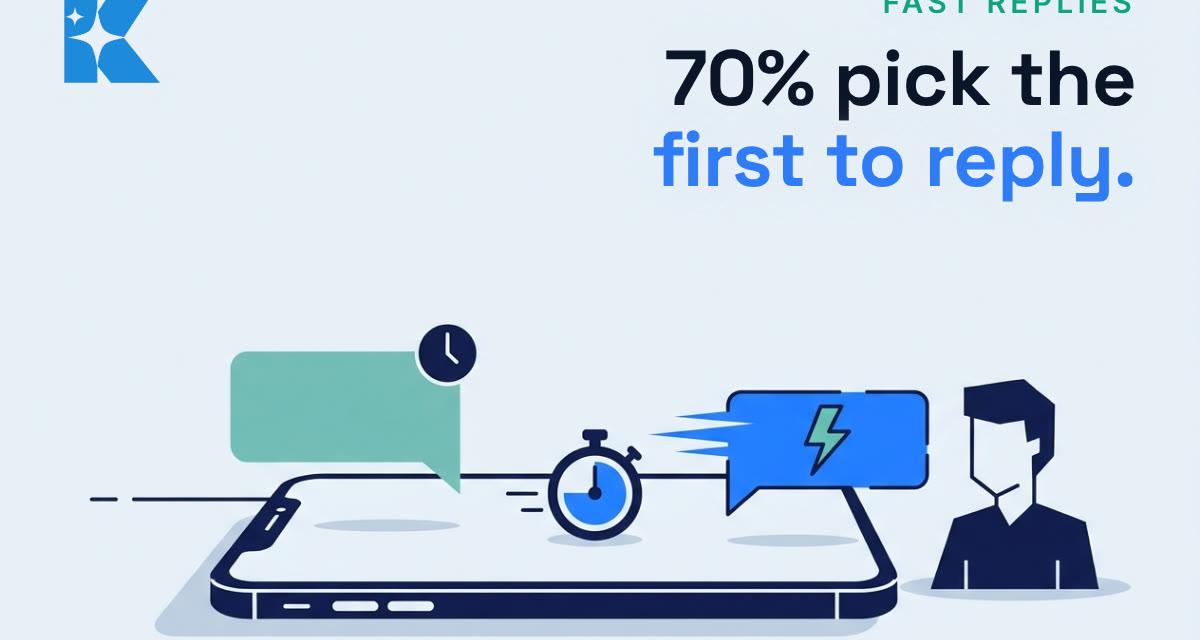
About 70% of UK customers say they will choose the first business that responds to them. That is the headline from a January 2026 survey by Moneypenny, run by Censuswide among 5,001 UK consumers and 2,000 business decision-makers. The same research found that only 23% of customers say they would keep trying if they did not hear back. We have seen the figures through trade-press coverage and Moneypenny's own report, and it is a phone-answering company's research, so read it as a strong signal rather than a law of nature. The direction is hard to argue with: the quote request that gets an answer first is the one that gets the job.
We covered missed phone calls recently. This post is about the other half: the written enquiry. The web form, the email, the Facebook message, the WhatsApp. They arrive while you are on a roof, under a sink or in a meeting, and they quietly go cold.
Why written enquiries go cold
A customer who messages three businesses is not being rude. They are comparing. They send the same question to a handful of firms, then go back to their day, and the first reply they see tends to set the tone for the whole decision. By the time you surface at the end of a job, the conversation may already be over. That is why the fix is less about working harder and more about making sure something answers on your behalf within minutes.
What the numbers say about waiting
Moneypenny's survey is the strongest UK figure we found, and you can read the report on Moneypenny's thought leadership report. A London-focused write-up of the same research says 73% of Londoners are likely to choose the business that responds first, which you can see on London Loves Business. Trade coverage on Contact Centres describes the gap between what firms believe about their service and what customers experience.
Two cautions. You may also see a "78% buy from the first responder" figure quoted around the internet. It is weakly sourced, so we have not used it. And the response-time averages that circulate, such as 47 hours for a UK business, come from vendor white papers, so we have left them out too. The Moneypenny numbers are enough to make the point.
A worked example, clearly illustrative
Take a small firm that gets 20 written enquiries a month and wins half. Suppose a customer is waiting on three replies and the first one lands in an hour, while yours lands the next morning. If just 4 of those 20 enquiries go to the faster rival and a typical job is worth £200, that is £800 a month, or £9,600 a year. Those are our own round numbers, not a forecast, so swap in your own. The point is that speed of first reply is one of the cheapest things to improve, because it costs minutes, not money.
Five checks to run this week
1. Time yourself
Send an enquiry to your own website form, your email and your Facebook page from a second phone. Write down how long each takes to get any reply. Most owners have never done this, and it is usually a surprise.
2. Send an instant "got it" reply
You do not have to answer the question in the first minute. You have to show you exist. A short automatic acknowledgement such as "Thanks, we have your message and will reply properly by 5pm today" is enough to stop a customer shopping around. Most website form tools, email apps and Facebook and WhatsApp Business accounts can send one for free.
3. Put every channel into one place
If messages land in four apps, one will always be forgotten. Forward form submissions to the inbox you check most, and turn on phone notifications for the business page and WhatsApp Business. The goal is one glance, not four.
4. Write the three replies you send most
Quote requests, availability questions and "are you covering my area". Write each once, in your voice, with a placeholder for the name and the job. You can ask Claude or ChatGPT to tidy them. Here is a prompt to start with, and you should fill in your own details:
"I run a [type of business] in [town]. Write three short, friendly reply templates for: a quote request, an availability question, and a customer outside my area. Each should thank them, answer plainly, and end with one next step. Keep each under 80 words and use British spelling."
Read the output before you use it. It will not know your prices or your diary, so treat it as a first draft.
5. Set an out-of-hours promise and keep it
If you cannot reply at 9pm, say when you will. "We reply to every message by 9am" is a promise a customer can plan around. Then check your phone at 9am, every day for a fortnight, and see how many conversations you start before breakfast.
Where AI can help, and where it should not
An AI assistant can draft the first reply, sort enquiries into urgent and routine, and nudge you when something has sat for an hour. We would keep a person in charge of anything that quotes a price, makes a promise or handles personal data, and we would check how any tool stores customer messages before connecting it. We have not run a client's inbox through this exact setup, so we are describing what we would set up and test, not reporting a result.
The one-line version
Reply fast, even if the first reply is only "got it". Time yourself this week, switch on one automatic acknowledgement, and write your three common replies once. If you would like help setting up faster replies without hiring anyone, we offer a free 30 minute AI audit.


