Choosing the right no-code platform can feel overwhelming, especially with so many options flooding the market. Whether you are a startup founder looking to launch your MVP quickly, a small business owner wanting to digitise operations, or an enterprise team seeking to empower citizen developers, the platform you select will significantly impact your success. In this comprehensive Lovable comparison guide, we examine three leading app builder options to help you make an informed decision.
The Rise of No-Code Platforms in UK Business
The no-code revolution is reshaping how British businesses approach software development. According to recent research, 63% of UK businesses now use low-code or no-code platforms to build applications, up from 41% in 2022. This dramatic shift reflects a broader trend: by 2026, Gartner predicts that 70% of new enterprise applications will utilise no-code or low-code technologies.
The appeal is clear. No-code platforms can reduce development time by up to 90% and cut costs by 70% compared to traditional methods. For UK SMEs facing budget constraints and skills shortages, these AI development tools offer a compelling path to digital transformation without the hefty price tag of custom development.
Understanding the Three Platforms
What is Lovable?
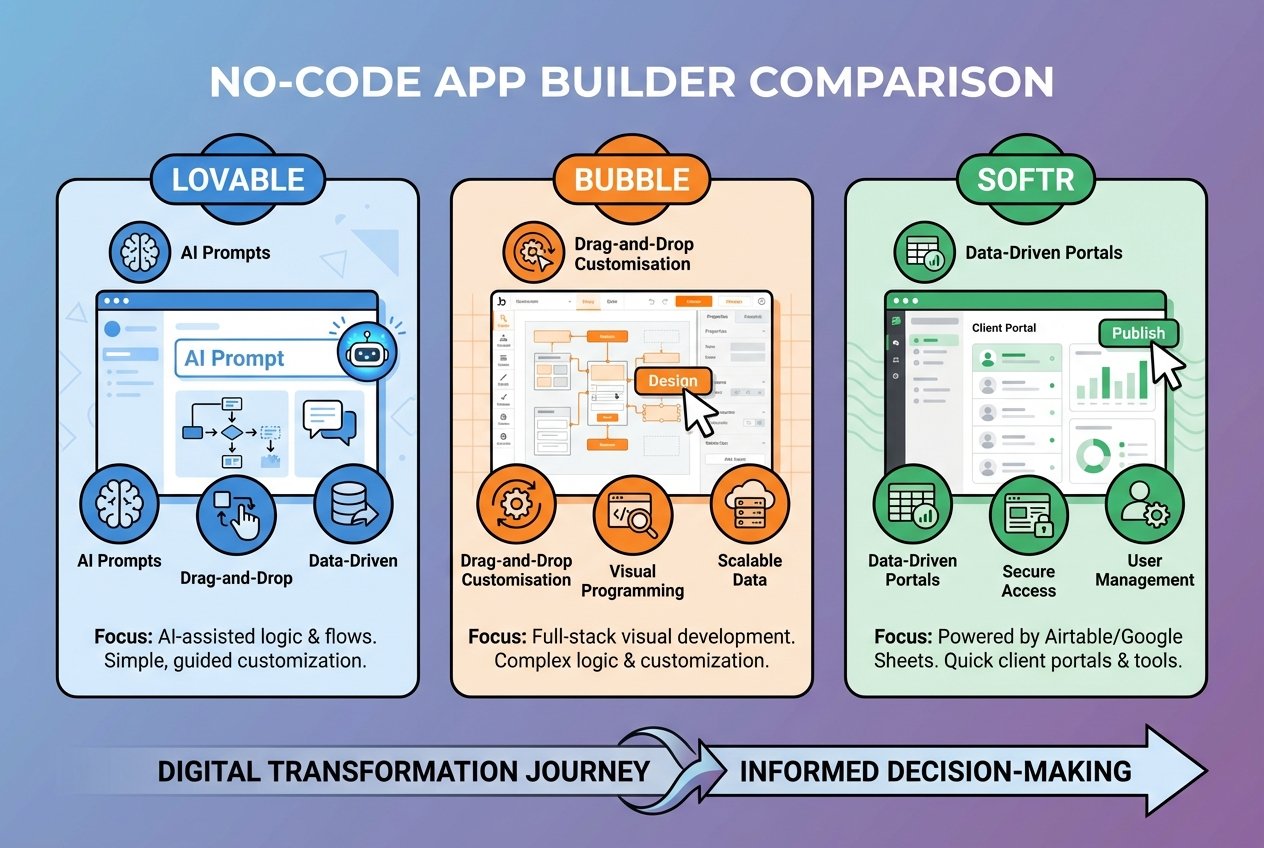
Lovable is an AI-powered app builder that takes a fundamentally different approach to no-code development. Rather than using traditional drag-and-drop interfaces, Lovable allows you to describe your application in plain English, and its AI generates a fully functional full-stack web application complete with frontend, backend, and database.
The platform generates production-grade React code with Tailwind CSS styling, integrates natively with Supabase for database and authentication, and offers seamless GitHub synchronisation. This means you can start building without code but maintain full ownership and the ability to customise later.
Following the release of Lovable 2.0 in 2025, the platform introduced significant improvements including Chat Mode for agentic development, multiplayer collaboration, enhanced security scanning, and a refined layout engine. These updates have positioned Lovable as a serious contender for teams wanting speed without sacrificing code quality.
What is Bubble?
Bubble has been the gold standard in no-code development for over a decade, with nearly 5 million applications built on the platform. It offers a comprehensive visual programming environment where users can design interfaces, build databases, create complex workflows, and deploy applications all within a single ecosystem.
Unlike simpler tools, Bubble provides complete control over frontend design, backend logic, and data management. Its extensive plugin marketplace offers thousands of integrations, and its visual workflow builder can handle sophisticated business logic that rivals traditionally coded applications.
What is Softr?
Softr takes a more focused approach, specialising in turning existing data sources like Airtable, Google Sheets, and Notion into functional web applications. Launched in 2019, it has carved out a niche for businesses wanting to build client portals, internal tools, membership sites, and directories quickly.
The platform prioritises ease of use with pre-built blocks and over 90 templates, making it possible for non-technical users to launch professional-looking applications within hours rather than weeks.
Feature-by-Feature Comparison
Ease of Use and Learning Curve
When evaluating any app builder comparison, ease of use often determines success. Softr leads in this category with its intuitive block-based interface. Most users can build and launch a basic application on their first day without any technical background. The trade-off is limited flexibility for complex customisations.
Lovable offers a unique middle ground. Because you interact primarily through natural language prompts, the learning curve is surprisingly gentle. According to independent testing, teams have produced functional prototypes within 90 minutes of first login. However, getting the most from the platform benefits from understanding basic web development concepts.
Bubble has the steepest learning curve of the three. Its power comes with complexity, and users typically need several weeks to become proficient. That said, Bubble offers extensive learning resources, including free courses and an active community forum with over a million members.
Customisation and Flexibility
For businesses with unique requirements, customisation capabilities are paramount. Bubble excels here, offering pixel-level control over design and complete flexibility in building workflows. You can create virtually any type of web application, from marketplaces and SaaS products to social networks and booking systems.
Lovable provides excellent customisation through its AI-assisted approach. You can request specific features, design changes, or functionality additions through conversation, and the AI implements them across your codebase. The GitHub export feature means you can also modify the generated React code directly.
Softr offers the least customisation. While you can adjust colours, fonts, and layouts, you cannot design from a blank canvas or implement highly custom logic. This limitation keeps the platform accessible but means it may not suit projects requiring unique functionality.
Database and Backend Capabilities
A critical differentiator in this no-code platforms comparison is how each handles data. Bubble includes a powerful built-in database with a visual editor for creating tables, defining relationships, and managing data. Its backend capabilities rival many traditional development approaches.
Lovable integrates with Supabase, providing PostgreSQL database functionality, authentication, and storage out of the box. This approach offers enterprise-grade database capabilities while maintaining the simplicity of no-code development.
Softr does not include its own database. Instead, it connects to external sources like Airtable, Google Sheets, or HubSpot. This approach works well if your data already lives in these tools but can become limiting as your application grows. Airtable’s record limits, for example, may constrain scaling.
Integration Ecosystem
Modern applications rarely exist in isolation. Bubble boasts the most extensive integration ecosystem with thousands of plugins and the ability to connect to any service via API. Whether you need payment processing, email marketing, or analytics, Bubble likely has a ready-made solution.
Lovable offers verified integrations with essential services including Stripe for payments, Clerk for authentication, OpenAI and Anthropic for AI features, and Resend for transactional emails. While the ecosystem is smaller, the integrations are curated and well-maintained.
Softr provides approximately 30 native integrations covering common needs like Stripe, Calendly, and Mailchimp. For Airtable users, the seamless data synchronisation is a significant advantage. However, connecting to services beyond the basics often requires technical workarounds.
Pricing Breakdown
Understanding pricing models is crucial for budgeting your development project. Here is how the three platforms compare:
Lovable operates on a credit-based system. The free tier provides 5 credits daily (30 per month), suitable for exploration. The Pro plan costs approximately 25 USD per month with 100 monthly credits, while Business plans at 50 USD per month add SSO and team features. Credits are shared across unlimited users, making it cost-effective for collaborative teams.
Bubble offers a free plan for building and testing. Paid plans start at 29 USD per month (Starter), with Growth at 119 USD per month and Team at 349 USD per month. Bubble uses workload units to measure usage, which can make costs unpredictable as your application scales.
Softr provides a free tier for up to 10 users. Paid plans begin at 49 USD per month for 20 users, scaling to 139 USD per month for 100 users and 269 USD per month for 500 users. The user-based pricing is predictable but can become expensive for applications with large user bases.
Which Platform Suits Your Needs?
Choose Lovable If…
You want to move from idea to working prototype rapidly. Lovable is ideal for startup founders validating MVPs, developers who want to skip boilerplate setup, and teams that may need to hand off to custom development later. The GitHub export and clean code generation mean you are never locked in.
Lovable particularly suits technical founders who understand web concepts but want to accelerate development, and agencies building client projects where code ownership matters. At Kaizen AI Consulting, we have seen clients achieve remarkable results using AI-powered development tools like Lovable to rapidly prototype and validate business ideas before committing to full-scale development.
Choose Bubble If…
You need maximum flexibility and plan to build a complex, scalable application. Bubble is the right choice for SaaS products, multi-sided marketplaces, and applications requiring sophisticated user roles and workflows. If you are prepared to invest time learning the platform, Bubble offers unmatched capabilities.
Bubble also suits teams committed to staying within a no-code ecosystem long-term. Its mature community, extensive documentation, and plugin marketplace provide ongoing support for growth.
Choose Softr If…
You need a simple, fast solution built on existing data. Softr excels for internal tools, client portals, membership directories, and CRM interfaces. If your data already lives in Airtable or Google Sheets and you want a professional frontend quickly, Softr delivers.
The platform also suits non-technical business users who need to launch without developer support. Its template library and block-based approach minimise the learning curve while producing polished results.
Making the Right Decision
The best no-code platform depends entirely on your specific requirements. Consider these factors:
Project complexity: Simple internal tools suit Softr. Full-scale applications need Bubble. Rapid prototypes with code ownership point to Lovable.
Technical capability: Non-technical users thrive with Softr. Those comfortable with code concepts can leverage Lovable effectively. Bubble rewards users willing to climb its learning curve.
Long-term plans: If you might need custom development later, Lovable’s code export provides flexibility. If you want to stay no-code indefinitely, Bubble’s ecosystem supports long-term growth.
Budget constraints: Softr offers predictable user-based pricing. Bubble’s workload model can surprise you as traffic grows. Lovable’s credit system works well for teams building iteratively.
Getting Expert Support
While no-code platforms democratise development, expert guidance can significantly accelerate your success and help you avoid common pitfalls. Understanding which platform aligns with your business objectives, how to structure your application for scalability, and when to transition to custom development are strategic decisions that benefit from experience.
Kaizen AI Consulting specialises in helping UK businesses navigate the rapidly evolving landscape of AI development tools and no-code solutions. Whether you need assistance selecting the right platform, building your initial prototype, or developing a comprehensive digital transformation strategy, our team brings practical expertise in modern development approaches.
The no-code revolution is transforming how businesses build software. By understanding the strengths and limitations of platforms like Lovable, Bubble, and Softr, you can make an informed choice that supports your growth objectives. Ready to explore how no-code development could accelerate your business? Get in touch with Kaizen AI Consulting today to discuss your project requirements.