How a Painting and Decorating Business Doubled Efficiency with AI Scheduling
Running a successful painting and decorating business in the UK has never been more demanding. Between managing multiple job sites, chasing quotes, handling customer calls, coordinating staff rotas, and keeping on top of invoicing, it is easy for the operational side of the business to consume time that should be spent on the tools. For one small painting contractor in the UK, the solution came in an unexpected form: AI scheduling technology that fundamentally transformed how the business operated day to day.
This is not a story about robots replacing skilled tradespeople. It is a story about how smart, accessible technology gave a real painting and decorating business back its most valuable resource: time. And the results speak for themselves.
The Problem Every Painting Business Knows Too Well
The UK painting and glazing sector comprises over 12,330 registered businesses, the vast majority of which are small, owner-operated firms. Revenue across the sector reached approximately £3.5 billion by 2025, yet profit margins remain tight at around 14.2%, squeezed by rising material costs, labour competition, and the relentless pace of administrative work.
Talk to any decorator and they will tell you the same thing: a huge portion of their working week disappears into admin. Scheduling jobs, responding to enquiries, sending reminders, preparing quotes, and then rescheduling when a customer cancels at short notice. According to the 2026 Houzz UK State of the Industry Report, 65% of UK design and build firms are now investing in process streamlining to boost productivity, with improving sales and quoting processes listed as a top-three priority. Yet most sole traders and micro-businesses still rely on paper diaries, WhatsApp messages, and memory to run their schedules.
The inefficiency compounds quickly. A missed callback leads to a lost quote. A double-booked appointment leads to a frustrated customer. A staff rota that was not updated means two decorators turn up to the same job. These are not just frustrating: they are costing real money.
What Is AI Scheduling and Why Does It Matter for Painters and Decorators?
Painter AI tools and decorator automation software represent a new generation of intelligent job management platforms. Unlike traditional calendar apps or even basic job management software, AI scheduling tools can factor in dozens of variables simultaneously: staff availability, job duration, travel time between sites, customer preferences, weather (relevant for exterior work), and even historical data about how long certain types of jobs tend to take.
Modern AI scheduling systems can handle over 100 variables with complex configuration options, automatically adjust rotas when circumstances change, and optimise routes to reduce wasted travel time between jobs. For a decorator managing four or five operatives across multiple sites in the same town or city, this kind of intelligent scheduling can reclaim hours every single week.
The broader business case is compelling. According to research cited by Top Ten AI Agents UK, the most widely recognised benefits reported by UK businesses using AI include time savings (54%), productivity gains (42%), and cost savings. Critically, 90% of small and medium-sized businesses that have adopted AI report more efficient operations overall.
A Real-World Example: Doubling Capacity Without Doubling Headcount
Consider a painting and decorating firm operating across a mid-sized UK city with a team of six decorators and one office manager. Before implementing any form of painting business technology, the owner estimated that between 15 and 20 hours per week were lost to scheduling conflicts, unanswered enquiries during working hours, and last-minute rescheduling. Jobs were booked via phone and recorded in a spreadsheet. Reminders were sent manually. Quotes were typed up on evenings.
After integrating an AI scheduling and job management platform, the results were dramatic:
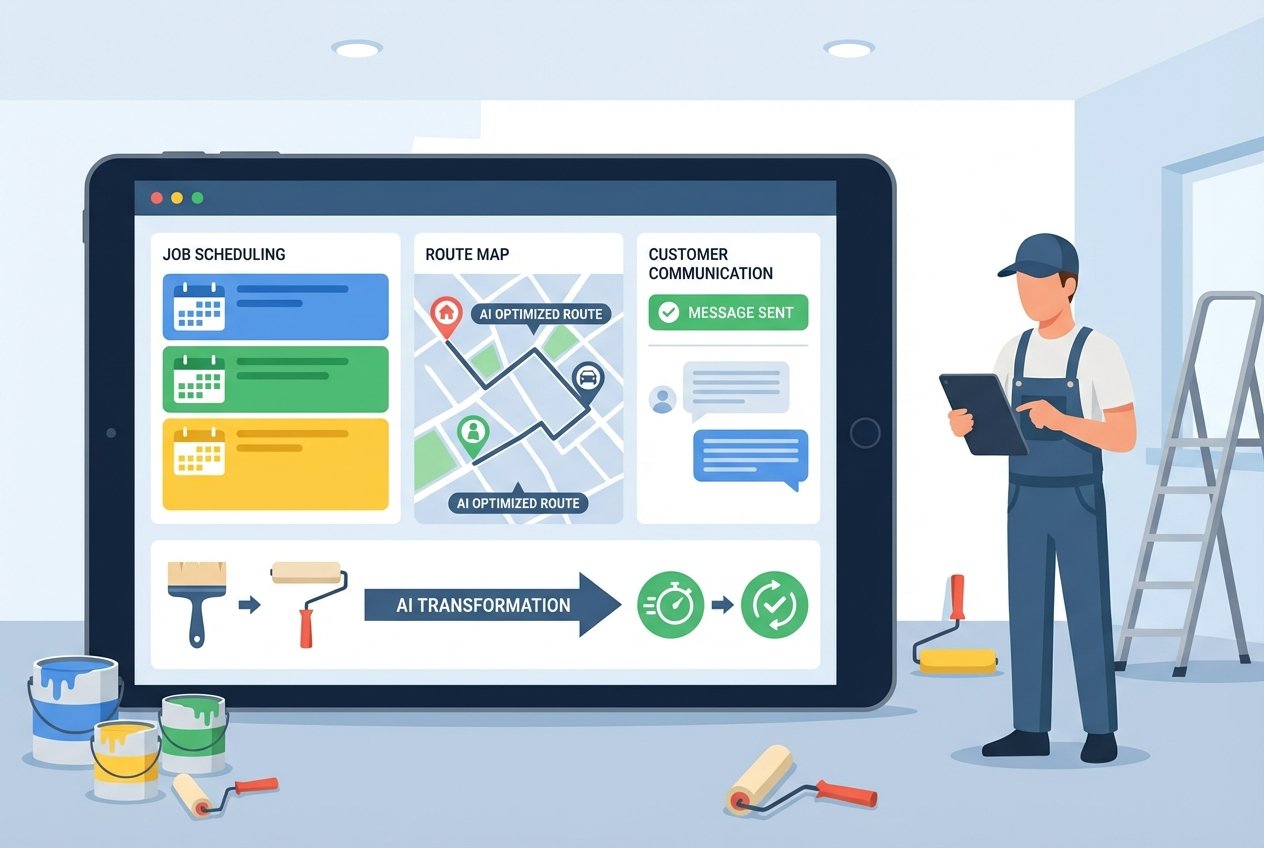
- Automated appointment booking allowed customers to self-schedule online, with the system intelligently assigning the right operative based on location, availability, and skill set
- Automated quote follow-up reminders meant fewer dead leads slipping through the cracks
- AI-generated job sheets and daily schedules were pushed directly to each decorator’s mobile phone every morning
- Customer communication, including booking confirmations, arrival reminders, and post-job follow-ups, was handled automatically without the owner lifting a finger
- Route optimisation reduced daily travel time by an estimated 25%, meaning more jobs could be completed per week with the same team
The net result was a near doubling of completed jobs per month, achieved not by hiring additional staff but by eliminating the administrative drag that had been quietly throttling growth. This is the real promise of scheduling AI for trades businesses: not replacement, but amplification.
Why Most Tradespeople Have Not Made the Jump Yet
If the benefits are this clear, why are so many UK painting and decorating businesses still operating without any form of AI scheduling support? The data offers a telling answer.
According to Compare the Cloud’s UK SME AI Adoption Report, the construction and trades sector has one of the lowest AI adoption rates of any UK industry, with just 6% of SMEs in the sector currently using AI tools. Compare that to professional services at 28% or information and communications at 43%, and it is clear that tradespeople are being left behind.
The primary barrier is not cost. Research from the Sales and Marketing Engineers 2026 AI Adoption Report found that 60% of businesses cite limited AI knowledge and skills as the key blocker, while 71% have simply not identified a clear use case for AI within their own operation. For a decorator who has run their business successfully with a notepad and a mobile for 15 years, the idea of AI can feel abstract, expensive, or unnecessary.
This is precisely where specialist guidance makes all the difference. At Kaizen AI Consulting, the team works specifically with UK small businesses and tradespeople to identify the right tools for their exact situation, implement them without disruption, and train teams to use them confidently. Rather than presenting a generic technology solution, the approach is to understand how the business currently operates and build AI automation around existing workflows.
Key Areas Where AI Delivers the Biggest Wins for Decorating Firms
1. Intelligent Job Scheduling and Rota Management
The most immediate win for most painting firms is in scheduling AI for trades. Rather than manually piecing together a daily or weekly rota, AI scheduling platforms ingest all available data, staff locations, job durations, customer time preferences, and site access requirements, and produce an optimised schedule automatically. When a cancellation or delay occurs, the system re-optimises in real time, minimising downtime and keeping every operative productively deployed throughout the day.
2. Automated Customer Communication
Customer communication is one of the most time-consuming parts of running any trade business. AI tools can handle the entire customer journey from initial enquiry through to post-job review request, using automated emails, SMS messages, and even AI-powered chat assistants on your website. Research shows that 46% of UK SMEs are already using AI-powered customer engagement tools, with leading platforms resolving over 50% of inbound queries without any human involvement.
3. Quote Generation and Follow-Up
AI can dramatically accelerate the quoting process by pulling together standard job costings, applying margin rules, and generating professional, branded quote documents in minutes rather than hours. Automated follow-up sequences ensure no potential customer is forgotten, significantly improving conversion rates from quote to confirmed booking.
4. Invoicing and Payment Chasing
Late payment is a persistent challenge for small trades businesses. AI-integrated invoicing tools can automatically issue invoices upon job completion, send polite payment reminders at set intervals, and escalate communications when invoices become overdue, all without the business owner needing to make a single awkward phone call.
5. Business Performance Insights
Perhaps the least obvious but arguably most powerful benefit of painting business technology is the data it generates. AI platforms provide real-time dashboards showing which jobs are most profitable, which operatives are most productive, which marketing channels are generating the most enquiries, and where the business is losing money. For a small decorator who has never had visibility beyond their bank balance, this level of insight is genuinely transformative.
Getting Started: What to Look for in AI Scheduling Tools
For painters and decorators considering their first step into decorator automation, the good news is that the market for accessible, affordable AI scheduling and job management tools has matured significantly. Key features to look for include:
- Mobile-first design, because your team is never at a desk
- Simple customer-facing booking portals that work on any device
- Integration with existing tools such as accounting software, email, and WhatsApp
- Automated reminders and follow-ups that do not require daily management
- Clear reporting dashboards that surface meaningful business data
- UK-based support and GDPR-compliant data handling
It is also worth considering whether off-the-shelf solutions fully meet your needs, or whether a more tailored approach would deliver better results. Many of the most impactful AI implementations for trades businesses involve combining multiple tools into a connected workflow, something that requires a degree of technical expertise to set up correctly but delivers significantly greater efficiency gains in the long run.
The Competitive Reality for UK Decorators in 2026
The UK AI market is now worth £21 billion, and AI adoption among UK small businesses grew from 25% in 2024 to 35% in 2025, according to the British Chambers of Commerce. A further 24% of SMEs plan to adopt AI tools in the near future. Meanwhile, only 11% are using AI to any meaningful depth. That gap represents both a risk and an opportunity.
For painting and decorating businesses, the risk is straightforward: competitors who adopt AI scheduling and automation tools will be able to take on more jobs, respond faster to enquiries, deliver a more professional customer experience, and undercut on price while maintaining healthier margins. The decorating firm that can confirm a quote in 10 minutes and send a booking confirmation automatically is going to win work over one that calls back two days later.
The opportunity is equally clear. Because trades sector AI adoption is still only at 6%, businesses that act now have a genuine first-mover advantage in their local market. The decorator who is already operating with AI-powered scheduling and communication in 2026 will be significantly harder to dislodge when the rest of the market catches up.
Take the First Step with Kaizen AI Consulting
If you are running a painting and decorating business and you are curious about what AI scheduling could do for your operations, the most important thing is to start with a clear picture of where your time is actually going. Most business owners are surprised by how much of their week disappears into tasks that AI could handle automatically.
The team at Kaizen AI Consulting specialises in helping UK small businesses, including trades and service firms, implement practical AI solutions that deliver real efficiency gains without unnecessary complexity or cost. Whether you are looking to streamline your scheduling, automate customer communication, or get a clearer picture of your business performance, our consultants can identify the right approach for your specific situation.
Explore our AI consulting services for UK businesses or read more about how small businesses are achieving step-change growth with AI. When you are ready to explore what is possible, get in touch with our team for an initial conversation. There is no obligation, and you may be surprised by how quickly the right AI tools can start delivering results.
The painting and decorating trade has always rewarded those who show up prepared and work efficiently. In 2026, the most effective preparation you can make is ensuring your business has the right technology in place to operate at full capacity, every single day.