Small Language Models: Why Smaller AI Might Be Better for Your Business
When most business owners think about artificial intelligence, they picture the headline-grabbing giants: ChatGPT, GPT-4, Google Gemini. These large language models (LLMs) have dominated the conversation since 2022, and for good reason. But in 2026, a quieter revolution is taking place, one that could be far more impactful for small and medium-sized businesses across the UK. Small language models, or SLMs, are emerging as a smarter, leaner, and more cost-effective alternative, and forward-thinking businesses are already reaping the rewards.
According to GlobalData, 2026 is firmly the year of efficiency, with small language models taking centre stage as businesses shift their focus from raw AI power to practical, deployable intelligence. If you have been sitting on the sidelines of the AI revolution, wondering whether the technology is truly accessible or affordable for your business, SLMs might just be the answer you have been waiting for.
What Are Small Language Models?
A small language model is an AI system typically containing between 1 billion and 13 billion parameters, the internal values that determine how the model processes and generates language. To put that in context, large language models like GPT-4 are estimated to contain hundreds of billions or even trillions of parameters. According to Machine Learning Mastery, SLMs are AI systems designed to be compact, fast, and efficient, capable of running on a standard laptop, an on-premise server, or even a mobile device, without the need for expensive cloud infrastructure.
Rather than trying to answer every question imaginable, SLMs are typically trained or fine-tuned for specific tasks, such as customer support, document summarisation, content drafting, or data classification. This focused approach is exactly what gives them their competitive edge over their larger counterparts.
The SLM Market Is Growing Rapidly
The business world has noticed. The global small language model market was valued at approximately USD 6.5 billion in 2024 and is projected to grow at a compound annual growth rate of 25.7% through to 2034. A separate report from Research and Markets values the SLM market at USD 10.99 billion in 2026, projected to reach USD 22.45 billion by 2030, reflecting a 19.6% CAGR. These are not niche figures. This is a technology category that is scaling fast, and UK businesses that adopt early will gain a meaningful competitive advantage.
Meanwhile, AI adoption across UK businesses is accelerating. According to the British Chambers of Commerce (March 2026), 50% of UK SMEs are now using AI tools, up from just 25% in 2024. Yet many are still relying on expensive, general-purpose LLMs that may not represent the best fit for their specific needs. SLMs offer a more targeted, more affordable, and often more effective route.
Why Smaller Can Mean Smarter: The Key Advantages of SLMs
1. Dramatically Lower Costs
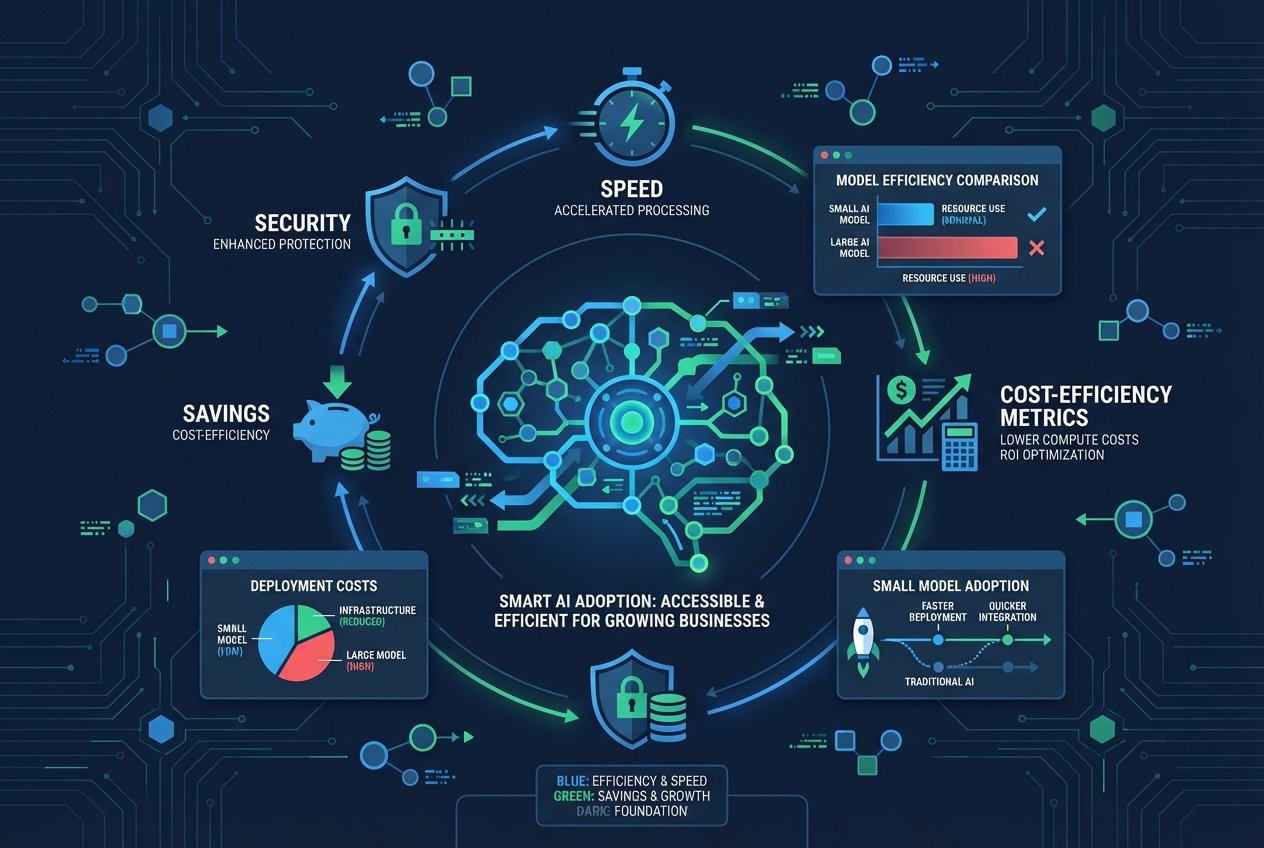
Running large language models at scale is expensive. Every query sent to a cloud-based LLM like GPT-4 incurs a cost, and for businesses generating thousands of interactions per month, those costs accumulate quickly. SLMs change the equation entirely. Because they require significantly less computing power, they can be run on standard hardware, on your own servers, or on affordable cloud infrastructure, reducing inference costs by a substantial margin.
Real-world examples support this. According to Turing, enterprise software firm Capacity achieved more than four times cost reductions by switching from GPT-4 to Microsoft Phi models for their automation workflows, while maintaining or improving overall performance. For a UK SME watching every pound of its technology budget, that kind of saving is transformational.
2. Superior Data Privacy and GDPR Compliance
For UK businesses operating under the UK GDPR, data privacy is not optional. It is a legal obligation. One of the most significant concerns about cloud-based LLMs is that your data, including sensitive customer information, internal documents, and proprietary business knowledge, leaves your systems and travels to a third-party server, potentially across international borders.
SLMs fundamentally change this dynamic. Because they can be deployed on-premise or within your own private cloud environment, your data never leaves your infrastructure. According to Intelegain (March 2026), this local processing capability makes SLMs particularly compelling for regulated UK sectors such as finance, healthcare, legal services, and any business handling personally identifiable information. You gain the power of AI without the compliance headache.
3. Faster Performance for Specific Tasks
Speed matters in business. Whether you are running a customer service chatbot, processing incoming enquiries, or summarising lengthy reports, response time directly affects user experience and operational efficiency. Because SLMs have fewer parameters to process, they generate responses significantly faster than LLMs, particularly for the focused tasks they are trained to perform.
According to Red Hat, SLMs are faster to customise and faster to infer, making them ideal for real-time applications. For tasks like sentiment analysis, document classification, or generating templated content, a well-tuned SLM will consistently outperform a large general-purpose model in both speed and accuracy.
4. Easier Fine-Tuning for Your Industry
Perhaps the most underrated advantage of SLMs is how easy they are to customise. Fine-tuning a large language model requires enormous computational resources and specialist expertise. Fine-tuning an SLM can be accomplished on standard hardware in a matter of hours or days, allowing businesses to train the model on their own terminology, tone of voice, product catalogue, or regulatory requirements.
For a UK legal firm that wants an AI assistant fluent in contract law, or a healthcare provider that needs a model trained on clinical protocols, this is a game-changer. Rather than trying to coax a general-purpose model into behaving correctly, you can shape an SLM precisely to your needs, quickly and cost-effectively.
Leading Small Language Models to Know in 2026
The SLM landscape has evolved rapidly. Here are three of the most capable and widely adopted models available to businesses right now:
Microsoft Phi-4
Microsoft’s Phi-4 family represents the gold standard of small language model development in 2026. The flagship Phi-4 model contains 14 billion parameters and, according to Microsoft’s Azure AI Foundry (March 2026), achieves strong performance on complex reasoning tasks, outperforming models with five times as many parameters on key benchmarks. Phi-4 supports multimodal inputs including text, vision, and audio, making it an exceptionally versatile choice for businesses that need to process documents, images, and spoken language within the same workflow. It is available via Azure AI Studio, Hugging Face, and can be run locally.
Google Gemma 3
Google’s Gemma 3 is an open-source SLM designed for efficient deployment across a range of hardware environments. Gemma 3 models are available in multiple sizes, with the smaller variants running comfortably on a single GPU or even on consumer hardware. Their open-source nature makes them highly accessible for UK businesses looking to experiment with on-premise AI without significant upfront investment. According to BentoML (March 2026), Gemma 3 ranks among the best open-source SLMs currently available, offering an excellent balance of performance, cost, and operational simplicity.
Meta Llama 3.3
Meta’s Llama 3.3 continues to be one of the most popular open-source model families for enterprise deployment. Available in sizes from 8 billion to 70 billion parameters, the smaller Llama 3.3 variants sit firmly in SLM territory and have been widely adopted by businesses building custom AI workflows. Their permissive licensing and strong community support make them a pragmatic choice for UK businesses that want flexibility and control over their AI stack.
Real-World Business Use Cases for SLMs
Understanding the technology is one thing; knowing how to apply it is another. Here are the most impactful ways UK businesses are deploying small language models right now:
Customer Support and Chatbots
SLMs are powering domain-specific customer service chatbots that handle first-line enquiries, route complex questions to human agents, and deliver consistent, on-brand responses around the clock. Unlike generic chatbots that frequently misunderstand context, an SLM fine-tuned on your product knowledge base and tone of voice delivers genuinely helpful interactions at a fraction of the cost of cloud LLM alternatives.
Document Summarisation and Analysis
From legal contracts and insurance policies to financial reports and compliance documentation, UK businesses generate vast quantities of text that requires careful review. SLMs excel at summarising lengthy documents, extracting key information, and flagging relevant clauses, enabling staff to focus on higher-value work. According to Thoughtworks UK, this is one of the most common and impactful SLM deployments in regulated industries.
Content Creation and Marketing
For marketing teams and content creators, SLMs offer a cost-effective way to generate first drafts, product descriptions, email campaigns, and social media copy, all in a consistent brand voice. Fine-tuned on your existing content library, an SLM can produce output that requires minimal editing and reflects your business’s personality far more accurately than a generic LLM prompt ever could. This is an area where the AI consulting services offered by Kaizen AI Consulting can add real value, helping businesses identify the right model, fine-tune it for their specific voice, and integrate it seamlessly into existing workflows.
Internal Knowledge Management
Deploying an SLM as an internal knowledge assistant allows employees to query company policies, procedures, product information, and historical data in plain English. Rather than searching through SharePoint folders or asking a colleague, staff get instant, accurate answers. Because the model runs locally, sensitive internal information remains entirely within your infrastructure, fully compliant with your data governance policies.
SLMs vs LLMs: Choosing the Right Tool
It is important to be clear: small language models are not a replacement for large language models in every scenario. If your use case genuinely requires broad general knowledge, complex multi-step reasoning across diverse domains, or highly creative open-ended generation, a frontier LLM may still be the better choice. The key is selecting the right tool for the right task.
Think of it this way. A specialist solicitor with deep expertise in property law will serve you better than a generalist when you are buying a house. SLMs are your specialists. They are trained deeply on a narrow domain, they work quickly, they cost less, and they do not expose your data to unnecessary risk. For the vast majority of repetitive, process-driven business tasks that represent the bulk of AI workloads in most organisations, an SLM is simply the smarter choice.
At Kaizen AI Consulting, we work closely with UK businesses to assess exactly which AI approach fits their goals, budget, and compliance requirements. Whether that means deploying a fine-tuned SLM on your own infrastructure or building a hybrid system that uses SLMs for routine tasks and routes complex queries to a larger model, we design solutions that are practical, cost-effective, and built to grow with your business.
Getting Started with Small Language Models
The good news is that the barrier to entry for SLMs has never been lower. Open-source models like Gemma 3 and Llama 3.3 are freely available, and platforms like Azure AI Studio, Hugging Face, and Ollama make it straightforward to experiment, fine-tune, and deploy models without needing a team of data scientists. However, getting the most out of an SLM, selecting the right architecture, preparing high-quality training data, and integrating the model into your business systems, still benefits enormously from experienced guidance.
With 50% of UK SMEs now actively using AI according to the British Chambers of Commerce, and the SLM market growing at nearly 20% annually, the window for early-mover advantage is still open but it will not stay open indefinitely. Businesses that invest in the right AI infrastructure today will be better positioned, more efficient, and more competitive in the years ahead.
If you are curious about how small language models could benefit your business specifically, whether you are in retail, professional services, hospitality, healthcare, or any other sector, we would love to have a conversation. Get in touch with the team at Kaizen AI Consulting today for a no-obligation consultation. We will help you cut through the noise, understand your options, and take a practical first step towards efficient, affordable AI that genuinely works for your business.