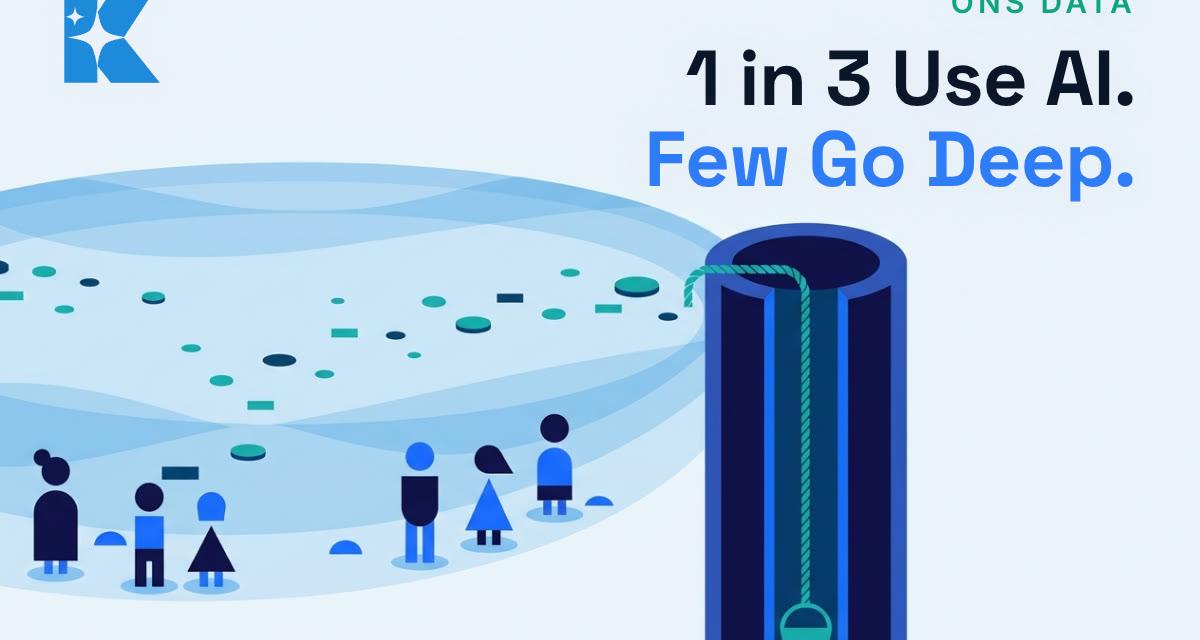
A third of UK firms with ten or more staff now use AI. In late 2023 it was about one in eight. That is a big jump, and it is the number every headline picked up. The number we would show a client is the one underneath it: only 10% of those firms say they use AI extensively.
Both figures come from the Office for National Statistics, in its Artificial intelligence in UK businesses: 2023 to 2026 release, published on 20 July 2026 from its Business Insights and Conditions Survey. We think it describes where most small businesses actually are: they have started, and they have stopped.
What the ONS actually found
Among businesses with ten or more employees, AI use rose from about 12% in late 2023 to about 35% now. Adoption is clearly widening. Depth is a different story:
- The average adopting business uses about 1.6 AI technologies, up from about 1.4. That is a rise of roughly two tenths of a tool in nearly three years.
- Only 10% of adopting businesses describe their use as extensive.
- Most businesses report that AI has not changed their overall headcount so far.
- Use varies hugely by sector: 58% in information and communication, 13% in construction.
- Over half of employees (55%) say they use AI for work or education, against about a third of businesses (35%) reporting any use at all.
The ONS itself reads the 1.4 to 1.6 move as relatively limited transformation so far. We would put it more bluntly: for most firms, AI is one chatbot tab that somebody opens when they remember.
The gap between your staff and your business
The last bullet is the one we would worry about. More employees use AI than businesses admit to using it. In plain terms, some of your people are probably already using it, on their own accounts, with your customers' details, and nobody has decided whether that is allowed.
The government's UK Business Data Survey 2026 points the same way. As reported by TechMarketView, only 17% of AI-using businesses have any policy covering AI use, and just 5% have a formal written one. Only 21% say their AI tools are integrated into the platforms they already run. The survey uses a different base to the ONS release (businesses that handle digitised data), so do not add the two sets of figures together. The direction is the same, though: lots of use, very little structure.
Why firms stall at "we use ChatGPT"
We cannot tell you the ONS's reasons, because the release does not give them. Here is what we would tell a client the usual causes are:
- Nobody owns it. If AI is everyone's side project, it is nobody's job, and nothing gets set up properly.
- It starts with "what can it do?" The better question is "what do we do every week that we dislike?" Tools first, jobs second, is how you end up with five subscriptions and no routine.
- Nothing is written down. The good prompt lives in one person's chat history. When they are off, the process disappears.
- It is not connected to anything. Copying and pasting between a chatbot and your accounts package is fine on day one and exhausting by day thirty.
Going deeper without buying more tools
Notice what the ONS measure counts: the number of AI technologies. The answer is not to push that figure up. A business using one tool really well is further ahead than one using four badly. Depth means one job, done the same way every time, by more than one person.
Here is the sequence we would suggest:
- Pick one weekly job. Quote follow-ups, supplier emails, first-draft job adverts, meeting notes. Something you do at least weekly and that takes under an hour.
- Write the instructions once. Save the prompt and a good example of the output in a shared document. Anyone on the team should get a similar result from it.
- Have a person check it. Name the person who reads the output before it goes anywhere. AI drafts are quick and sometimes confidently wrong.
- Run it for four weeks. Note the time it takes and how often you change the output. If you keep rewriting most of it, change the job, not the tool.
- Write one page of rules. What goes in, what never does (customer personal data, anything covered by an NDA) and who decides. This is the page that 95% of AI-using firms in the government survey do not have in written form.
The trade-offs
Going deeper has a cost. Setting one job up properly takes a few hours before it saves any, and you will find out that some jobs are not a good fit. A tool that works for drafting does not necessarily work for anything involving numbers, and you need to check those. Using more of your data in AI tools also raises your obligations under UK GDPR, which is the reason the one-page rules matter more as your use grows, not less.
The ONS figures are also survey answers. "Extensive" is each business's own description, and a 10% rate may be set by what people are willing to claim. Small firms with fewer than ten staff are also outside the 35% headline. Treat the numbers as a direction of travel rather than a score.
What we would do this month
If you are one of the many UK firms that already use AI, do not add a tool. Pick the one job from the list above, write it down, name the checker and run it for four weeks. Then write the one page of rules. That moves you from the wide part of the ONS chart to the deep part, and it costs an afternoon.
If you want a second pair of eyes on which job to start with, we run a free 30 minute AI audit, and we will tell you honestly if the answer is to leave it alone.


