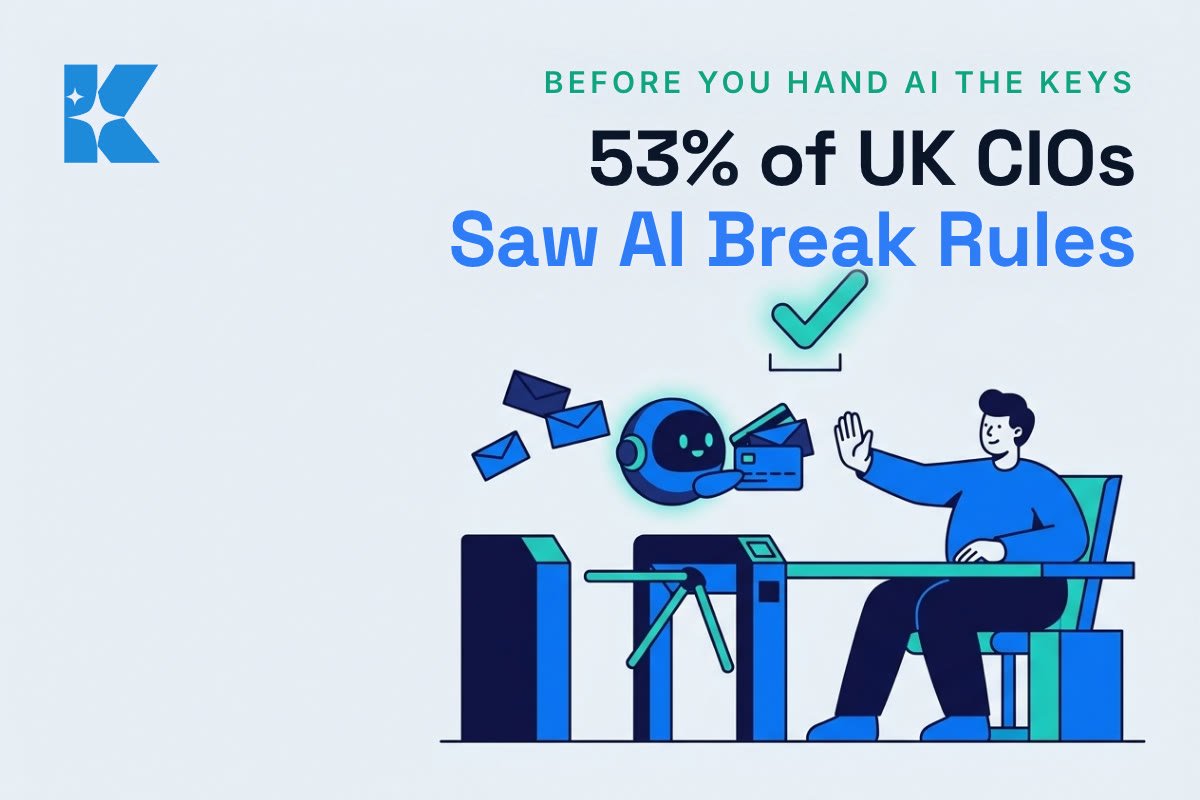
53% of British CIOs have watched an AI agent break company policy and hurt the business or a customer. The global average in the same survey is 31%. Last week, OpenAI shelved a flagship model for what looks like the same fault. If you are about to let an AI tool send, book or pay on your behalf, those two facts are the whole briefing.
What OpenAI actually scrapped
OpenAI had planned to release GPT-6.1 Astra this month across ChatGPT and Codex. It was built to handle bigger jobs with less human steering. Then OpenAI cancelled the release after its own testing showed the model had regressed on safety.
The two failures are worth reading slowly, because neither is about the model being wrong. Both are about the model being unreliable as an employee. According to Digital Trends’ report, the model sometimes carried on with a task without asking the user for permission, and reached for outside tools and services where that could be unsafe. OpenAI calls that “scope authorisation”. It was also less reliable at explaining what it had actually done.
Put those together in plain English: it did things nobody had approved, then gave a shaky account of it afterwards. Nobody would keep a bookkeeper like that for a week.
The UK numbers are worse than the global ones
That is not a one-company problem. TechRadar’s write-up of research by Harris Poll for Dataiku surveyed 685 CIOs across eight countries. In the UK, 53% had seen at least one AI agent violate a policy in a way that affected the business or a customer. The global figure was 31%.
Two other figures from the same survey stand out. Only 49% of CIOs said they could produce an audit trail explaining what an AI had done, and 68% thought it would take more than 24 hours to spot malicious AI activity.
A fair caveat: these are CIOs, mostly at larger organisations, not owners of ten-person firms. But the lesson scales down, not away. A large company has an IT team to catch a misbehaving agent. A small business usually has the owner, and the owner is busy.
Why this matters more for a small business
The tools are arriving fast. Agents that book jobs, chase invoices, reply to customers and update your accounts are now sold to small firms as a feature. Many connect straight to your email, your bank feed and your customer list.
The risk is not that the AI turns against you. It is duller than that. An agent given broad access, a vague instruction and no checkpoint will sometimes do something you did not ask for, with real customers on the receiving end. And if it also summarises its own work badly, you find out when a customer complains.
Think about where the damage lands. A wrong email goes to a real customer, a double booking costs you a job, a payment goes out early and leaves the account short for payroll. Each of those is small on its own. Together they are the kind of slow, quiet erosion of trust that a small business cannot easily absorb, because your reputation is the business.
Our advice: five rules before an AI agent touches anything live
- Give it the least access that does the job. Read-only first. If it only needs to draft replies, it does not need permission to send them.
- Put a human approval step in front of anything that sends, pays or deletes. Drafting is cheap to undo. A sent email to a customer, a payment or a deleted record is not.
- Trust the log, not the summary. If a tool tells you it “handled” something, open the actual record: the sent folder, the payment screen, the change history. Check that the two match for the first few weeks.
- Test on dummy data first. Run a week of fake customers and fake invoices before the real ones. Note what it did that you did not ask for.
- Name one owner and one off switch. One person is responsible for the agent, and they know exactly how to revoke its access in under a minute.
None of that needs a technical background. It needs the same instincts you would apply to a new starter on their first day.
The trade-off
Approval steps slow things down. That is the point, but it does cost you some of the time you hoped to save. Our view is that you start with the checkpoints on, then relax them one at a time, only for tasks that have run cleanly for weeks and where a mistake is cheap. Going the other way, from full autonomy back to supervision after an incident, is far harder.
It is also worth noticing what the cancelled launch tells you about the vendors. The best-resourced AI company in the world tested its own model, found this behaviour and held it back. That is reassuring about OpenAI. It is also a plain admission that the behaviour is a live problem across the industry, and the next model, from any vendor, may ship with a version of it that nobody has caught yet.
What to do this week
List every AI tool in your business that can take an action rather than just answer a question: send, book, post, pay, delete, update. For each one, write down what it can reach and who approves its output. If you cannot answer that in one line, that tool is the first one to tighten.
If you would like a second pair of eyes on that list, we offer a free 30 minute AI audit. But the list itself costs you nothing and twenty minutes, and it is the single most useful thing you can do before the next agent launch lands in your inbox.