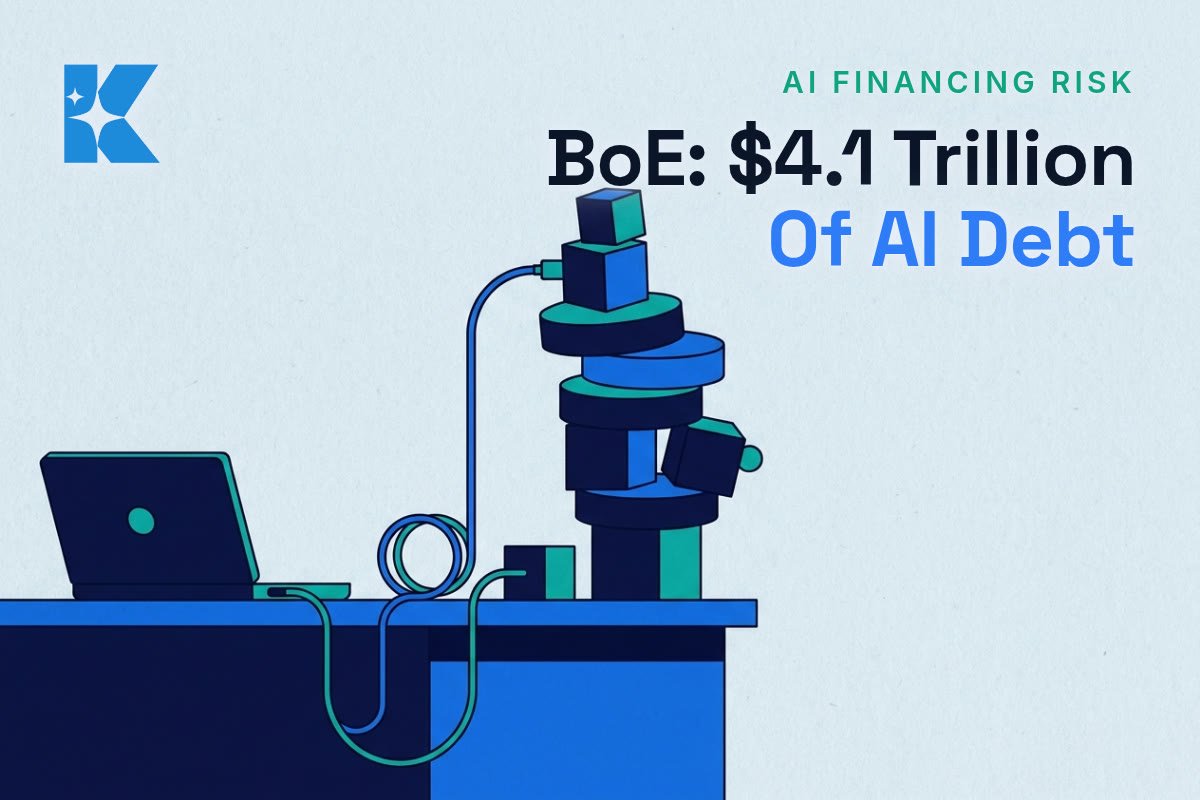
$4.1 trillion. That is the amount JP Morgan analysts estimate will be borrowed to pay for AI building work between 2026 and 2030, and the Bank of England put the figure in the record of its Financial Policy Committee meeting on 25 September. We are not here to tell you the sky is falling. We are here to tell you what we would ask any client who runs part of their business on AI tools, because a warning from the people who watch the financial system is worth five minutes of your attention.
What the Bank of England actually said
The committee noted that a growing share of AI investment is being financed through debt rather than cash. Its record says the increasing indebtedness of AI firms, combined with opacity and, at times, “circular arrangements”, can complicate the assessment of risks and could amplify losses if expectations disappoint. It also warned that a reassessment of how much productivity AI will deliver could hit AI-related asset valuations and, beyond that, government bond markets.
Governor Andrew Bailey has gone further in his public comments, saying AI may deliver less than markets expect and that the benefits could take a lot longer to arrive. The Computer Weekly report and the wire coverage both stress the same point: this is a warning about financing and valuations, not about whether the technology works.
What it does not say
It is worth being straight about the limits here. The Bank did not say your AI tools are about to disappear. It did not say prices will rise, and it did not say any named company is in trouble. We cannot tell you whether ChatGPT, Claude, Gemini or Copilot will cost more or less next year, and nobody who claims to know is being honest with you.
What the warning does tell us is that the companies behind these tools are spending very large sums of borrowed money on the assumption that demand keeps growing. If that assumption wobbles, the people who feel it first are lenders and investors. The people who may feel it second are customers, through changed pricing, changed plans or products that get switched off. That second part is a possibility, not a forecast, and it is the part a small business can prepare for cheaply.
Why this matters more to you than it did a year ago
AI has moved from a curiosity to a working tool in small firms very quickly. Simply Business’s 2026 research found that 47% of UK small businesses now use AI tools, up from 22% in 2025. When a tool becomes part of how you quote, answer emails, write copy or chase invoices, it stops being an experiment. It becomes a supplier, and you manage suppliers differently.
The uncomfortable bit is that most small businesses do not treat AI tools as suppliers at all. There is no second option, no copy of the work outside the tool, and no plan for the day the tool changes. That is a perfectly reasonable way to start. It is a risky way to carry on once the tool is doing real work.
Five things we would do this month
None of these needs a developer, and none of them means using AI less. They are the same habits you would apply to a card payment provider or a booking system.
- Keep your know-how in files you own. Your prompts, your standard replies, your tone-of-voice notes and your process steps should live in a shared drive or document you control, not only inside a chat history or one vendor’s memory feature. If you had to move tomorrow, you would paste them into another tool and carry on.
- Read the terms before you prepay. Annual plans are often cheaper per month, but they commit you. Check what happens to the price at renewal, whether you can cancel, and whether you can export your data. If the answer is vague, pay monthly until it is not.
- Test a second tool on your three most important jobs. Pick the three tasks you would hate to lose, such as drafting quotes, summarising calls or writing product descriptions. Run each one through a second vendor once, this week, and keep a note of how it compared. You are not switching. You are finding out how hard switching would be.
- Write the manual fallback. For any process that leans on an AI tool, write down in a few lines what you would do for a week if it were unavailable. Who does it, with what, and what you tell customers. If the honest answer is “nothing works”, that process is the one to fix first.
- Watch cost per job, not the headline price. A tool at a few pounds a seat can still be expensive if it is doing work that a cheaper tier could handle. Know what each AI-assisted job costs you in tool fees, so a price change is something you can read off a page rather than discover on an invoice.
The trade-off we would name
Resilience has a cost. Running a second tool means a second login, a second set of terms to read and some duplicated learning. For a three-person business that is real time. Our view is that it is worth paying where the tool touches revenue or customers, and not worth paying for the nice-to-haves. Your newsletter drafting tool can be a single point of failure. Your quoting process should not be.
There is a balance to hold in the other hand. A possible financing wobble in the sector is not, by itself, a reason to stop using tools that are saving you time today. The sensible response to a risk you cannot size is to make yourself harder to hurt, not to sit still or panic.
What to do this week
Take twenty minutes. List every AI tool your business pays for, what each one costs per month and which jobs depend on it. Mark any job where you would have no fallback. That list is the most useful thing you can have in front of you the next time a headline about AI and debt appears, because you will know straight away whether it touches you.
If you would like a second pair of eyes on that list, we run a free 30 minute AI audit, and part of it is exactly this: which of your tools are carrying real weight, and where a small change would stop them being a single point of failure.
Sources: Bank of England Financial Policy Committee record, 25 September 2026; Computer Weekly; Insurance Journal; Simply Business SME Insights Report 2026. Figures as reported by those sources at the time of writing.