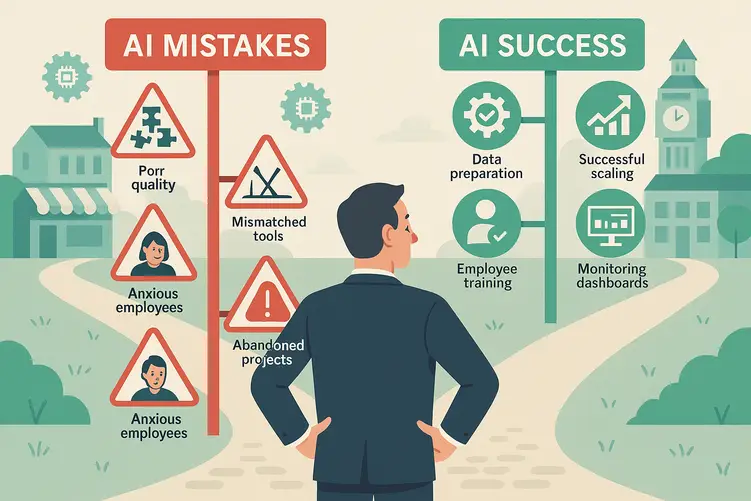
Artificial intelligence has become more accessible than ever for small businesses across the UK. From chatbots to predictive analytics, AI tools promise to revolutionise operations, boost productivity, and drive growth. However, the journey to successful AI implementation is fraught with potential pitfalls. According to McKinsey research, only 20% of organisations have scaled AI beyond pilot projects, with many falling victim to common but avoidable mistakes.
Understanding these AI mistakes before you invest time and resources can save your business from costly missteps and position you for genuine competitive advantage. Let’s explore the five most common AI pitfalls that trap small businesses and, more importantly, how to sidestep them entirely.
1. Implementing AI Without a Clear Strategy or Business Case
Perhaps the most prevalent of all business AI errors is jumping onto the AI bandwagon without understanding why. Many small business owners hear about competitors using AI or read about its transformative potential and immediately seek to implement it, without first identifying specific problems that need solving.
This approach typically results in purchasing expensive AI tools that sit unused, integrate poorly with existing systems, or solve problems that weren’t actually hindering business growth. Gartner reports that organisations without a clear AI strategy are three times more likely to abandon their AI projects within the first year.
How to Avoid This Mistake
Start by conducting a thorough audit of your business processes. Identify bottlenecks, repetitive tasks, and areas where human error occurs frequently. Ask yourself: Where would automation deliver the most value? What customer pain points could AI address? What business metrics do you want to improve?
Develop a clear business case that outlines expected ROI, implementation costs, and success metrics. According to IBM research, businesses that define success metrics before implementation are 2.5 times more likely to achieve their AI objectives.
If you’re unsure where to begin, working with AI consultants like Kaizen AI Consulting can help you identify high-impact opportunities specific to your business model and industry. Professional guidance ensures your AI strategy aligns with genuine business needs rather than following trends.
2. Neglecting Data Quality and Preparation
AI systems are only as good as the data they’re trained on. This fundamental truth is where many small businesses stumble. They invest in sophisticated AI tools but feed them incomplete, inconsistent, or outdated data, then wonder why the results are disappointing.
Poor data quality is responsible for an average of £9.7 million in losses annually for UK businesses, according to Experian research. When it comes to AI implementation failures, data issues are the culprit in approximately 85% of cases, as reported by industry analysts.
How to Avoid This Mistake
Before implementing any AI solution, assess your current data infrastructure. Is your data centralised or scattered across multiple systems? Is it standardised and consistently formatted? How often is it updated? Are there significant gaps in your historical data?
Invest time in data cleaning and preparation. Remove duplicates, standardise formats, fill gaps where possible, and establish ongoing data governance protocols. Create clear processes for data entry and maintenance to ensure quality remains high over time.
Consider starting with a data audit. Many businesses discover they have more valuable data than they realised, but it requires proper organisation and cleaning. The upfront investment in data quality will pay dividends across all your AI initiatives.
3. Choosing the Wrong AI Tools or Overcomplicating Solutions
The AI marketplace is crowded with countless vendors promising revolutionary results. Small businesses often fall into one of two traps: selecting overly complex enterprise solutions that exceed their needs, or choosing cheap, limited tools that can’t deliver meaningful results.
This represents one of the most frustrating AI pitfalls because it wastes both financial resources and team morale. Employees become sceptical of AI initiatives after struggling with poorly matched tools, making future implementation efforts even harder.
How to Avoid This Mistake
Match your tool selection to your actual requirements and technical capabilities. If you’re a small retail business wanting to improve customer service, you don’t need the same AI infrastructure as Amazon. Look for solutions designed for businesses your size.
Consider these factors when evaluating AI tools:
- Integration capabilities with your existing systems
- User-friendliness and training requirements
- Scalability as your business grows
- Vendor support and documentation quality
- Total cost of ownership, including maintenance and updates
- Compliance with UK data protection regulations including GDPR
Start with simpler, proven solutions and scale up as you gain experience. Many successful businesses begin with basic automation tools before advancing to more sophisticated AI applications. This incremental approach follows AI best practices and reduces implementation risk.
4. Underestimating Change Management and Employee Training
Technical implementation is only half the battle. Many business AI errors occur because companies focus exclusively on the technology whilst ignoring the human element. Employees may resist new AI systems, use them incorrectly, or simply work around them if they haven’t been properly trained and brought into the process.
Research from PwC indicates that 67% of UK employees feel anxious about AI replacing their jobs, whilst 77% would like retraining to work effectively alongside AI systems. This anxiety and skills gap creates significant barriers to successful implementation.
How to Avoid This Mistake
Involve employees from the beginning. Communicate clearly about why you’re implementing AI, how it will affect their roles, and what benefits they can expect. Emphasise that AI is meant to augment their capabilities, not replace them.
Provide comprehensive training that goes beyond basic functionality. Help employees understand the principles behind the AI tools so they can use them more effectively and identify opportunities for improvement. Create champions within your team who can support others and provide feedback.
Establish clear processes for monitoring AI system performance and gathering employee feedback. Regular check-ins during the first six months can identify issues early and demonstrate that management values employee input.
Kaizen AI Consulting specialises in supporting businesses through this transition, offering tailored training programmes that ensure your team feels confident and empowered to leverage AI tools effectively.
5. Failing to Monitor, Measure, and Iterate
Many businesses treat AI implementation as a one-time project rather than an ongoing process. They launch an AI solution, briefly check that it’s working, and then move on to other priorities. This neglect leads to degrading performance, missed optimisation opportunities, and AI systems that fail to evolve with changing business needs.
According to MIT Technology Review, AI systems require continuous monitoring because they can develop biases over time, become less accurate as conditions change, or encounter edge cases they weren’t trained to handle.
How to Avoid This Mistake
Establish clear KPIs before implementation and monitor them consistently. Depending on your AI application, relevant metrics might include accuracy rates, time saved, customer satisfaction scores, error reduction, or revenue impact.
Schedule regular review sessions to assess AI performance. Monthly reviews work well for most small businesses, though some applications may require weekly monitoring initially. Use these sessions to identify issues, gather user feedback, and spot optimisation opportunities.
Plan for iteration from the start. AI best practices emphasise continuous improvement. Your initial implementation should be viewed as version 1.0, with regular updates and enhancements planned over time. Budget for ongoing optimisation, not just initial deployment.
Document what works and what doesn’t. This knowledge becomes invaluable as you expand your AI initiatives to other areas of your business.
Moving Forward with Confidence
Avoiding these common AI mistakes positions your small business for genuine transformation rather than expensive disappointment. The key is approaching AI strategically, preparing thoroughly, choosing appropriate solutions, supporting your team through change, and committing to ongoing optimisation.
Remember that successful AI implementation isn’t about having the most advanced technology or the biggest budget. It’s about making smart decisions aligned with your specific business context, learning from others’ mistakes, and building capabilities systematically over time.
The UK small business landscape is becoming increasingly competitive, and AI offers genuine advantages to those who implement it thoughtfully. By steering clear of these AI pitfalls, you can join the successful minority who achieve measurable results from their AI investments.
If you’re ready to explore AI opportunities for your business whilst avoiding these common traps, Kaizen AI Consulting can guide you through every stage of the journey. From initial strategy development to implementation support and ongoing optimisation, our team ensures your AI initiatives deliver real business value. Contact us today to discuss how we can help your business harness AI effectively and avoid costly mistakes that hold other businesses back.