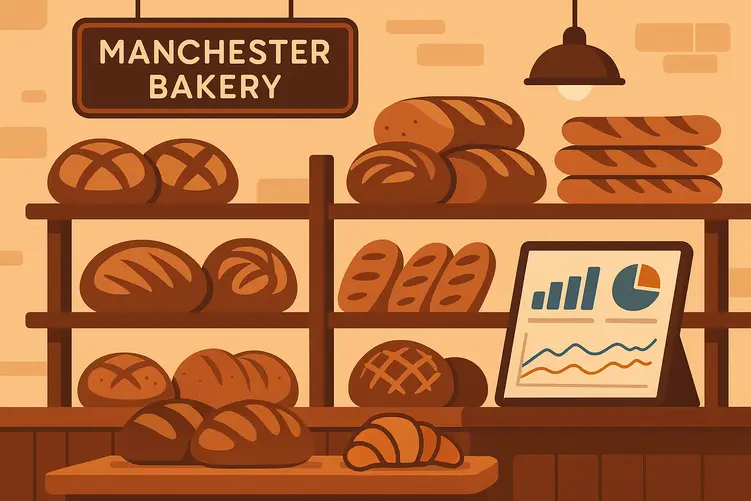
In the heart of Manchester’s bustling Ancoats district, a family-owned artisan bakery was facing a challenge familiar to many UK food businesses: rising costs, fierce competition, and the constant pressure to maintain quality while growing revenue. Within twelve months of implementing artificial intelligence solutions, this small bakery achieved a remarkable 40% sales increase whilst reducing waste by 35%. This bakery AI case study demonstrates how even traditional food businesses can leverage technology to achieve extraordinary results.
The Challenge Facing Modern UK Bakeries
The British bakery sector contributes over £3.9 billion annually to the UK economy, employing more than 200,000 people across the country. However, SME bakeries face mounting pressures from multiple directions. Ingredient costs have risen by an average of 25% since 2021, energy bills have soared, and consumer expectations for convenience and personalisation have never been higher.
Our featured Manchester bakery, like many food businesses, struggled with several critical issues:
- Inaccurate demand forecasting leading to either stockouts of popular items or excessive waste
- Inefficient production scheduling causing staff overtime and energy wastage
- Limited understanding of customer preferences and buying patterns
- Manual inventory management consuming valuable time
- Difficulty competing with larger chain bakeries’ marketing budgets
This Manchester SME success story began when the bakery’s owner recognised that continuing with traditional methods alone wouldn’t be sufficient to thrive in an increasingly digital marketplace.
How AI Transformed Operations
Demand Forecasting and Production Optimisation
The cornerstone of this transformation was implementing AI-powered demand forecasting. By analysing historical sales data, weather patterns, local events, school holidays, and even social media trends, the AI system could predict daily demand for each product with 87% accuracy. According to research from McKinsey & Company, retailers using AI for demand forecasting can reduce forecasting errors by 30-50%.
For the Manchester bakery, this meant:
- Producing the right quantities of each item daily, reducing waste from 18% to 6%
- Ensuring popular items were always available, eliminating frustrated customers
- Optimising baking schedules to reduce energy consumption during peak-rate hours
- Better staff scheduling aligned with actual production needs
This type of food business automation doesn’t replace the baker’s expertise but rather enhances it, allowing skilled artisans to focus on quality and innovation rather than guesswork.
Customer Intelligence and Personalisation
The bakery implemented a customer data platform integrated with their point-of-sale system and loyalty programme. This AI-driven solution identified purchasing patterns and customer segments, enabling personalised marketing that resonated with different customer groups. Research from Epsilon shows that 80% of consumers are more likely to purchase when brands offer personalised experiences.
Practical applications included:
- Sending targeted promotions for customers’ favourite items at optimal times
- Creating special offers for customers who hadn’t visited in over two weeks
- Developing new products based on observed preference trends
- Optimising pricing strategies for different times of day and days of week
Smart Inventory Management
Manual inventory tracking was replaced with an AI system that monitored ingredient levels in real-time, automatically generating orders when stock reached predetermined thresholds. The system considered lead times, supplier reliability, upcoming demand forecasts, and bulk purchasing opportunities. This UK bakery technology implementation reduced inventory carrying costs by 22% whilst ensuring ingredients were always fresh and available.
Digital Marketing Optimisation
Perhaps the most visible aspect of the transformation was the bakery’s enhanced digital presence. AI tools analysed social media performance, optimised posting times, generated engaging content ideas, and even predicted which products would photograph well and generate the most engagement. The bakery’s Instagram following grew from 800 to 12,500 local followers within ten months, translating directly to increased foot traffic and sales.
The Results: A 40% Sales Increase
After twelve months of AI implementation, the bakery’s transformation yielded impressive results:
- 40% increase in overall sales revenue
- 35% reduction in food waste, saving approximately £1,800 monthly
- 28% improvement in gross profit margins
- Customer satisfaction scores increased from 7.2 to 9.1 out of 10
- Staff overtime reduced by 60%, improving work-life balance
- Energy costs decreased by 18% through optimised production scheduling
- Average transaction value increased by 23% through personalised upselling
This sales increase AI generated wasn’t achieved through a single dramatic change but rather through numerous incremental improvements across all aspects of the business. The bakery maintained its artisan quality and personal touch whilst leveraging technology to operate more intelligently.
Key Success Factors
Several factors contributed to this Manchester bakery’s successful AI adoption:
1. Strategic Implementation Partner
Rather than attempting to navigate AI adoption alone, the bakery worked with specialists who understood both technology and the unique challenges of food businesses. Kaizen AI Consulting approaches such projects by first understanding the business’s specific pain points, then designing tailored solutions that deliver measurable ROI. This guided approach prevented costly mistakes and ensured the technology genuinely served business objectives.
2. Staff Training and Buy-In
The bakery invested time in training staff to use new systems and, crucially, explaining how AI would make their jobs easier rather than replace them. According to PwC research, businesses that prioritise employee training during digital transformation are 5 times more likely to achieve their objectives.
3. Data Quality Foundation
AI is only as good as the data it processes. The bakery spent the first month cleaning and organising existing data, establishing proper data collection processes, and ensuring information accuracy. This foundation proved essential for generating reliable insights.
4. Phased Rollout
Rather than implementing everything simultaneously, the bakery adopted a phased approach. They started with demand forecasting, proved the concept, then gradually added inventory management, customer intelligence, and marketing optimisation. This reduced risk and allowed the team to adapt progressively.
Lessons for Other UK Food Businesses
This bakery AI case study offers valuable insights for other small and medium-sized food businesses considering AI adoption:
Start with Your Biggest Pain Point: Identify the single most costly or frustrating aspect of your operations. Whether it’s waste, stockouts, or inconsistent customer traffic, begin your AI journey by addressing this specific challenge. Quick wins build momentum and justify further investment.
AI Doesn’t Require Massive Budgets: Many assume AI is only for large corporations with substantial technology budgets. Cloud-based AI solutions have made this technology accessible to SMEs, with many implementations requiring investment of just £5,000 to £15,000, delivering ROI within 6-12 months.
Preserve Your Unique Character: AI should enhance, not replace, what makes your business special. This Manchester bakery maintained its artisan approach and personal customer relationships whilst using technology to operate more efficiently behind the scenes.
Measure Everything: Establish clear metrics before implementation so you can objectively assess results. The bakery tracked 15 different KPIs throughout their transformation, allowing them to identify what worked and what needed adjustment.
Seek Expert Guidance: The food business landscape has unique regulatory, operational, and customer considerations. Working with consultants who understand both AI and your specific industry significantly increases success probability. Kaizen AI Consulting specialises in helping UK SMEs navigate AI adoption, providing not just technology implementation but strategic guidance tailored to your business model and growth objectives.
The Future of AI in UK Food Businesses
The success of this Manchester bakery represents just the beginning of AI’s potential in the food sector. Emerging applications include:
- Computer vision for quality control: AI cameras that can detect product defects or inconsistencies faster than human inspection
- Voice-activated production systems: Allowing bakers to access recipes, set timers, and log production without touching screens
- Predictive maintenance: AI that monitors equipment performance and predicts failures before they occur, reducing costly downtime
- Dynamic pricing: Real-time price optimisation based on demand, inventory levels, and competitor pricing
- Supply chain transparency: AI-powered blockchain solutions that provide complete ingredient traceability
According to UK Government AI Sector Deal initiatives, artificial intelligence could add £232 billion to the UK economy by 2030, with SMEs positioned to capture significant value through strategic adoption.
Taking the First Step
If you’re a UK food business owner inspired by this Manchester SME success story, the journey to AI adoption begins with assessment and planning. Consider these initial steps:
- Audit Your Current Operations: Document your processes, identify inefficiencies, and quantify the cost of problems like waste, stockouts, or manual tasks
- Research Available Solutions: Explore AI platforms designed for food businesses, reading case studies and requesting demonstrations
- Consult with Specialists: Speak with AI consultants who can assess your specific situation and recommend appropriate solutions
- Start Small and Scale: Begin with a pilot project that addresses one clear problem, prove the value, then expand
- Invest in Training: Ensure your team has the skills to maximise your AI investment
The transformation of this Manchester bakery demonstrates that AI isn’t just for technology companies or large corporations. Small food businesses with the right guidance and approach can leverage artificial intelligence to compete more effectively, serve customers better, and build more profitable, sustainable operations.
Ready to explore how AI could transform your food business? Contact Kaizen AI Consulting today for a complimentary assessment of your operations and a tailored roadmap for implementing AI solutions that deliver measurable results. Our team specialises in helping UK SMEs navigate digital transformation with practical, affordable solutions that generate real ROI. Don’t let your competition gain the advantage – discover how AI can help your business thrive in today’s challenging market.